Formulation
Comparing Process and QC Plans for Powder and Ready-to-Drink Magnesium Beverages
A process and QC evidence comparison for powder drink mixes and ready-to-drink magnesium beverages, including heat-treated still and carbonated cold-fill.
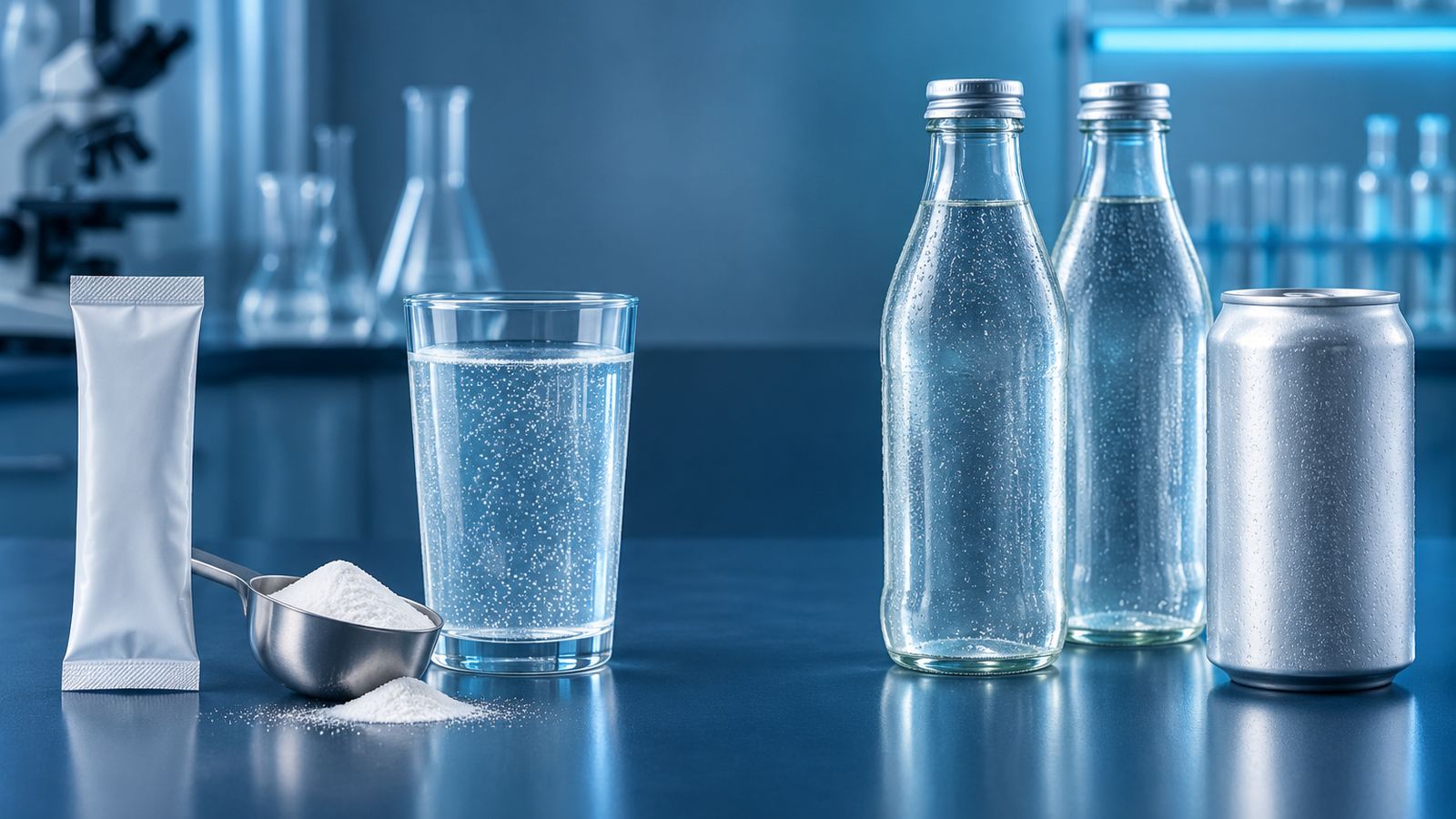
When a brand adds magnesium to a new drink, the first commercial decision is often the path: a powder drink mix reconstituted at use, or a ready-to-drink product already in the package. If the team chooses a ready-to-drink path, the process usually splits again, into a heat-treated still drink or a carbonated cold-fill drink.
This article compares those paths at the same elemental magnesium target. The deliverable is a process and QC evidence plan for the concept file, not a ranking of salts and not advice about which magnesium a consumer should drink. Salt identity is a separate comparison: see the forms used in beverage formulation and a glycinate–citrate project comparison. How a powder concept later becomes a bottle is covered in from powder concept to a ready-to-drink magnesium beverage. The paths can share an elemental target, an assay basis and a sensory direction. They do not share process records, in-process checks, release tests or dating evidence.
Hold the elemental target constant, then split the evidence
Write the target as milligrams of elemental magnesium per serving, and convert it with the lot assay on a stated basis. As a labeled calculation, 100 mg elemental magnesium from an ingredient assayed at 8% as-is requires 1.25 g of ingredient per serving, in a stick pack or in a bottle. Recalculate when the lot assay changes. The serving-format mass and volume budget checks whether that mass fits the chosen unit.
Agree the product category early. A conventional beverage and a dietary supplement use different labeling and manufacturing rule sets. For a conventional beverage with added magnesium, 21 CFR 101.9(g) treats the added nutrient as Class I and requires the nutrient content of the composite sample to be formulated to be at least equal to the declared value. That rule is not a guarantee that every container will still meet the declaration through a printed date. Support any date with a finished-product study on the formula and package that will be sold.
The powder path: moisture, fill, reconstitution and dry-system dating
A powder drink mix is manufactured as a dry blend and judged, in use, as a drink, so the process and QC plan has to cover both states. Residual moisture, pack barrier and filling-room humidity affect flow and caking; agree those conditions before treating a short handling trial as complete. Record fill-weight variation across the run, and keep the magnesium calculation tied to the lot assay in the batch record.
Test reconstitution the way the label will direct: time to disperse, appearance after a set interval, residue, and the pH of the prepared drink. Repeat the checks in more than one water type if the user will not be given a single specified water. A clear beaker in purified water is not, by itself, an in-use result. Dating evidence for a dry system belongs in the commercial pack and typically includes moisture, caking and flow, reconstitution performance and magnesium assay. Do not assign a date from the ingredient's storage life, and do not use a powder study to date a ready-to-drink product. This is a plan for evidence, not a predicted shelf life. See working with a powder drink mix manufacturer and the solubility and dissolution test design page.
The ready-to-drink path: heat-treated still versus carbonated cold-fill
Finished water activity and finished equilibrium pH can place a ready-to-drink product in a regulated process category. 21 CFR 113.3 and 21 CFR 114.3 define low-acid foods in part as having a finished equilibrium pH greater than 4.6 and a water activity greater than 0.85. 21 CFR 114.3 defines acidified foods as low-acid foods to which acid or acid foods have been added, with a finished equilibrium pH of 4.6 or below and a water activity greater than 0.85; part 114 exclusions include carbonated beverages and foods stored, distributed, and retailed under refrigeration. Classification is a process-authority and regulatory decision, not a magnesium-assay result; see the hot-fill and pasteurization checks.
For a heat-treated still drink, record the addition point relative to the heat step. Measure the same fortified batch and an unfortified control before and after the real heat profile, in the commercial container type, and log time and temperature. A passing heat check supports moving to a shelf-life study on processed samples; it does not set a date.
For a carbonated cold-fill drink, dissolve or disperse the magnesium in the still base, confirm incorporation, then carbonate. Record the order of addition and report carbonation in a stated unit at a stated temperature. Keep product pH and degassed QC pH distinct: the pH of the carbonated drink is the pH of the product as sold; a degassed measurement is a QC check on a changed sample and does not substitute for the product value. A still sample does not stand in for the carbonated trial. See the carbonated magnesium beverage trial page and the sparkling water formulation article, including the fortification-policy question that applies to many conventional carbonated drinks.
Appearance work belongs in the finished base and the commercial package; see the clarity and stability screen. Use the shelf-life testing plan and the finished-beverage shelf-life study page to design the protocol. None of those pages, and not this article, predicts a shelf life.
Evidence R&D, quality and regulatory should collect
The table is a decision framework for the project file. Label each cell as known, calculated or to-be-verified. A written process description can be known once the co-packer agrees it; an ingredient mass derived from a target serving is calculated; a heat-hold or carbonated appearance result is to-be-verified until the pilot is run.
Evidence | Powder path | Heat-treated still RTD | Carbonated cold-fill RTD | Label in the file |
|---|---|---|---|---|
Process description | Dry blending, filling and sealing; labeled reconstitution directions | Liquid batching, scheduled heat or hot-fill process, container and cooling | Still-base batching, carbonation, cold fill, container and closure | Known when written with the manufacturing partner; to-be-verified on a pilot |
Elemental target and assay basis | Same elemental target and the same as-is or dry basis in every path | Same | Same | Target and assay basis are stated from the formula and the ingredient documentation; the ingredient mass is calculated from the current lot assay and to-be-verified against the incoming COA |
In-process data | Blend-uniformity samples, fill-weight variation, filling-room humidity | Time and temperature of the heat step, in-process pH | Order of addition, still-base appearance before carbonation, carbon dioxide at a stated temperature | To-be-verified in the actual process |
Release tests | Fill weight, reconstitution appearance, magnesium in the filled unit, microbiology required by the specification | Appearance, pH with method and temperature, magnesium in the liquid, heat-process records | Appearance in the closed package, product pH and degassed QC pH as separate results, carbon dioxide, magnesium after the agreed degassing procedure | To-be-verified against criteria set in advance |
Dating or shelf-life protocol | Moisture, caking, flow, reconstitution and assay in the commercial dry pack | Finished-beverage protocol in the commercial container, using processed product as time zero | Finished-beverage protocol in the commercial carbonated container | The protocol can be written now; results are to-be-verified. Do not predict a date |
What must not be copied from one path to another
- A powder moisture, caking or reconstitution study does not support ready-to-drink shelf life, and the reverse is also true.
- A still sample does not stand in for a carbonated trial. Product pH and degassed QC pH are not interchangeable.
- Ingredient storage life is not finished-product dating evidence on any path.
- A heat-process result does not describe a carbonated cold-fill product, and the reverse is also true.
- A water-solubility statement does not show behavior in the finished base.
- A salt comparison does not answer the path question, and a path comparison does not answer which salt to use.
- Meeting the Class I formulation requirement for a conventional beverage composite does not, by itself, prove that every container will meet the declaration through a date.
What to request next
Send the manufacturing partner and the ingredient supplier a short file request: the chosen path and product category; the elemental target and assay basis; the intended process, package and serving or reconstitution directions; a draft process description with planned in-process and release tests; an outline of the dating or shelf-life protocol (attributes and methods, not a requested date); and the current ingredient specification, a sample-lot certificate of analysis and a sample quantity sized to the trial plan. The answers fill the table above. They do not promise that a path will succeed, and this article does not predict shelf life, sensory outcome or commercial performance.
Sources and limits
- 21 CFR 101.9, nutrition labeling of food, including 101.9(g) compliance classes
- 21 CFR 113.3, definitions for thermally processed low-acid foods
- 21 CFR 114.3, definitions for acidified foods
- FDA, Guidance for Industry: Distinguishing Liquid Dietary Supplements from Beverages (2014)
The comparison table is a decision framework, not a validated protocol and not a set of universal acceptance limits. Process classification remains a decision for the brand, its process authority and regulatory counsel.
Two development questions used to organize this article — how to choose between a powder path and a ready-to-drink path, and which powder attributes and in-use checks belong in the development file — were rewritten from consumer People also ask in a public Google Search on 17 November 2026. The original questions were not laboratory or procurement speech, and they are not presented here as Google AI questions or as B2B questions Google has already asked. This article answers process and QC path choice only. It does not answer which magnesium is best to drink, whether a powder is absorbed better, or whether a powder "works."
Need samples or documentation?