Formulation
Magnesium Glycinate, Citrate, Lactate and Gluconate Compared for Beverage Formulation
Compare magnesium glycinate, citrate, lactate and gluconate for drinks by elemental content, counter-ion effects, labeling and bench testing.
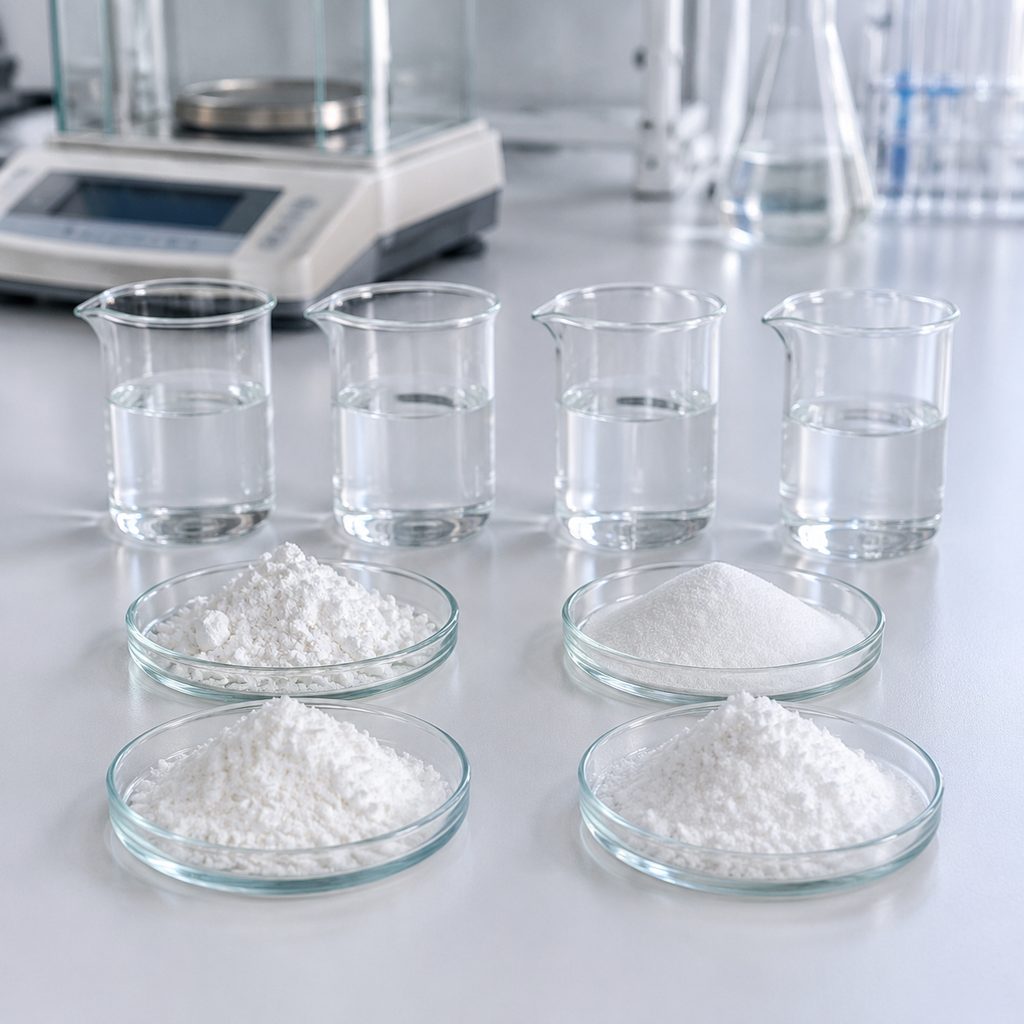
A beverage team choosing a magnesium ingredient for beverages usually ends up with a short list of organic salts and chelates: magnesium glycinate, magnesium citrate, magnesium lactate and magnesium gluconate. All four can appear in drink development. They differ in how much ingredient a serving needs, what the counter-ion adds to the liquid, how the source is named on the label and what the bench screen has to check.
This guide compares them on those practical points. It does not rank one form as better than another, and it makes no statement about absorption or any physiological effect. The right choice depends on the specific beverage, process and label.
Start with elemental magnesium, not ingredient weight
Every comparison should begin with the elemental magnesium target per serving. The label declares magnesium, not the weight of the source compound, so a formula that adds 1 g of one salt and 1 g of another delivers different amounts of magnesium.
The table below shows calculated values for pure compounds, using molecular formulas from PubChem and the standard atomic weight of magnesium from CIAAW. Commercial materials differ in hydration state and composition, so these are teaching values, not specifications.
Compound (theoretical) | Molecular weight | Calculated magnesium | Ingredient for 100 mg magnesium |
|---|---|---|---|
Magnesium bisglycinate, anhydrous (C4H8MgN2O4) | 172.42 | 14.1% | 0.71 g |
Trimagnesium dicitrate, anhydrous (C12H10Mg3O14) | 451.12 | 16.2% | 0.62 g |
Magnesium L-lactate, anhydrous (C6H10MgO6) | 202.45 | 12.0% | 0.83 g |
Magnesium L-lactate dihydrate | 238.48 | 10.2% | 0.98 g |
Magnesium gluconate dihydrate | 450.63 | 5.4% | 1.85 g |
In practice, use the as-is elemental magnesium assay on the lot COA. A beverage grade magnesium glycinate specified at 8.00% elemental magnesium needs 1.25 g of ingredient for 100 mg of magnesium. The theoretical magnesium content guide explains why a commercial assay and a calculated value for a pure compound are different numbers, and the elemental magnesium guide walks through the conversion.
Ingredient mass matters in a drink for more than cost. It adds dissolved solids, can contribute its own taste and has to disperse in the available water and mixing time.
Magnesium citrate vs glycinate in beverages
Citrate is the conjugate base of citric acid, which is already the acidulant in many drinks. Adding magnesium citrate therefore puts more citrate into the acid system. That can change the buffering of the base and the amount of acid needed to reach the target pH. When citric acid is also used, the finished liquid contains magnesium, citrate and glycine or other ligands in a mixed system, and the ingredient name no longer describes every species present.
Magnesium glycinate brings glycine, an amino acid, as the ligand. Glycine has its own acid and base behavior, so it also influences the buffering of a drink, though not in the same way as extra citrate. Any magnesium ingredient can move the pH of a lightly buffered base. In both cases, measure pH after the ingredient is added, not only before.
For a fair magnesium citrate vs glycinate in beverages comparison, hold the acid system and target pH constant, add each candidate at the same elemental magnesium level and record how much acid each sample needed. The pH, citrate and phosphate guide describes omission controls that help locate an interaction when one appears.
Where a magnesium lactate beverage fits
Lactate is the conjugate base of lactic acid. A magnesium lactate beverage project faces the same basic questions as citrate: the counter-ion becomes part of the acid and flavor system, and the hydration state of the commercial material changes how much ingredient is needed. The difference between anhydrous and dihydrate lactate in the table above is close to 18% more ingredient for the same magnesium, which is why the assay basis on the COA has to be clear before the batch sheet is written.
Lactic acid is used as an acidulant in some beverages, and lactate salts can act as buffering or pH-control ingredients. If the formula already contains lactic acid or another lactate, account for it when interpreting pH and taste results.
Gluconate and the dissolved solids budget
Gluconate is a large anion. At about 5.4% magnesium for the dihydrate, magnesium gluconate needs roughly 1.85 g of ingredient for 100 mg of magnesium, compared with 0.62 g to 1.25 g for the other examples. In a small serving, that mass becomes a large share of the dissolved solids. Check whether it fits the mass and volume budget for the serving and whether the extra solids change mouthfeel or appearance in the base. The serving format budget guide helps with that arithmetic.
How each form is named on the label
The category decides the panel. A conventional beverage uses a Nutrition Facts panel under 21 CFR 101.9 and lists the source ingredient by its common or usual name in the ingredient statement under 21 CFR 101.4. A liquid dietary supplement uses a Supplement Facts panel under 21 CFR 101.36, which allows the source to be identified in parentheses, for example magnesium (as magnesium glycinate). In both cases the declared amount is elemental magnesium. Our beverage label guide covers the two routes and their rounding rules.
Regulatory status also needs a check for each candidate and each category. The fact that some magnesium salts are listed in 21 CFR part 184 does not cover every salt or every use. Ask each supplier for the documentation behind its status statement. MagneINNO magnesium glycinate is self-affirmed GRAS.
Test the candidates in the same base
A desk comparison narrows the list. The bench decides. Run the shortlisted forms through one screen:
- Prepare the finished base without any magnesium ingredient as the control.
- Add each candidate at the same elemental magnesium level, using its lot assay to calculate the ingredient mass.
- Record pH before and after addition, and the acid needed to reach the target.
- Record appearance or turbidity under a defined method, immediately and after agreed holding times.
- Process a portion through the intended thermal or non-thermal step and repeat the measurements.
- Compare taste and mouthfeel under a defined sensory method, keeping the flavor system identical across samples.
The beverage clarity and stability screen and the sensory evaluation guide give more detail. Our earlier article on pH and heat stability testing covers the process step.
Reading the comparison
A result applies to the formula that was tested. A candidate that stays clear and tastes neutral in one lemon-flavored water at pH 3.4 may behave differently in a tea base or a protein drink. Write the conclusion with its conditions attached.
For purchasing, compare qualified candidates on the cost of delivering the same elemental magnesium, not on price per kilogram of ingredient. The elemental cost and batch planning guide shows the calculation. Then add documentation: a specification with the assay basis, lot COAs with methods, and a clear change notification commitment.
Frequently asked questions
Which magnesium form contains the most magnesium per gram?
Among the theoretical examples above, anhydrous trimagnesium dicitrate calculates highest at about 16.2%. Commercial materials vary, so compare lot assays on the same basis.
Can magnesium glycinate be used with citric acid in a drink?
Yes, many beverage formulas combine them. Measure pH after the magnesium ingredient is added and test appearance and taste in the complete base, because the acid system and the magnesium source interact.
Does the counter-ion appear on the label?
On a Supplement Facts panel the source can be named in parentheses after magnesium. On a conventional beverage, the source appears in the ingredient statement. The declared amount is always elemental magnesium.
Request a beverage grade sample
MagneINNO offers magnesium glycinate in three grades, including the Ultra Taste Free grade at 8.00% elemental magnesium for powders, stick packs and beverages. We can send free 50 g samples, the current specification and a lot COA so your team can run the comparison above in your own base. Contact our technical team with your serving volume, magnesium target and process.
Need documentation?