Formulation
Developing a Magnesium Glycinate Powder Drink Mix With a Contract Manufacturer
What to send a powder drink mix manufacturer for a magnesium glycinate stick pack or tub, from batch math to blending, fill weight and release.
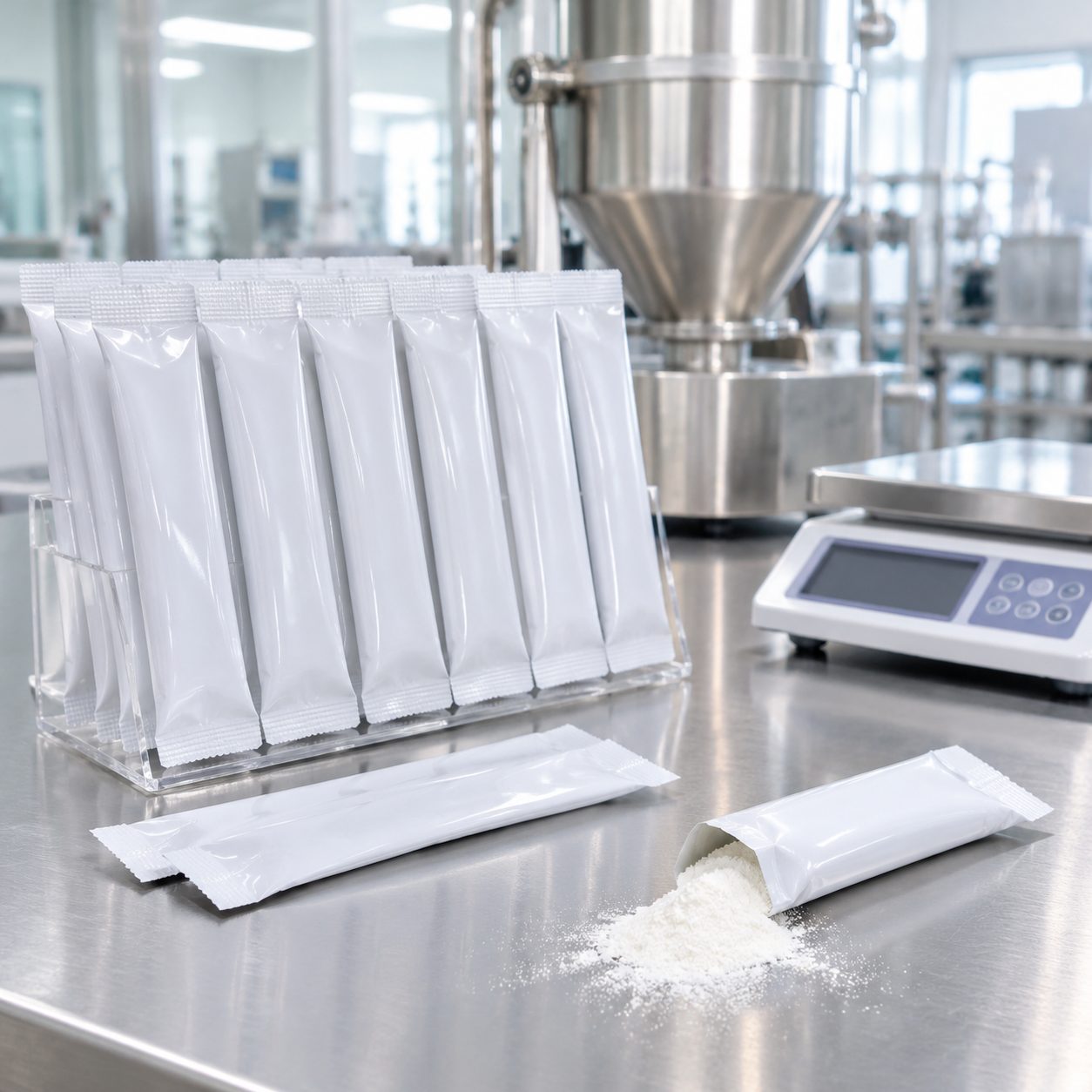
A magnesium glycinate powder drink starts as a formula on paper and becomes a product at a magnesium powder drink mix manufacturer, where dry ingredients are weighed, blended, filled into stick packs, sachets or tubs and sealed. The pack holds a dry powder rather than a prepared drink, though it still carries some residual moisture, so the usual liquid questions about thermal processing and haze give way to dry ones: does the blend stay uniform, does it fill at a consistent weight, does it stay free-flowing, and does it disperse when the end user adds water.
This guide covers what a brand should settle before the first trial, what to put in the manufacturer brief, and which checks show that each lot of a magnesium drink mix was made as designed.
Decide between powder and ready to drink first
Many magnesium glycinate beverage formulation projects begin by choosing between a drink mix and a ready to drink bottle. The two routes share an elemental magnesium target and a sensory direction, but little else.
A dry mix has low water activity. The low-acid and acidified food definitions in 21 CFR 113.3 and 21 CFR 114.3 refer to foods with a water activity above 0.85, so the scheduled process questions that shape a liquid launch are not where a powder project starts. The work moves instead to blending, filling, moisture control and reconstitution.
The trade-off is control over the final drink. The end user chooses the water, the volume and how long to stir or shake, so the formula has to perform across a realistic range of home conditions. A ready to drink product fixes those variables but adds a process step, a liquid shelf life study and a co-packer. Choose the route before writing the brief, because it changes who the manufacturing partner is.
Confirm the product category
The manufacturer needs to know whether the drink mix is a dietary supplement or a conventional food before it quotes the work. A dietary supplement is manufactured under the current good manufacturing practice rule in 21 CFR part 111 and carries a Supplement Facts panel. FDA's FSMA frequently asked questions (question DS.4) explain that a supplement manufacturer also follows the CGMP provisions of 21 CFR part 117 subpart B where they do not conflict with part 111, and 21 CFR 117.5(e) exempts supplement manufacturing that complies with part 111 and the serious adverse event reporting requirements from the hazard analysis and supply-chain provisions in subparts C and G. A conventional food drink mix is made under 21 CFR part 117 and carries Nutrition Facts. The category decides the records the manufacturer keeps, the specifications it must establish and how magnesium is declared. Our article on declaring magnesium on a beverage label explains the two label routes.
Write a complete manufacturer brief
Send the technical package before the first trial so that the manufacturer can plan equipment, sequence and testing.
- The product category, serving size in grams and the reconstitution directions: water volume and stirring or shaking instructions
- Elemental magnesium per serving, the magnesium glycinate grade and the as-is assay basis used in the calculation
- The full formula, with the function of each ingredient: magnesium source, acids, sweeteners, flavors, colors, flow aids and any other actives
- Specifications and current lot COAs for every component, including particle size, bulk density and water content for the magnesium ingredient
- The sensory reference sample and the acceptance method
- The draft label with the declared magnesium amount
- Finished product tests, methods and acceptance criteria, including fill weight limits
Our guide on how to specify magnesium glycinate with your contract manufacturer covers the specification fields in more detail.
Do the batch math in elemental magnesium
Write the formula in elemental magnesium per serving first, then convert it to ingredient mass with the lot assay. For a stick pack that delivers 100 mg of elemental magnesium, an ingredient at 8.00% as-is needs 1.25 g per stick. In a 6.0 g stick, magnesium glycinate is about 20.8% of the blend, which makes it one of the largest components and an important factor in flow and dispersion.
If the lot used for production assays at 8.2%, the same target needs about 1.22 g. Write the adjustment rule into the manufacturing instructions so the operator does not guess. Any intentional overage belongs on its own approved line; for dietary supplements, 21 CFR 111.210 requires the master manufacturing record to include a statement of any intentional overage of a dietary ingredient. The elemental magnesium calculator and the assay and overage guide show the reasoning.
Plan for blend uniformity
A drink mix often combines a large mass of magnesium glycinate and sugar or acid with very small amounts of high-intensity sweetener, flavor or vitamins. Differences in particle size and bulk density can cause the blend to separate during transfer, in the hopper and in the filler. A blend that is uniform in the mixer can still deliver uneven sticks.
Ask the manufacturer how it will show magnesium drink mix blend uniformity: where it samples the blender, how many samples it takes, and whether it also samples filled units from the start, middle and end of the run. Low-dose ingredients are often pre-blended with a carrier before they reach the main mixer. Magnesium content in filled units, tested by a validated elemental method, is the evidence that matters. The blend uniformity and segregation guide explains sampling plans.
Check fill weight, flow and moisture
Stick pack and sachet lines usually dose powder by auger or volumetric filler, so fill weight depends on how consistently the blend flows and packs. Share the bulk and tapped density of the magnesium ingredient and of the finished blend with the manufacturer, and agree fill weight limits before the trial. The powder flow and density guide covers the measurements.
Moisture is the other common problem. Some acids, sugars and flavor carriers pick up water from humid air, and a blend that flows well on the first day can cake inside a sealed stick weeks later. Agree the filling room conditions, the packaging film and a short storage check before committing to a commercial run. Our troubleshooting guide on why magnesium drink powders clump and the packaging and storage stability guide cover the details.
Test reconstitution the way the end user will
A drink mix is judged in a glass of water, so test filled units the way the label directs. Measure the time to disperse with the stated stirring or shaking, the appearance after a set time, any residue on the glass, the pH of the reconstituted drink and its taste against the reference. Repeat with more than one water type, because tap water hardness varies widely. Our article on solubility and dissolution by format explains the difference between the two measurements, and the electrolyte drink mix guide covers formulas that also carry sodium and potassium.
Define release documents for each lot
Agree before the first commercial run what the manufacturer reports for each lot and what the brand reviews before release. A typical set includes:
- The batch record with the magnesium glycinate lot number and the assay used for the calculation
- Blend and fill checks, including fill weight results across the run
- Finished product magnesium results by a validated method, compared with the label target
- Microbiological and other tests required by the specification
- Retained samples from the lot
For dietary supplements, 21 CFR 111.75 requires at least one appropriate identity test on a dietary ingredient component before use. Other component specifications can be confirmed by test or by relying on a supplier COA once the manufacturer has qualified that supplier under the conditions the rule sets out.
Frequently asked questions
Which MagneINNO grade suits a stick pack drink mix?
Ultra Taste Free, at 8.00% elemental magnesium, is the usual starting point for powders, stick packs and beverages. Taste Free (10.00%) and Taste Optimized (12.01%) can be evaluated when the serving mass budget is tight. Compare candidates at the same elemental magnesium in the finished blend.
What should the drink mix manufacturer receive from the magnesium supplier?
At minimum the current specification, a COA for each lot supplied, the SDS and samples for bench and pilot work. Agree how the supplier will notify the brand and the manufacturer of any change to the ingredient.
Can stability data from the powder support a ready to drink version?
No. A ready to drink product has a different water activity, pH, process and package, so it needs its own development and shelf life work.
Start your drink mix trial with MagneINNO
MagneINNO supplies magnesium glycinate for powder drink mix projects with the current specification, lot COAs and free 50 g samples for bench and blending trials. Material ships in 25 kg fiber drums, and stock held in California typically ships in about 3 days. Contact our technical team with your drink mix brief, and we will help you prepare the ingredient documentation for your manufacturer.
Need documentation?