Formulation
Switching a Beverage From Magnesium Citrate or Lactate to Magnesium Glycinate
How to move an existing drink to magnesium glycinate, from ingredient mass and pH to taste, label, stability and change control.
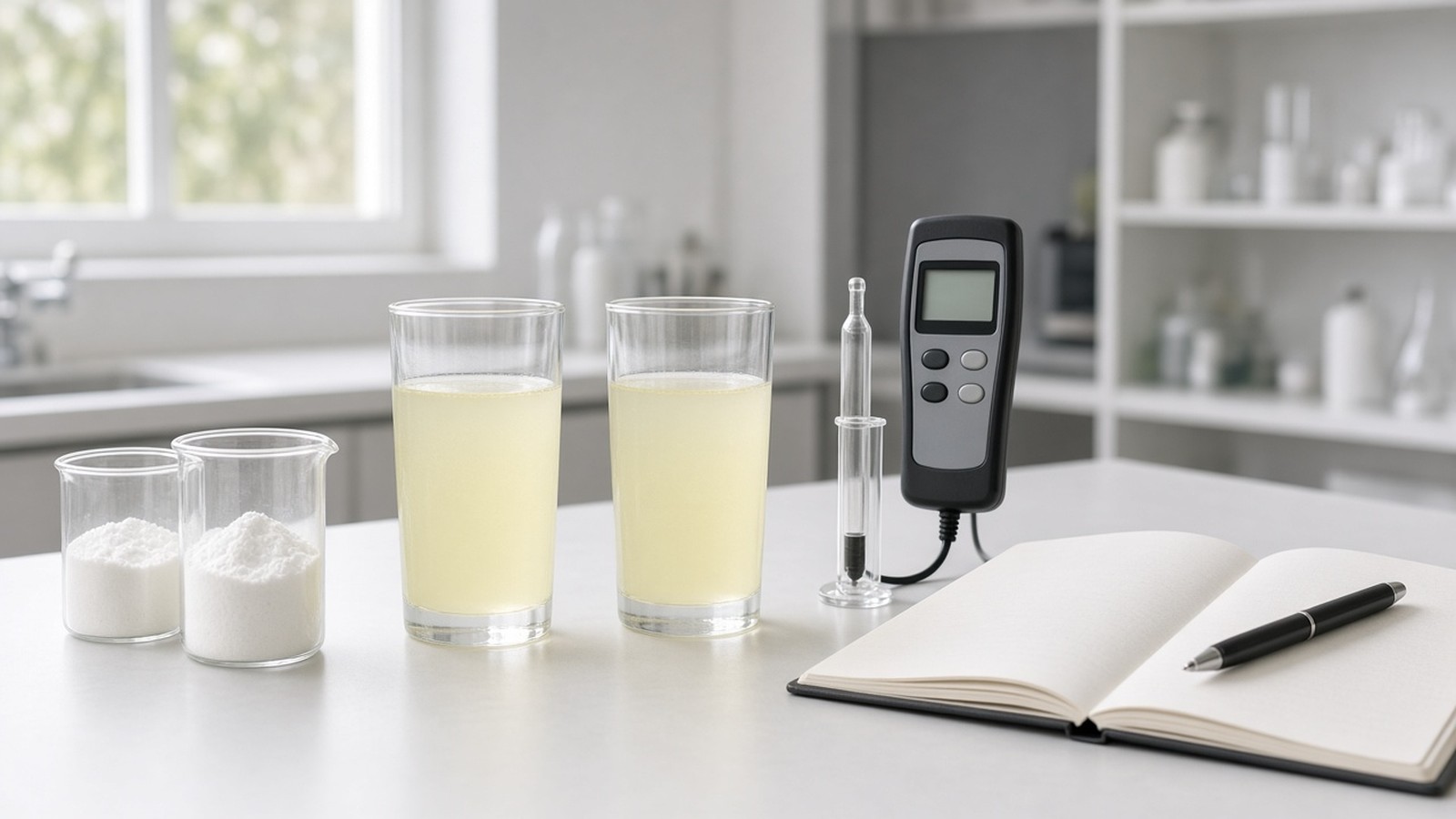
Choosing a magnesium source for a new drink is one project. Changing the source in a drink that is already on shelf is another. The label is printed, the co-packer has a batch sheet, the flavor has been approved and consumers know the taste. When a brand moves an existing magnesium beverage formulation from magnesium citrate or magnesium lactate to magnesium glycinate, every one of those approvals has to be checked again.
This guide treats the switch as a change project. For the chemistry behind the comparison, our article on magnesium forms for beverage formulation covers elemental content, counter-ions and labeling for each salt.
Step 1. Recalculate the ingredient mass
The elemental magnesium target usually stays the same, so the Nutrition Facts or Supplement Facts amount does not change. The ingredient mass almost always does.
Work from the actual assay of each material on the same basis, not from theoretical values. As an illustration, suppose the current drink delivers 84 mg of magnesium per 355 mL serving from a citrate ingredient assaying 15%, which needs 0.56 g per serving. An 8% magnesium glycinate grade needs 1.05 g per serving for the same 84 mg, close to twice the mass. The batch sheet, the dissolving step and any premix dose rate change with it. The elemental magnesium calculator makes the comparison quick.
For a magnesium lactate beverage, check the hydration state first. Calculated from formula weights, magnesium lactate dihydrate needs about 18% more ingredient than the anhydrous form for the same magnesium. Our forms comparison shows the numbers.
Step 2. Rebuild the acid system
Citrate is the conjugate base of citric acid and lactate is the conjugate base of lactic acid. When the magnesium source changes, part of the drink's buffer changes with it. Glycine, the ligand in magnesium glycinate, is an amino acid with its own acid and base behavior, so it buffers differently.
In practice, the same amount of acidulant will not give the same pH. Re-titrate the base to the target pH with the new source, record the acid needed and compare titratable acidity with the current product, because sourness tracks acid level as well as pH. The pH, citrate and phosphate interactions page explains how other buffers and phosphates can complicate the picture.
Step 3. Match the taste and appearance
The reason for a switch is often sensory or label related, but the new formula still has to match the approved product closely enough that consumers do not notice an unwanted change. Plan two sensory steps.
First, a difference test, such as a triangle test, between the current product and the new formula at the same elemental magnesium. If the panel finds a difference, adjust the acid, sweetener or flavor and retest. Second, a check of the attributes that matter most for the product, such as sourness, mineral note and aftertaste. The sensory evaluation page covers panel design, and our guide to building a flavor system around magnesium glycinate covers the adjustments.
Check clarity and sediment in the final base after processing and in the final package. The beverage clarity and stability screen gives a simple setup.
Step 4. Update the label and the documents behind it
On a conventional beverage, the ingredient statement changes because the source ingredient is declared by its common or usual name under 21 CFR 101.4. If the acid level changes, the ingredient order may change as well. On a Supplement Facts panel, the source named in parentheses after magnesium changes, as allowed by 21 CFR 101.36. The magnesium amount stays the same if the target is unchanged. Review any claims on pack that mention the source.
Our beverage label guide covers both panels.
Step 5. Confirm stability before the switch goes live
In a conventional beverage, added magnesium is a Class I nutrient under 21 CFR 101.9(g). For Class I compliance, the nutrient content of the composite sample must be formulated to be at least equal to the declared value; this is not a per-bottle or through-date guarantee. Section 101.36(f)(1) also incorporates the relevant compliance rules for supplements. Separately, the proposed date should be supported by stability evidence for the finished formula and package. A change of magnesium source and acid level is a new formula for stability purposes. Run at least a confirmation study on the new formula in the final package, measuring magnesium, pH, appearance and flavor. Our article on magnesium glycinate pH and heat stability testing covers the process screen that should come first.
Step 6. Run it through change control
A magnesium source change touches several documents. Treat it as a formal change, not a purchasing substitution.
- Ingredient specification. Write a new specification for magnesium glycinate with assay basis, solubility and clarity checks and supplier. Our article on specification change control explains the review steps.
- Batch records. For dietary supplements, the master manufacturing record must state the weight of each component and the declared amount of each dietary ingredient under 21 CFR 111.210.
- Food safety plan. For conventional beverages, 21 CFR 117.170(b) requires reanalysis of the plan, or the applicable part, when a significant change creates a reasonable potential for a new hazard or a significant increase in a known one. The facility should document whether the ingredient change meets that test.
- Supplier approval. Qualify the new supplier and grade. The supplier change control page lists what to review.
If the drink uses a mineral premix for beverages, the premix specification and the premix COA change as well. Our article on specifying magnesium glycinate in a beverage mineral premix explains what to update.
Step 7. Plan the cutover
Decide when to run the first batch with the new formula, how old and new stock are separated, and when the new labels start. Keep retained samples of the last batch with the old source and the first batch with the new one, so any later question can be answered by comparison.
Frequently asked questions
Does the Nutrition Facts panel change when the magnesium source changes?
Not if the elemental magnesium target stays the same. The ingredient statement changes, and a Supplement Facts panel changes the source named in parentheses.
Why does the pH change if the magnesium amount is the same?
Citrate, lactate and glycine have different acid and base behavior. Changing the source changes part of the buffer, so the same acid level gives a different pH.
Is a full shelf life study needed?
At least a confirmation study on the new formula in the final package. The brand's quality team decides the scope based on how much the formula and process changed.
Plan a magnesium source change with us
MagneINNO, the magnesium glycinate brand of NutraINNO USA Inc., offers an 8% elemental magnesium Ultra Taste Free grade for beverages. We provide specifications, lot COAs and free 50 g samples for side-by-side trials. Contact our technical team with your current formula targets, and we will help you plan the ingredient side of the switch.
Need documentation?