Supply Chain
Magnesium Glycinate Supplier Specification Changes
How procurement and QA can review a revised magnesium glycinate supplier specification line by line, from elemental magnesium to buffered claims.

A revised specification from a magnesium glycinate supplier can look routine: a new revision number, a refreshed logo, a date. Underneath, a single changed line can alter your label claim, your fill weight or your incoming testing. Procurement often receives the document first, so procurement needs a reliable way to review it before it is filed and forgotten.
This guide gives procurement and quality teams a line-by-line method for comparing an old and a new magnesium glycinate supplier specification, and a decision path for what happens next. If the update arrived as a technical data sheet rather than a specification, our guide to how a TDS differs from a COA explains which document carries the binding limits.
Why a supplier spec change is your change too
Under the dietary supplement CGMP rule, the firm that uses a component must establish its own component specifications, including identity, the properties needed for finished-product purity, strength and composition, and contaminant limits. If the supplier's specification moves, your component specification, your master manufacturing record and your incoming tests may all need review. Quality control must review and approve all master manufacturing records and any modifications to them.
Brands that use a contract manufacturer are not off the hook. FDA's small-entity guidance explains that a distributor having a supplement made under its own label has an obligation to know what and how manufacturing activities are performed so it can decide whether the product conforms. A supplier spec revision is exactly the kind of information that must reach the brand.
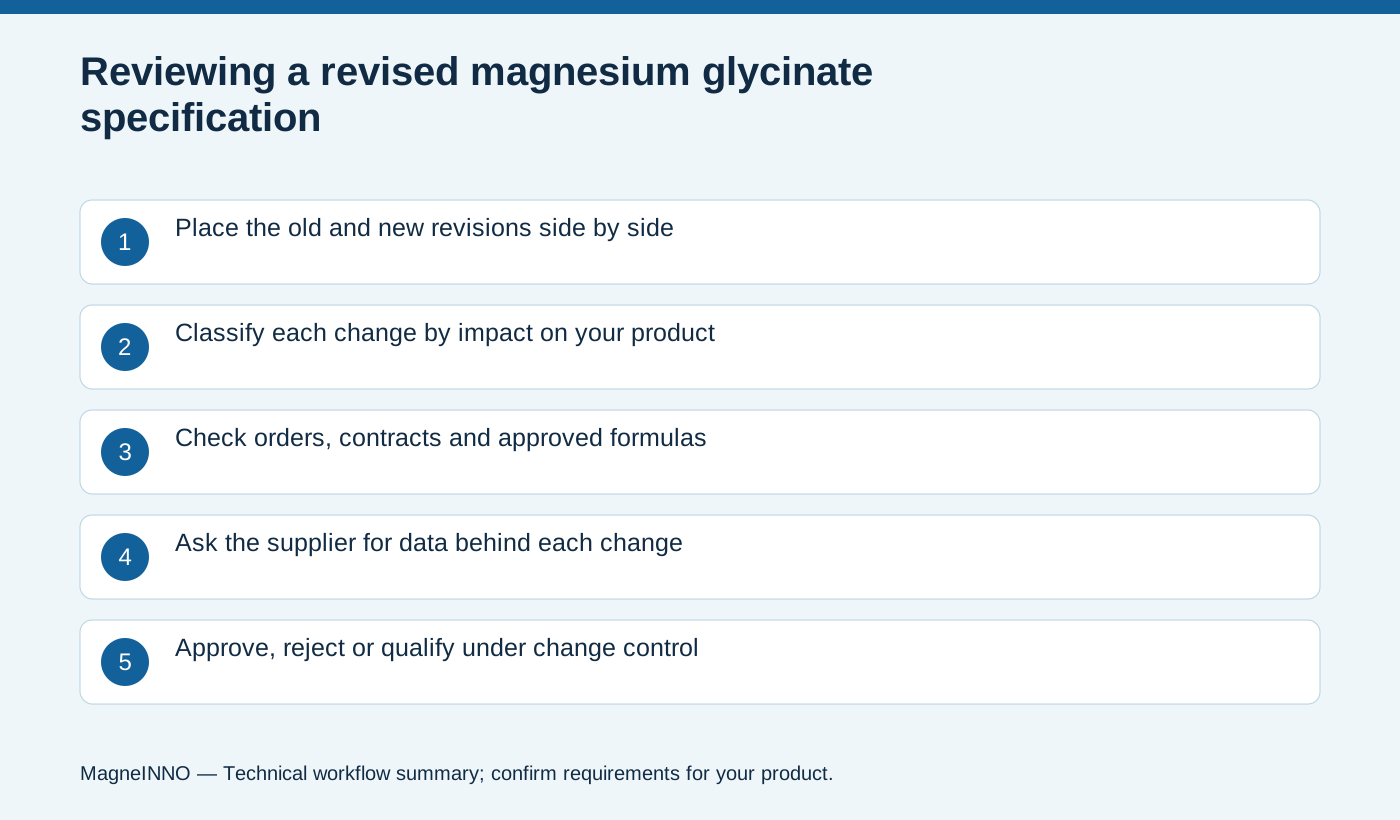
Step one: put the old and new supplier specification side by side
Never review a new specification on its own. Request the previous revision, or retrieve it from your approved-supplier file, and compare them line by line. If the supplier cannot provide a change summary, build one yourself. The lines that most often change for magnesium glycinate are listed below.
Elemental magnesium assay
Check the range, the target and the reporting basis. A shift from dry basis to as-is basis can make an unchanged material look different, or hide a real change. A move between grades, for example from 12% to 10% elemental magnesium, changes the ingredient mass you need per serving. Our elemental magnesium versus ingredient weight calculation shows the impact, and our explainer on what a 14% elemental magnesium specification really means covers how elemental magnesium glycinate figures are reported.
Water or loss on drying
Look for a changed limit, a changed method, or a change from water content to loss on drying. These are different measurements, so the numbers are not interchangeable.
Identity and composition
Note any change in the identity method, in the description of the material as buffered magnesium glycinate or unbuffered, or in the stated ratio of ingredients. Our guide to buffered and unbuffered composition specifications explains what to look for.
Particle size and bulk density
Changes here matter for capsules, tablets and stick packs. Check whether a mesh size, a distribution parameter or the method changed.
Contaminant and microbiological limits
Compare every limit and method. A widened limit may still meet your specification, but you need to know.
Test methods and units
A new method for an unchanged attribute can shift results. If the specification cites a USP monograph or method, check whether the reference or its edition changed, because a USP magnesium glycinate claim depends on it. Ask whether the supplier has compared the old and new methods on the same samples.
Packaging, storage and shelf life
Check container type, liner, net weight, storage conditions and shelf life or retest dating. These affect your receiving checks and warehouse.
Document control details
Confirm the revision number, effective date, approval signatures and whether the change applies to lots already shipped or only to future lots.
Step two: classify each change
Sort each changed line into one of three groups:
- Editorial: formatting, wording, or corrected typos with no change to limits or methods.
- Tightening: narrower limits or improved methods. Usually positive, but confirm that your current lots would still pass.
- Loosening or substantive: wider limits, new methods, a new grade, a new composition, or changes to packaging and shelf life. These need technical review before acceptance.
Step three: check commercial and formula impact
Procurement should check:
- Open purchase orders and contracts that reference the old revision.
- Approved formulas and master manufacturing records that rely on the old limits.
- Incoming test plans and COA review checklists that use the old methods or units.
- Customer specifications or retailer requirements that cite the old values.
If any item depends on the old revision, the change cannot simply be filed.
Step four: ask for the data behind the change
For substantive changes, ask the supplier why the change was made, what data support it, and whether the material or only the document changed. If the supplier relies on its COA for your acceptance, remember the rule requires a COA to describe the test methods, the limits and the actual results, and you must periodically re-confirm it. A method change may mean re-confirmation is due early.
Step five: decide under your change control procedure
Record the review and the decision in your change-control system. Options include accepting the revision, accepting it with additional testing for the next few lots, requiring a qualification study, or rejecting it and sourcing elsewhere. Our supplier change-control brief outlines which changes should trigger a supplier change notification in advance.
How MagneINNO handles specification updates
MagneINNO is the ingredient brand of NutraINNO USA Inc., a U.S. company. We issue specifications with revision control and can provide a change summary alongside any revised document, so procurement does not have to reconstruct one. Our grades are offered at 12%, 10% and 8% elemental magnesium for capsules and tablets, gummies, and powders or beverages respectively. Each lot ships with a COA reporting methods, limits and results, including water content.
FAQ
Is a new revision number always a real change?
No. Many revisions are editorial. That is why a line-by-line comparison is needed rather than assuming either way.
Who should approve a revised supplier specification?
Quality control approves changes to specifications and master records. Procurement should flag the revision and confirm commercial impact.
What if the supplier will not provide the previous revision?
Use your approved-supplier file. If you cannot reconstruct the change, treat the revision as substantive until proven otherwise.
To compare our current specification with the one you hold, contact our team for the specification sheet and a change summary.
Need documentation?