Supply Chain
Specifying Magnesium Glycinate in a Beverage Mineral Premix
How to write the magnesium line of a beverage mineral premix spec, from assay basis and blend uniformity to overage ownership and COAs.
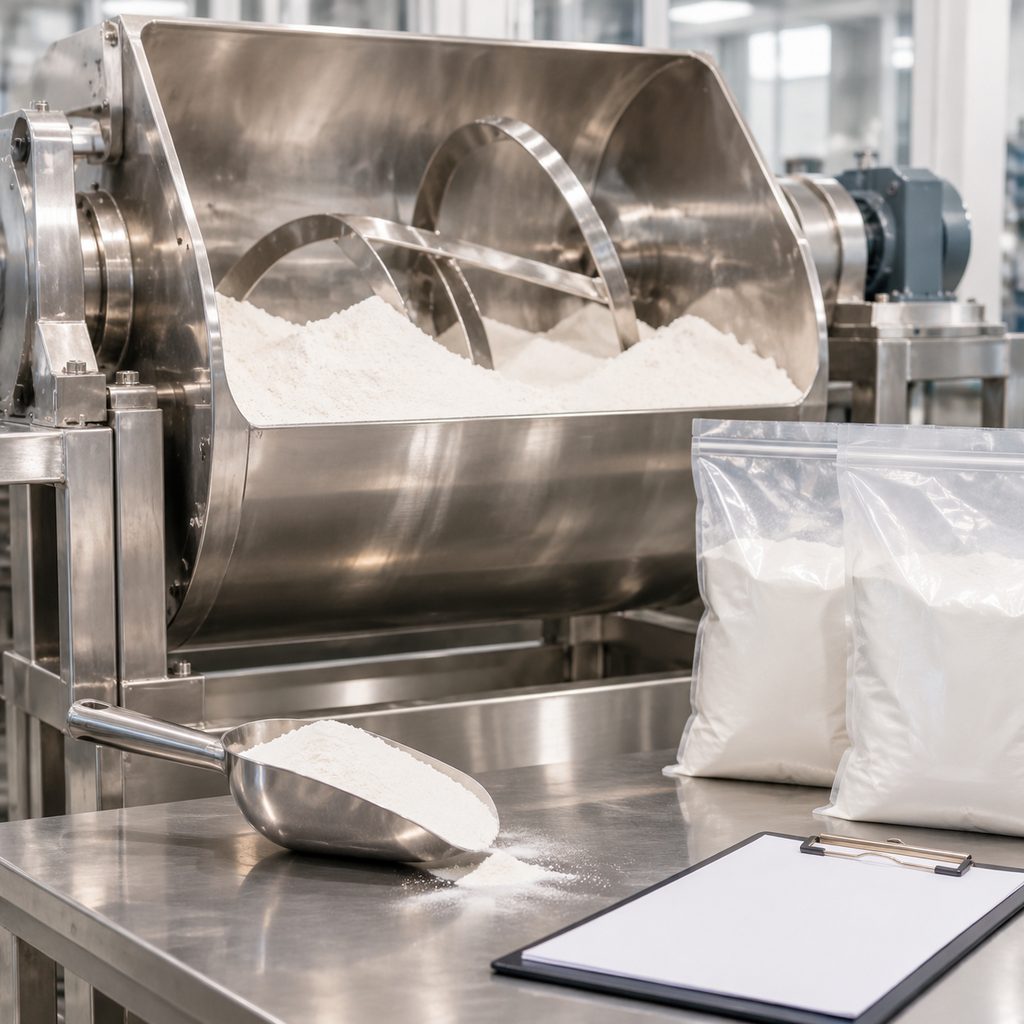
Many beverage brands do not weigh each vitamin and mineral into the batch tank. They buy a custom mineral premix for beverages from a premix manufacturer and add one pre-weighed blend per batch. That simplifies batching, but it moves several technical decisions into the premix specification. If the magnesium line of that specification is vague, the finished drink can miss its target even when every party followed its own paperwork.
This guide covers what a brand should write into the premix specification when magnesium glycinate is the magnesium source, and what each party should document.
Why magnesium needs special attention in a premix
Magnesium targets are set in tens of milligrams per serving, while trace minerals such as zinc or selenium are set in single milligrams or micrograms. The Daily Values in 21 CFR 101.9 show the scale: 420 mg for magnesium against 11 mg for zinc and 55 mcg for selenium. Once the elemental target is converted to ingredient mass, the magnesium source is often one of the largest components of the mineral premix by weight.
At 60 mg of magnesium per serving and an as-is assay of 8%, the premix carries 0.75 g of magnesium glycinate per serving. A change of one percentage point in assay changes that mass by more than 10%. Small errors in the magnesium line therefore have a visible effect on premix dose rate, cost and the finished assay.
What the premix manufacturer needs from the brand
Before quoting or formulating, a premix manufacturer needs a clear brief. For the magnesium part of mineral fortification of beverages, that brief should state:
- the elemental magnesium target per finished serving and the serving volume
- the premix dose rate, per serving or per batch, and the batch size it will be used in
- the named magnesium source and grade, for example magnesium glycinate at a stated elemental magnesium assay
- whether the brand or the premix manufacturer applies any intentional overage
- the product category and label panel, Nutrition Facts or Supplement Facts
- the finished format and process, such as hot fill RTD or powder stick pack
A brief that only says magnesium, 60 mg leaves the premix manufacturer to choose the source, the assay basis and the overage, and the brand then discovers those choices in the finished product.
Write the magnesium line of the specification
The specification line for magnesium should identify the ingredient and its basis, not just the nutrient.
Identity and grade. Name the source, such as magnesium bisglycinate or magnesium glycinate, and the supplier grade the brand has approved. If the brand has qualified a specific beverage grade magnesium glycinate, say so, and require notification before any substitution.
Assay basis. State the elemental magnesium assay and whether it is reported as-is or on a dry basis. The premix manufacturer should calculate the ingredient input from the accepted lot assay, on the same basis as the material it dispenses. The assay, process loss and overage guide explains why these adjustments should be recorded separately.
Physical properties. Particle size and bulk density affect how well magnesium glycinate mixes with the carrier and the other minerals. Agree a particle size range that suits the premix process. Our article on particle size specifications covers how to set one.
Moisture and contaminants. Carry the brand's raw material limits for water, heavy metals and microbiology into the premix specification or reference the approved ingredient specification directly.
Blend uniformity and sampling
A premix is only useful if every portion added to a batch carries the same composition. Ask the premix manufacturer how it demonstrates blend uniformity for the magnesium component and the trace minerals, and what sampling plan supports the premix COA. Uniformity at the premix stage does not guarantee uniformity in the finished drink, but a non-uniform premix guarantees a problem.
For the receiving side, the representative sampling guide and the blend uniformity guide describe how to sample a blended material without misleading results.
Give overage and assay adjustment one owner
Overage is the most common source of double counting. If the premix manufacturer adds an overage to cover processing and the beverage maker adds another at the batch tank, the finished drink can carry far more magnesium than the label target. If neither adds one, the brand may assume someone did.
Write down who applies the assay adjustment, who applies any intentional overage, the amount and the reason. Keep the label amount, the premix formula amount and the batch input as separate, labeled numbers.
Documents to request and keep
The premix COA should report the magnesium content of the premix with the method used, alongside the trace minerals. It should trace back to the magnesium glycinate lot used in the blend, and that lot should have its own COA from the ingredient supplier. The COA review workflow is a useful checklist for both documents.
The regulatory framework depends on the category. For dietary supplements, 21 CFR 111.75 requires an identity test for dietary ingredients and allows reliance on a supplier COA for other component specifications only after the supplier is qualified and its COAs are periodically confirmed. For conventional beverages, a receiving facility whose hazard analysis identifies a hazard requiring a supply-chain-applied control needs a supply-chain program under 21 CFR 117.405, with the program requirements set out in 21 CFR 117.410. Either way, the premix manufacturer and the brand should agree in writing which tests each party performs.
Labeling a premix ingredient
On a conventional beverage, the components of the premix still have to be declared. Under 21 CFR 101.4(b)(2), a multi-component ingredient with an established common or usual name can be declared by that name followed by its components in parentheses, or each component can be listed in the ingredient statement in order of predominance in the finished drink. Magnesium on the Nutrition Facts panel is declared as elemental magnesium. On a Supplement Facts panel, the source can be named in parentheses. Make sure the premix manufacturer provides a complete component list so the regulatory team can build the label. Our beverage label guide covers both panels.
Manage changes before they reach the tank
Write change notification into the premix agreement. A change of magnesium source, grade, ingredient supplier or assay basis can change the premix dose rate, taste and finished assay. The supplier change control guide lists the changes that should trigger a review.
Frequently asked questions
Should the brand or the premix manufacturer choose the magnesium source?
The brand should approve it. The premix manufacturer can recommend, but the brand owns the label and the finished product specification.
Can the premix COA replace testing of the finished drink?
No. The premix COA describes the premix. Confirm magnesium in the finished beverage by analysis, especially after processing.
Does a premix need a different grade of magnesium glycinate than a direct addition?
Not necessarily. The same grade can work for both, but confirm that particle size and flow suit the premix process.
Work with a magnesium for beverages supplier that supports premix projects
MagneINNO can supply magnesium glycinate directly to the premix manufacturer your brand nominates, with the current specification, lot COAs and free 50 g samples for blending trials. Material ships in 25 kg fiber drums. Contact our technical team with your premix brief and we will help align the magnesium line with your specification.
Need documentation?