Formulation
Magnesium Bisglycinate vs. Acetate & Citrate Drinks
Compare soluble magnesium bisglycinate against magnesium acetate, citrate, and lactate for sparkling, RTD, and electrolyte drink formulations.
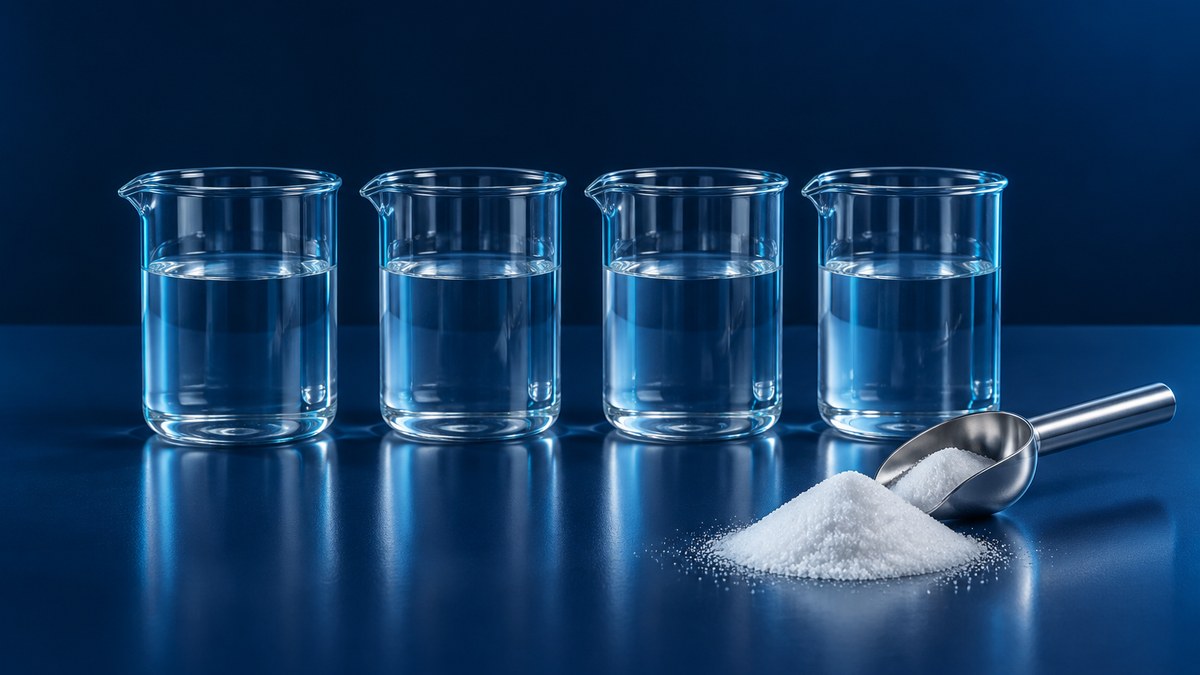
Formulating a clear ready-to-drink hydration bottle, carbonated wellness water, or cold-water electrolyte stick pack pushes procurement and R&D teams past the usual capsule shortlist. Several water-soluble organic magnesium salts look workable at first pass on paper, yet behave very differently once they encounter flavor volatiles, organic acids, carbonation pressure, and U.S. conventional-food qualification.
This technical comparison evaluates soluble magnesium bisglycinate for sparkling and electrolyte drinks side by side with magnesium acetate, magnesium citrate, and magnesium lactate. Rather than ranking salts in the abstract, it maps stoichiometry, sensory off-notes, matrix stability, and food-use review so R&D teams can run one controlled bench comparison.
Elemental magnesium density and stoichiometry differences
Every beverage mass budget begins with actual elemental magnesium, not compound weight. The U.S. Daily Value for magnesium is 420 mg, which makes 42 mg elemental magnesium a common 10% DV target per beverage serving. How much raw powder each form needs depends directly on its stoichiometry and commercial hydration state.
Anhydrous magnesium acetate (C4H6MgO4, molecular weight 142.39 g/mol) calculates to roughly 17.07% elemental magnesium, while the common commercial tetrahydrate form (C4H14MgO8, molecular weight 214.45 g/mol) drops to about 11.33%. Anhydrous trimagnesium dicitrate (C12H10Mg3O14, molecular weight 451.12 g/mol) calculates to roughly 16.16% elemental magnesium, while commercial hydrated citrate grades sit lower depending on bound water. Anhydrous magnesium lactate (C6H10MgO6, molecular weight 202.45 g/mol) sits near 12.01% before hydration, and pure anhydrous magnesium bisglycinate (C4H8MgN2O4, molecular weight 172.42 g/mol) has a stoichiometric ceiling near 14.10%. Commercial unbuffered sensory-tuned bisglycinate for drinks, such as MagneINNO Ultra Taste Free, is standardized at a nominal 8% elemental magnesium target so dissolved off-notes stay low in cold-mix and liquid formulas.
Magnesium salt form | Formula and anhydrous Mg ceiling | Primary sensory profile in drinks | Matrix and regulatory watchpoints |
|---|---|---|---|
Magnesium acetate | C4H6MgO4 (~17.07% anhydrous; ~11.33% tetrahydrate) | Mild saline and potential acetic or vinegar aroma notes in delicate bases | High water solubility; not listed in 21 CFR Part 184 GRAS affirmation; confirm 21 CFR 170.30 food-use scope |
Magnesium citrate | C12H10Mg3O14 (~16.16% anhydrous trimagnesium dicitrate) | Pronounced tart citric sharpness that locks in sour-citrus flavor builds | Can precipitate in phosphate or multi-mineral systems; not listed in 21 CFR Part 184; osmotic GI sensitivity at higher doses |
Magnesium lactate | C6H10MgO6 (~12.01% anhydrous; ~10.2% dihydrate) | Soft dairy-like note that can feel flat in crisp sparkling flavor profiles | Moderate solubility headroom in cold water; not listed in 21 CFR Part 184 |
Unbuffered magnesium bisglycinate (Ultra Taste Free) | C4H8MgN2O4 (~14.10% anhydrous ceiling; 8% nominal beverage grade) | Clean neutral-glycine sweetness balance engineered for lower metallic bitterness | Free Mg controlled <= 0.02% w/w to avoid MgO haze; self-affirmed GRAS dossier available under 21 CFR 170.30 |
Why magnesium acetate behaves differently from bisglycinate
Beverage chemists often shortlist magnesium acetate when rapid cold-water dissolution is the sole laboratory filter. Both anhydrous magnesium acetate and its tetrahydrate salt dissolve rapidly at ambient temperatures, making bench dissolution look effortless in plain deionized water trials.
Sensory and volatile chemistry create the real tradeoff. Because the acetate counter-ion comes from acetic acid (pKa near 4.76), formulating magnesium acetate into low-acid functional waters, floral teas, or lightly flavored sparkling SKUs risks faint saline or acetic vinegar-like top notes as drink pH sits around 3.2 to 4.5 or as aroma compounds equilibrate over warm-warehouse storage. By contrast, glycine in a fully reacted chelate contributes subtle amino smoothness without introducing volatile organic-acid aromas.
Citrate and lactate versus chelated bisglycinate in RTD and stick mixes
Magnesium citrate remains widely used in tart citrus powders, yet comparing glycinate and citrate for beverages highlights two practical ceilings. First, high citrate inputs push total acidity upward and narrow flavor flexibility away from cucumber-mint, berry, coconut, or herbal profiles. Second, excess citrate anions alongside calcium or phosphate salts can form slow-settling complexes during refrigerated RTD shelf-life holds.
A dedicated magnesium lactate beverage review finds a gentler flavor impact than citrate, though solubility ceilings require careful agitation in chilled water and the mild lactic profile can dull bright carbonated notes. Standard beverage comparisons across glycinate, citrate, lactate and gluconate also note that commercial unbuffered magnesium bisglycinate avoids adding oxide sediment only when unreacted free magnesium is tightly controlled. Grades blended with magnesium oxide (often exceeding 18% elemental magnesium) generate cloudy alkaline haze and gritty bottom film in transparent cans and PET bottles.
Clarity, addition order, and sparkling CO2 stability
Optical clarity in carbonated cans and clear bottled waters depends heavily on addition sequence during batching. Residual suspended solids create nucleation points during CO2 injection, triggering gushing at filling nozzles and slow sediment rings under chill storage.
When bench-testing soluble unbuffered magnesium bisglycinate such as 8% Ultra Taste Free, dissolve the magnesium chelate first in ambient deaerated water (20 to 25 C) until optically uniform before introducing sodium/potassium salts, slow acidulant adjustment, flavors, and chilling prior to carbonation. Verify performance through a structured beverage clarity and stability screen rather than judging transparency only 30 seconds after laboratory magnetic stirring.
U.S. regulatory compliance across conventional foods and supplements
A salt that dissolves cleanly still fails launch review if its food-use dossier does not match the label panel. Under FDA's 2014 Liquid Dietary Supplements Guidance, beverage presentation, Nutrition Facts paneling (21 CFR 101.9), serving volume, and conventional refreshment positioning govern food status, whereas dietary supplement powders and shots carry Supplement Facts under 21 CFR 101.36.
Unlike certain inorganic magnesium salts listed directly in 21 CFR Part 184 (such as carbonate, chloride, hydroxide, oxide, phosphate, and sulfate), magnesium acetate, magnesium citrate, and magnesium lactate do not hold individual 21 CFR Part 184 GRAS affirmation regulations. Formulators placing any organic magnesium salt into a conventional drink must document lawful intended-use GRAS eligibility under 21 CFR 170.30 and review FDA's 2015 Fortification Policy guidance when considering carbonated drinks. See our dedicated magnesium sparkling water formulation guide for route-selection checkpoints before locking co-packer tooling.
Frequently asked questions
Does magnesium acetate carry fewer formulation risks than magnesium bisglycinate?
No. Although magnesium acetate dissolves very quickly, its acetate counter-ion risks subtle acetic aroma notes in mildly flavored waters and lacks a dedicated 21 CFR Part 184 GRAS affirmation listing. Unbuffered beverage-grade magnesium bisglycinate avoids acetic odor while offering self-affirmed GRAS documentation for qualified food-use review.
Which MagneINNO grade fits clear drinks and electrolyte mixes?
Begin formulation trials with Grade 3 Ultra Taste Free (nominal 8% elemental magnesium). At 8% assay, supplying 42 mg elemental magnesium (10% DV) requires 525 mg of powder, and supplying 100 mg elemental magnesium in an electrolyte stick pack requires 1,250 mg, balancing sensory neutrality and dispersion.
Why do buffered bisglycinate grades cause haze in drinks?
Buffered blends combine magnesium glycinate with insoluble magnesium oxide to artificially boost total elemental percentage above the ~14.10% bisglycinate ceiling. In water, unreacted oxide forms suspended haze, chalky sediment, and elevated alkaline pH.
Evaluate MagneINNO 8% Ultra Taste Free in your beverage base
MagneINNO™ magnesium glycinate is supplied by NutraINNO USA Inc., the U.S. company behind the MagneINNO brand, and is built on proprietary MagniLift™ technology with purity at 99.8% and a release pass rate of 99.8% tracked as separate quality metrics. Commercial grades are produced at an NSF GMP for Sport registered facility, hold self-affirmed GRAS and Non-GMO Project Verified documentation paths, and control free magnesium at <= 0.02% w/w by complexometric titration alongside ICP-OES, FTIR, XRD, HPLC, and Karl Fischer verification.
For side-by-side RTD, sparkling hydration, or electrolyte trials, free 50 g samples ship from Ontario, California inventory. Commercial lots arrive in 25 kg fiber drums. Unopened material carries a 24-month shelf life. In-stock California orders typically ship in about 3 days, while production orders take 1 to 2 weeks. Request Ultra Taste Free samples and beverage documentation with your target elemental magnesium per serving, acidulant system, and format route.
References
[1] PubChem Compound Summary: Magnesium Acetate (CID 8896) and Magnesium Acetate Tetrahydrate (CID 134717).
[2] PubChem Compound Summaries: Trimagnesium dicitrate (CID 6099959), Magnesium lactate (CID 6536825), and Magnesium glycinate (CID 84645).
[3] Electronic Code of Federal Regulations: 21 CFR 170.30 (GRAS eligibility), 21 CFR 101.9, and 21 CFR 101.36.
[4] U.S. Food and Drug Administration: GRAS Overview, Distinguishing Liquid Dietary Supplements from Beverages (2014), and Questions and Answers on FDA's Fortification Policy (2015).
Technical & QA Review
Prepared by MagneINNO Technical Team for supplement formulators, QA teams, and procurement managers. Verify specifications and analytical methods on our Chelation Science, Quality & Certifications, and About NutraINNO USA Inc. pages.
Need samples or documentation?
Review MagneINNO samples, specifications, and supply options.
Continue Exploring
Related Articles & Knowledge Base Guides
Magnesium Forms Compared: Sourcing Guide for Supplement Brands
Magnesium Glycinate for Functional Beverages: Solubility, Taste, and Positioning
Switching a Beverage From Magnesium Citrate or Lactate to Magnesium Glycinate
Can Magnesium Glycinate Be Used in Beverages?
Formulation constraints, pH targets, and 8% Ultra Taste Free qualification for drinks.
Beverage Clarity & Stability Screen
Screening workflow for haze, precipitation, and accelerated shelf-life checks.