Supply Chain
How to Compare Magnesium Bisglycinate Suppliers: A Weighted Scorecard for Procurement Teams
A weighted scorecard for comparing magnesium bisglycinate and magnesium glycinate suppliers on chelation evidence, assay basis, documents, lots and supply.
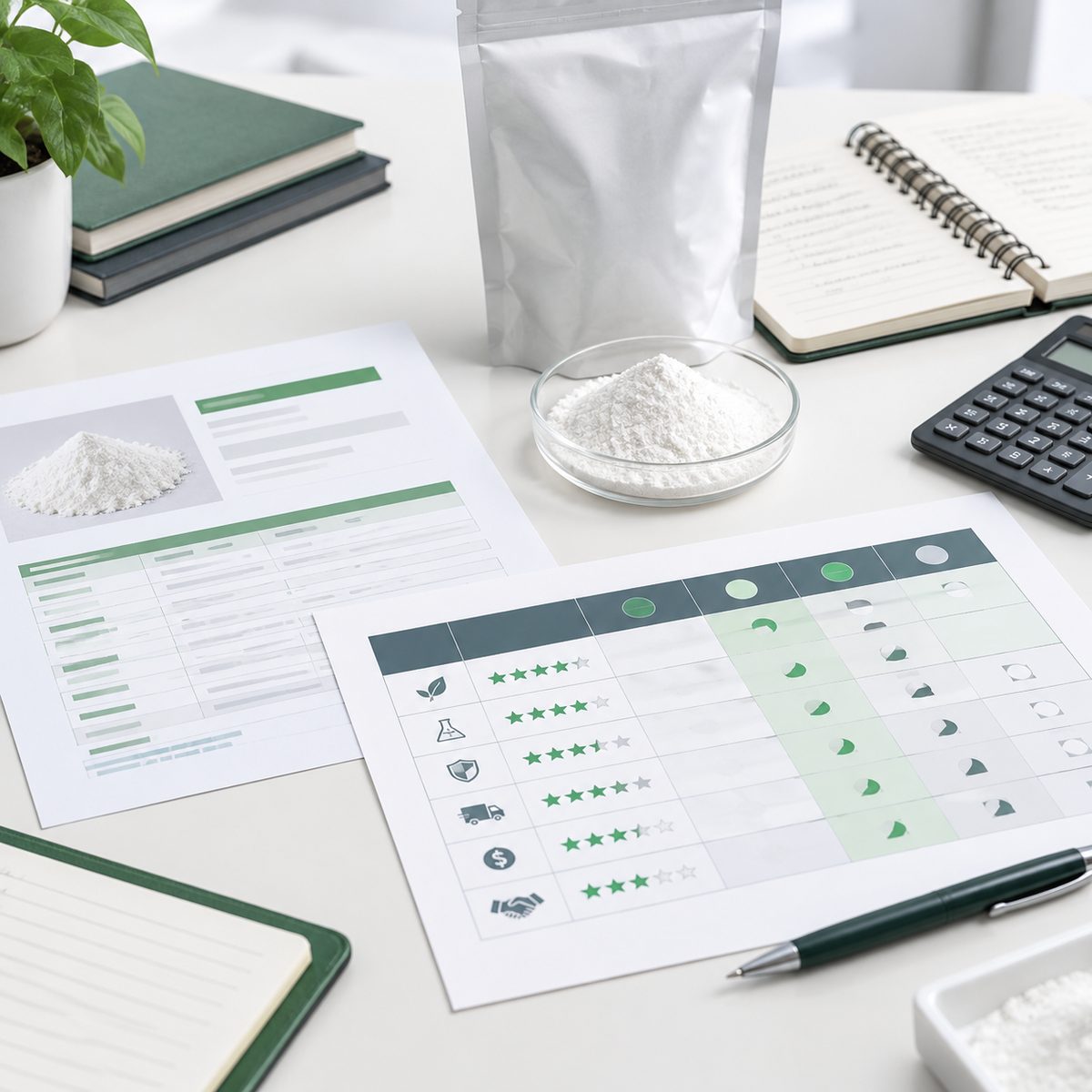
Comparing magnesium bisglycinate suppliers takes more than placing competing quotes side by side. Procurement, formulation and quality teams need to know whether each candidate can provide the same technical identity, reliable documentation, repeatable lot performance and supply continuity for the intended finished product.
A weighted scorecard makes that decision auditable. It separates non-negotiable qualification gates from criteria that can be scored, records evidence rather than sales descriptions, and makes trade-offs visible before a purchase order is issued. The framework below is written for supplement and functional beverage brands evaluating a bulk magnesium bisglycinate or magnesium glycinate raw material.
Start with qualification gates
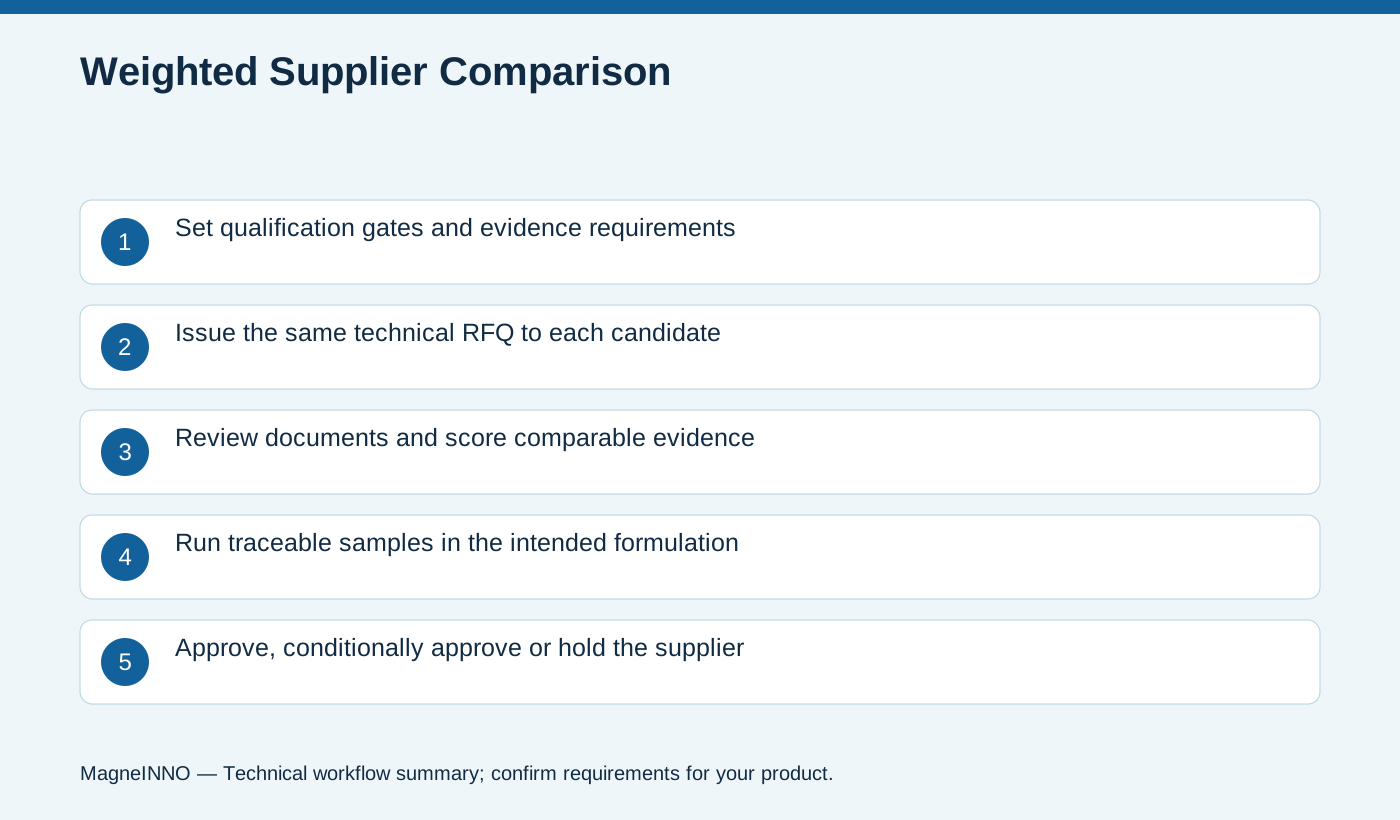
Some requirements should be treated as pass-or-hold gates rather than averaged into a supplier score. A candidate should not end up with a strong overall result because an attractive lead time compensates for missing identity evidence or an unclear assay basis.
- A current specification identifies the material, intended grade, elemental magnesium target and relevant impurity or microbiological limits, and declares the composition: any other magnesium sources, added free glycine or other components, and whether the material is buffered.
- A representative certificate of analysis, or COA, is available for review with methods, units, acceptance limits and lot information.
- For each reported value, the supplier states the reporting basis (as-is or dry basis) and what kind of number it is: a specification limit, a theoretical calculation, a typical value or an actual lot result.
- The supplier can describe its change-notification process and escalation route for deviations or out-of-specification results.
- The sample is traceable to the technical documents and can be evaluated in the intended dosage form.
For a broader document request, use this technical RFQ brief so supplier responses arrive in a format that is easier to compare.
Weighting the supplier scorecard
Once a candidate passes the gates, score each criterion on a consistent scale, such as zero through five. Define what each score means before reviewing supplier submissions. For example, a five can mean complete, specific evidence backed by lot data or test results; a three can mean partial evidence requiring follow-up; a one can mean a statement with no supporting document; and a zero can mean the requirement is absent or contradictory. Decide in advance how a missing answer is treated, then calculate each supplier's total as the sum of weight multiplied by score divided by five.
Criterion | Suggested weight | Evidence to request |
|---|---|---|
Chelation evidence | 20% | FTIR or equivalent identity evidence, interpretation, sample traceability and any complementary analysis. |
Elemental magnesium and assay basis | 20% | Elemental magnesium specification, assay method, reporting basis, moisture or loss-on-drying context and calculation basis. |
Documentation package | 15% | Specification, COA, technical data sheet, safety data sheet, allergen and regulatory statements, and document revision control. |
Lot-to-lot consistency | 15% | Anonymized historical COAs, retain-sample policy, sampling approach, trend data where available and deviation history. |
Sample performance | 15% | Formulation trial results for the intended format, including handling, flow, dispersion, sensory observations or process fit. |
Supply continuity | 10% | Stocking context, standard order timing, production-order timing, packaging options and communication during allocation or delay. |
Change notification | 5% | Advance-notice period, change categories, requalification triggers and quality-agreement responsibilities. |
The suggested weights are a starting framework, not a universal standard. A beverage team may raise the weight for sample performance and supply continuity, while a capsule or tablet program may put more emphasis on elemental magnesium, particle characteristics and lot consistency. Record the reason for any weight change so the decision still makes sense during a later review.
How to score technical evidence
Chelation evidence should answer a specific identity question: does the evidence support the claimed chelated composition, rather than only showing that magnesium and an amino acid are present? FTIR can be useful when the spectrum, reference basis and interpretation are supplied, but a spectrum without sample identity or an explanation of what is being assessed is weak procurement evidence. FTIR on its own also does not give a quantitative chelation percentage, so ask what acceptance criteria and complementary tests the supplier relies on. Review the FTIR and complementary-analysis plan alongside the supplier's own material documents.
Elemental magnesium must be scored separately from ingredient purity and from ingredient weight. A material may be described as high purity while still requiring a particular mass to deliver the target elemental magnesium. Ask the supplier to reconcile the specification, assay method, moisture basis and finished-label calculation, so that a theoretical composition value is not mistaken for a guaranteed lot result.
For example, an 8%, 10% or 12% elemental magnesium grade describes elemental content, not purity and not a dosage-form limit. The actual ingredient mass depends on the verified assay and the finished product's approved formulation. Keep the calculation basis in the product development record and confirm it against the incoming COA.
Run the comparison in four stages
- Issue one technical RFQ. Send every candidate the same specification template, intended format, target elemental magnesium range, documentation request and change-control questions.
- Complete a desk review. Apply the qualification gates, record unanswered questions and score only evidence received by the agreed review date.
- Test a traceable sample. Use the same formulation procedure, equipment and observation sheet for each candidate, and have formulation and QA sign off independently.
- Confirm commercial readiness. Review packaging, receiving inspection, release testing, change control, replenishment planning and the approval path before issuing a purchase order.
A sample score should not rest on how the powder looks in a bag. Test the material in the intended process and keep the sample identification with the results. The trial-to-commercial readiness checklist gives a useful structure for evidence gates before commercial purchasing.
Supply and change-control questions
Ask each magnesium bisglycinate supplier to state current stocking and order timing in writing rather than relying on a general availability statement. For MagneINNO, the current supply terms are U.S. stock held in California, in-stock orders shipping in about three days, production orders taking about one to two weeks, free 50 g samples, and 25 kg fiber drums with a 24-month shelf life. Treat these as inputs for the supply-continuity score and still confirm availability against your specific order.
Change control deserves its own score because an ingredient can meet today's specification and still create requalification work later if changes are communicated late. Ask what counts as a reportable change, how much notice is given, which documents are revised and whether the buyer receives a pre-change sample or comparability data. Keep those commitments in the quality agreement or purchase specification. The supplier change-control brief offers a practical review structure.
Frequently asked questions
Should price be part of the technical score?
Keep price visible, but do not let it hide a qualification failure. Compare commercial quotations only after the technical gates are passed, and normalize the comparison for elemental magnesium contribution, packaging, testing requirements, expected release work and supply risk. Our note on wholesale quote terms covers what a comparable quote should state.
Is a COA enough to verify a supplier?
No. A COA supports lot release review, but it does not replace identity evidence, specification review, sample testing, change control or supplier qualification. Check whether the reported result is actual, typical or theoretical and whether the test method answers the intended quality question. This guide to reading a magnesium glycinate COA walks through each field.
What should procurement do when assay bases differ?
Ask QA and the supplier to reconcile as-is, dry-basis and theoretical reporting before comparing scores. Do not rank one supplier higher simply because its number is reported on a different basis. Document the agreed conversion or comparison rule and apply it the same way to every candidate.
Can the top-scoring supplier still need qualification work?
Yes. A scorecard supports prioritization; it does not replace approval. Any open evidence gap should have an owner, a due date and a stated decision impact before the supplier is approved for routine purchasing.
MagneINNO™ magnesium glycinate is supplied by NutraINNO USA Inc., the U.S. company behind the MagneINNO brand, and is built on proprietary MagniLift™ technology for supplement and beverage brands that need dependable, well-documented supply.
To run MagneINNO through the same scorecard, contact our team to request a sample, COA, specification sheet or quote.
Need documentation?