Formulation
Magnesium Glycinate Supplier: Pilot to First Order
A stage-gate checklist for brands and CMOs taking a magnesium glycinate supplier from first sample and pilot batch to a qualified first bulk purchase order.

The first sample of a magnesium glycinate ingredient usually arrives with optimism. It looks clean, the COA is tidy, and the bench test went well. Then the first commercial batch at the contract manufacturer runs slowly, the fill weight drifts, or the CMO's quality team asks for documents nobody collected. The gap between a promising sample and a qualified magnesium glycinate raw material is where launches slip.
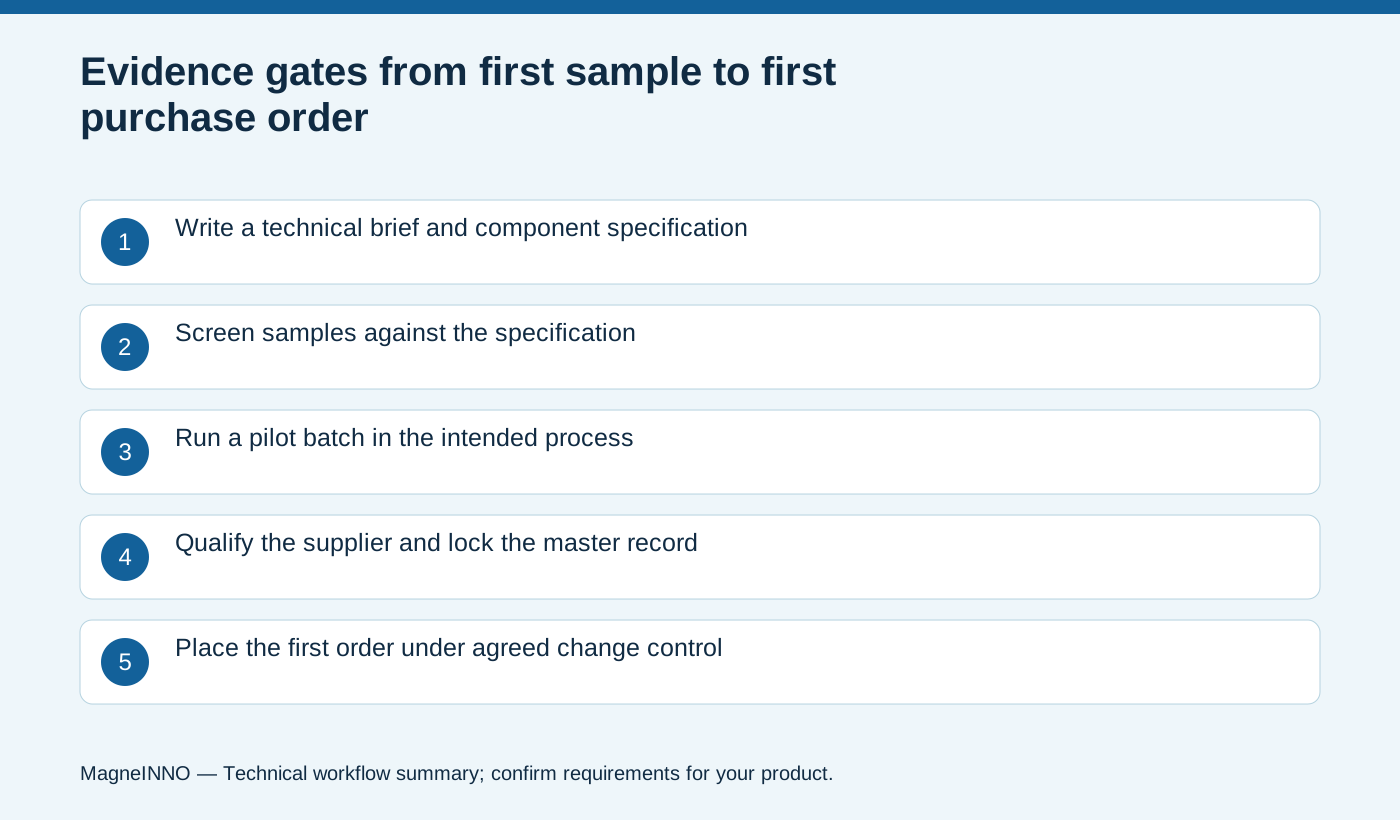
This stage-gate checklist helps brands and contract manufacturers decide what evidence a magnesium glycinate supplier must provide before the first commercial purchase order for bulk magnesium glycinate is placed.
Gate one: technical brief and specification
Before samples are compared, write down what the ingredient has to do.
- Dosage form and serving design: capsules, tablets, gummies, powders, stick packs or beverages, and the elemental magnesium target per serving.
- Grade: the elemental magnesium percentage you will design around, because it sets the ingredient mass. Our serving format mass and volume budget shows how to check that the serving fits.
- Component specification: the CGMP rule requires an identity specification and limits on contamination that may adulterate the finished batch for every component, plus the specifications needed to meet finished-product purity, strength and composition.
- Critical attributes for the process: particle size, bulk density, flow, water content, taste or clarity, depending on the format.
A short technical RFQ brief built from this information makes supplier responses comparable.
Gate two: sample screening
Screen samples against the specification, not against each other. Confirm identity, elemental magnesium assay with its reporting basis, water content and the attributes that matter for your format. Sensory screening belongs here for powders, gummies and beverages. Our sample evaluation checklist lists the first tests to run.
Exit criterion: the sample meets the specification and shows no obvious process risk.
Gate three: pilot batch in the intended process
Bench results do not predict how a powder behaves on a production line. Run a pilot batch at the CMO, on the equipment and with the excipients intended for commercial production. Record:
- Blending and flow behavior.
- Fill or compression weight variation and capsule or tablet quality.
- For powders and beverages: wetting, dispersion, clarity and taste.
- Finished-product test results against the product specification.
- Any process adjustment needed, and why.
If the pilot needs adjustment, decide whether the fix belongs in the process or in the ingredient specification. Our guide to technical transfer and scale-up covers which parameters should stay fixed.
Gate four: qualify the magnesium glycinate supplier and its documents
The user of the ingredient, usually the CMO, must be able to show that each specification is met. For dietary ingredient identity, testing before use is required. For other specifications the CMO may rely on the supplier COA, but only after qualifying the supplier, documenting how, and having quality control approve the basis, with periodic re-confirmation afterwards. Our guide to evaluating a new magnesium glycinate supplier from sample to qualification walks through that record.
The document pack typically includes:
- Specification sheet with methods.
- Lot COAs for the pilot lot and for qualification lots.
- Safety data sheet.
- Allergen, GMO and residual solvent statements where your market requires them.
- Shelf life and storage statement.
- Regulatory status statement for the intended use.
- Packaging description.
- A change-notification commitment.
Gate five: lock the master manufacturing record
FDA's small-entity guidance explains that a master manufacturing record is prepared for each unique formulation and each batch size. The rule lists what it must contain, including the weight or measure of each component and any intentional overage of a dietary ingredient. For magnesium glycinate that means the ingredient quantity must be calculated from the specified grade and reporting basis, and any overage must be stated rather than hidden in the calculation. Our note on separating assay adjustment, process loss and overage explains the difference.
Gate six: bulk order terms and change control
Before the first order, agree:
- The approved grade and specification revision referenced on purchase orders.
- Packaging, labeling and delivery requirements.
- Lead time expectations for stock and production orders.
- How the supplier will notify changes to process, materials, site or specification (see supplier change control).
- How lot traceability is maintained from receipt to finished batch.
A promising sample versus a qualified raw material
A promising sample passed a bench screen. A qualified raw material has a specification, a supplier qualification record, a pilot batch in the real process, a locked master record, and agreed change control. Only the second should carry a commercial purchase order.
How MagneINNO supports commercial readiness
MagneINNO™ magnesium glycinate is supplied by NutraINNO USA Inc., the U.S. company behind the MagneINNO brand, and is built on proprietary MagniLift™ technology for supplement and beverage brands that need dependable, well-documented supply. Stock is held in California. It is offered at 12%, 10% and 8% elemental magnesium as starting points for capsules and tablets, gummies, and powders or beverages respectively. We provide a free 50 g sample for screening, production lots for CMO pilot trials, and the specification sheet, lot COAs and supporting statements for qualification. The ingredient has self-affirmed GRAS status, a 24-month shelf life and ships in 25 kg fiber drums. Capacity of more than 3,000 tonnes per year, about three days for in-stock orders and one to two weeks for production orders help the move from pilot to commercial supply.
FAQ
Can we place the first order before the pilot batch?
You can, but you take the risk that the ingredient does not run in the process. Many brands place a small pilot order first.
Who owns supplier qualification, the brand or the CMO?
The firm that uses the ingredient under Part 111, often the CMO, must qualify it. Brands should agree in the quality agreement who collects which evidence.
Do we need a new master record if we change grade?
A different grade changes the component weight, so the master record must be updated and approved.
When you are ready to move from sample to pilot, contact our team for a sample, pilot material or the qualification document pack.
Need documentation?