Supply Chain
Magnesium Glycinate Wholesale for Supplement Brands: How MOQs, Pack Sizes, Trial Orders and Quote Terms Work
Magnesium glycinate wholesale guide for B2B buyers: what to ask from sample to trial order, how MOQ differs from pack size, and what a bulk quote should state.

Buying magnesium glycinate wholesale involves four decisions that are easy to confuse: the amount a supplier is willing to sell, the size of the physical package, the quantity needed for a formulation trial, and the commercial terms attached to a quote. Mixing them up is how two quotes for the same 25 kg drum can end up describing different order quantities.
This guide explains a practical path from free sample to trial order and then to the first commercial purchase order. It does not state MagneINNO minimum order quantities, prices, discounts or payment terms. Those items should be requested directly in a written quote for the grade and quantity under review.
Start with the technical brief, not the quantity
Before asking for a magnesium glycinate wholesale quote, define the intended use, grade, elemental magnesium basis, dosage form and documentation requirements. A capsule or tablet project may begin with a different elemental magnesium target than a powder, gummy or functional beverage project. The target refers to elemental magnesium, while the ingredient purchase is made by the mass of the magnesium glycinate material.
A stated elemental percentage is a formulation input, not a purity claim. For example, a supplier may offer one grade specified at around 12% elemental magnesium for capsule and tablet work and another at around 8% for powders and stick packs. Those figures describe the purchased ingredient, not the finished product. They are starting points for product development; the finished formulation still requires its own mass balance, testing and label review. Ask the supplier to state whether assay results are reported as-is or on a dry basis, and ask quality teams to reconcile the reporting basis before approving a quote.
The RFQ should also identify whether the requested material is a standard grade or a product with specific sensory, particle-size, flow, solubility or beverage-performance requirements. A technically different material should not be treated as a comparable quote simply because both documents use the words magnesium glycinate. Sending the same technical RFQ brief to every supplier makes their responses easier to compare.
How a bulk magnesium glycinate order normally moves
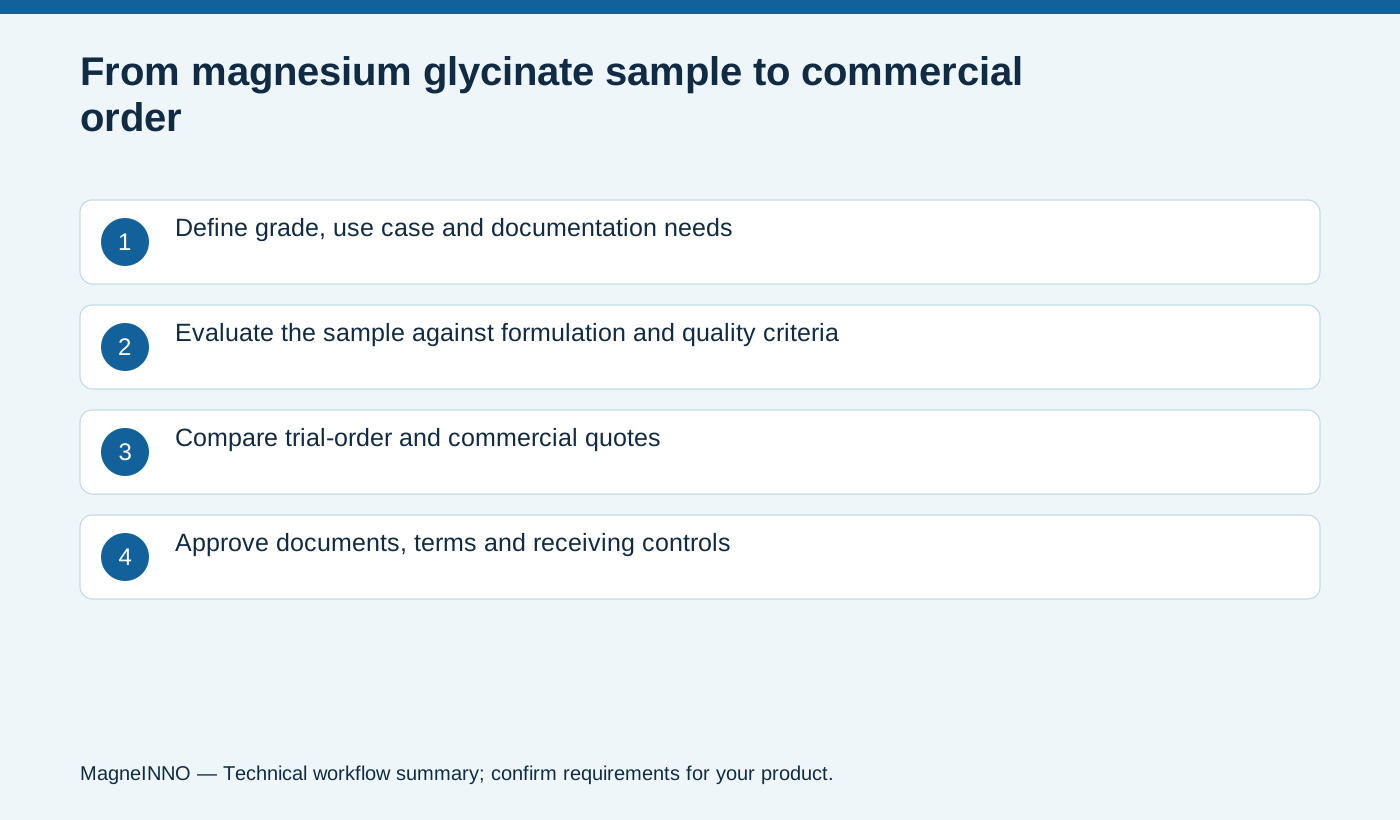
- Request a technical sample. State the intended dosage form, target elemental magnesium basis, trial purpose and required documents. A free 50 g sample is available for evaluation of MagneINNO material.
- Run the formulation and quality screen. Confirm identity, assay basis, sensory fit, handling characteristics and compatibility with the intended process. Record the lot number and retain the supplier documents used in the evaluation.
- Request a trial-order quote. Ask whether the trial quantity can be supplied as a partial package, a full package or another defined quantity. Confirm that the quoted grade and documentation match the sample.
- Approve the first commercial purchase. Quality should approve the specification and document package while procurement confirms quantity, quote validity, delivery timing and payment terms.
A sample is evidence for development work; it is not automatically approval for production purchasing. The formulation team should document what was tested, and quality should define which attributes must be confirmed on receipt. The sample evaluation checklist can help structure that handoff, and the pilot-to-first-order checklist covers what to close out before scaling up.
MOQ and pack size answer different questions
MOQ means minimum order quantity. It is a commercial threshold that may apply to a purchase order, a product grade, a custom requirement or a production run. Pack size describes how the material is physically packaged. A 25 kg fiber drum is an example of a pack size; it does not, by itself, establish the supplier's MOQ, the number of drums required or whether mixed quantities are accepted.
Ask the supplier to state four separate items: the minimum purchase quantity, the standard pack size, whether the order must be placed in full-pack increments, and whether an approved trial order follows different rules. A fifth question is whether the quoted quantity is net ingredient weight or includes packaging. These details prevent a quote from appearing comparable when the underlying commercial assumptions differ.
MagneINNO material ships in 25 kg fiber drums. U.S. stock is held in California. In-stock orders ship in about 3 days, while production orders take about 1–2 weeks. Treat these as planning context and confirm current status, timing and quantity in the quote before issuing a purchase order.
What a comparable wholesale quote should state
A useful magnesium glycinate wholesale quote should identify the exact material and the assumptions behind the offer. Ask the supplier to include:
- Product name, grade, intended use and any relevant formulation or sensory specification.
- Declared composition, including any added components and whether the material is buffered or unbuffered.
- Elemental magnesium basis, assay reporting basis and whether the stated percentage is a specification or a formulation estimate.
- Pack size, minimum order quantity, order increments and the quantity covered by the quoted price.
- Quote validity period, currency, payment terms, applicable taxes or charges and any conditions for changing the offer.
- Current stock status, estimated ship timing, production lead time where applicable and any lot allocation assumptions.
- Shelf life, storage conditions and the documents supplied with the lot.
Quote validity matters because a price may depend on the stated quantity, grade and timing. Ask what happens if the purchase order is issued after the validity period, if the requested quantity changes, or if the supplier offers a different lot. Procurement should keep the accepted quote with the purchase order so the commercial basis is traceable. For the factors that move the number itself, see what drives bulk magnesium glycinate pricing.
Documents that should travel with every lot
For each received lot, request and review the lot's certificate of analysis, and confirm that you hold the current revision of the specification sheet and safety data sheet. The COA is lot-specific and should identify the lot and report the release results against the relevant specification. The specification sheet defines the material requirements and test expectations. The SDS provides handling and hazard information; it does not replace the COA or establish that a finished supplement complies with its own release requirements.
Quality teams should compare the lot identity, package labels, quantity, manufacturing or retest dates where provided, and document revision against the purchase order and approved specification. If a result is reported on a different basis from the internal requirement, pause the release decision and request reconciliation from the supplier. The incoming COA review workflow provides a useful framework for that check.
MagneINNO material carries a 24-month shelf life. Confirm the shelf-life statement, storage conditions and lot-specific dates in the current technical documents supplied with the order.
Questions to resolve before issuing the purchase order
Procurement should ask whether the quoted material is the same grade used for the sample, whether the lot is available for the requested timing, and whether the supplier can provide the required COA, specification sheet and SDS before or with shipment. Formulation should confirm that the elemental magnesium basis and physical characteristics remain suitable for the finished format. Quality should confirm the acceptance criteria, test methods, change-notification expectations and disposition process for a discrepancy.
Ask explicitly how long the quote remains valid, what payment terms apply, whether a trial order has separate commercial conditions, and whether the supplier will reserve a lot after receiving the purchase order. These questions are more useful than asking for a generic "best price" because they expose the conditions behind the offer. For a broader checklist, see questions to ask a magnesium glycinate supplier before you buy.
FAQ
Is a 25 kg drum the same as a 25 kg MOQ?
No. A 25 kg drum describes packaging. The MOQ may be one drum, several drums or another quantity, depending on the supplier's terms and the requested grade. Ask for both figures separately.
Can a free sample qualify a supplier for commercial purchasing?
A sample supports development and preliminary quality evaluation. Commercial qualification should also cover the approved specification, lot documentation, receiving checks, change control and the conditions stated in the purchase agreement.
Does a COA replace independent incoming testing?
Not entirely. Under U.S. dietary supplement cGMP rules, the manufacturer is generally expected to confirm the identity of each dietary ingredient lot itself, and a supplier COA can stand in for other specification tests only after the supplier has been qualified and the results are periodically verified. That testing can be done in-house or by a contract lab.
MagneINNO™ magnesium glycinate is supplied by NutraINNO USA Inc., the U.S. company behind the MagneINNO brand, and is built on proprietary MagniLift™ technology for supplement and beverage brands that need dependable, well-documented supply.
For a current evaluation, request a sample, COA/specification sheet or written quote that states the grade, elemental magnesium basis, pack size, MOQ, validity period, timing and document package.
Need documentation?