The practical answer
Qualify a ready-to-drink magnesium beverage container against the complete acidified or carbonated formula and thermal process before locking shelf life. Pair container food-contact compliance letters with filled-pack tests for liner integrity, gas barrier and closure performance.
Separate raw-material packaging from finished-beverage container qualification
Qualifying the drum that ships bulk magnesium glycinate powder and qualifying the container that holds a finished ready-to-drink beverage are separate engineering tasks. An ingredient packaging specification protects dry powder against moisture pickup and physical damage during warehouse storage and batching. Once the mineral enters an aqueous, acidified or carbonated liquid formula, the primary sales pack faces ionic strength, organic acids, dissolved gases, headspace oxygen, thermal processing and long liquid contact.
Do not assume that a generic food-grade container catalog entry covers an electrolyte or mineral beverage. An aluminum can liner, a polyethylene terephthalate bottle resin or a glass bottle closure gasket can respond differently when formula pH, chelating ligands, acid type, salt concentration or fill temperature change. Container qualification belongs alongside formula screening before a team funds full-length stability testing in commercial units.
Compare lined aluminum cans, PET bottles and glass bottles against process conditions
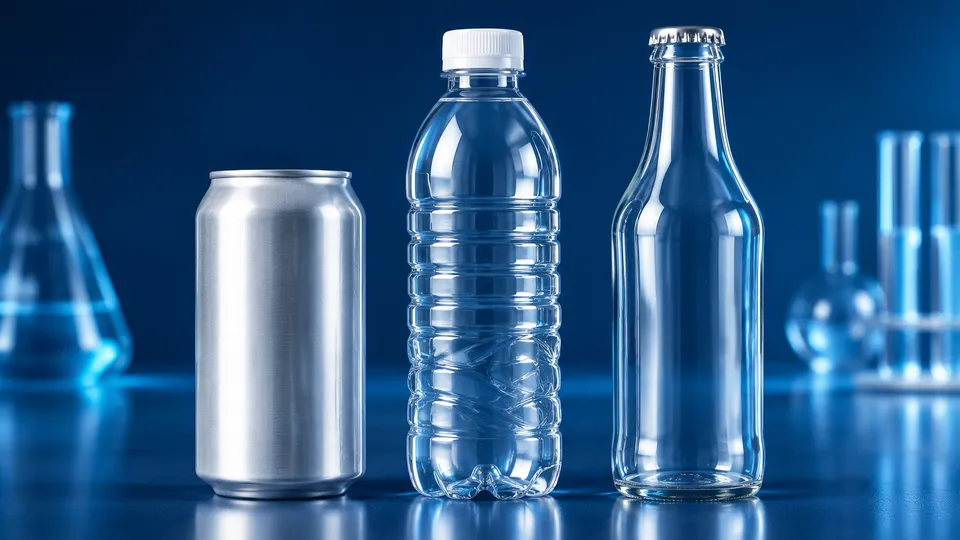
Each container format places different technical demands on the beverage formulation and contract filler. The table below organizes the main qualification checkpoints across lined two-piece aluminum cans, PET bottles and glass bottles with commercial closures. No container type is automatically superior across all magnesium drink formats; the right choice depends on carbonation level, thermal kill step, target distribution conditions and co-packer line capability.
When a line relies on a co-packer's house container, confirm which exact liner specification or resin grade will be supplied in commercial runs. Switching between two nominal equivalents without checking barrier or coating specs can change stability outcomes late in commercialization.
| Container format | Primary process and stability risks | Key qualification checks before commercial lock |
|---|---|---|
| Lined aluminum cans | Pinholes, enamel blistering, metal pickup and seam integrity loss under low pH, chloride or organic acid matrices | Accelerated and ambient corrosivity pack test on the exact formula; lacquer continuity / enamel rater checks; double-seam teardown; dissolved aluminum or iron checks over time |
| Cold-fill or hot-fill PET bottles | Thermal paneling or neck distortion above resin glass-transition limits; carbonation loss and oxygen ingress over shelf life | Verify hot-fill bottle design against planned fill temperature and vacuum panel recovery; measure CO2 retention, O2 transmission and headspace color or off-note drift |
| Glass bottles and closures | Closure liner chemical resistance, torque retention after thermal shock and cap corrosion on metal lug or crown closures | Confirm gasket polymer compatibility with acids and flavors; measure removal torque and vacuum or pressure retention after pasteurization and storage; inspect metal closures for under-cap rusting |
On smaller screens, scroll the table horizontally.
Verify food-contact regulatory status for the intended beverage conditions
Before running filled-pack trials, confirm that every food-contact layer in the proposed container has documented U.S. regulatory clearance covering your food type and condition of use. Under 21 CFR 174.5, substances intended for food-contact articles must meet applicable conditions of safe use and good manufacturing practice, including limits on extractives and freedom from off-odors or flavors imparted to food. [1]
Match the container documentation to the specific material layer contacting the drink. Resinous and polymeric internal can coatings and closure coatings are governed by 21 CFR 175.300, whereas polyethylene terephthalate polymers used for bottles are addressed under 21 CFR 177.1630. [2] [3] When a supplier relies on a newer coating, barrier additive or resin cleared through a Food Contact Notification rather than an older CFR listing, request written confirmation tied to the effective notification under 21 CFR 170.100, verifying that the intended aqueous or acidic food type and maximum fill or pasteurization temperature fall inside the cleared conditions of use. [4]
A compliance letter confirms that the container materials are permitted for the stated food-contact scope; it does not predict shelf life or prove that a specific magnesium beverage will stay clear, uncorroded and carbonation-tight for its dating period. Keep the compliance file and the filled-pack performance record as two separate gates in the qualification checklist.
Hand off a container qualification brief before locking the shelf-life study
When sending a formula brief to a contract manufacturer or packaging vendor, include the finished beverage pH range, planned acid system, target elemental magnesium per serving, co-formulated electrolytes such as chloride or phosphate, target carbonation volumes, thermal process temperature and hold time, intended storage temperature and target shelf life. Ask the packaging vendor to nominate a specific can liner code, bottle resin preform weight or closure liner compound tied to those exact inputs rather than quoting a generic stock bottle.
Run small filled-pack screening lots in the nominated commercial container-closure combination before locking a formal finished-beverage shelf-life protocol. Evaluate integrity, visual clarity, sensory stability, gas retention and any metal-ion or extractive shift at early checkpoints. If the container spec, liner supplier or closure torque specification changes later, treat that change as a requalification trigger rather than carrying forward old stability data from a different pack.
Common questions
Does a magnesium raw-material COA or food-grade ingredient status qualify an aluminum can liner?
No. An ingredient certificate covers the magnesium powder before formulation. A lined aluminum can must be qualified separately with food-contact compliance documentation for the coating system and filled-pack testing using the complete acidic or carbonated beverage.
Can a supplier food-contact letter of guaranty replace filled-can or bottle pack testing?
No. A food-contact letter addresses regulatory clearance of the container polymer or coating for stated food types and temperatures. Filled-pack trials are still required to verify enamel integrity, closure retention, barrier performance and sensory stability in the commercial formula.
Sources & further reading
- 21 CFR 174.5, general provisions applicable to indirect food additives
- 21 CFR 175.300, resinous and polymeric coatings
- 21 CFR 177.1630, polyethylene terephthalate polymers
- 21 CFR 170.100, submission of a food contact substance notification