
Formulation and scale-up
A starting answer for beverage buyers and formulators: what decides whether magnesium glycinate works in a drink, how much ingredient a serving carries, and which grade to screen first.

Formulation and scale-up
Distinguish magnesium raw-material solubility from mixing speed and finished-tablet release, then define useful conditions and endpoints for a laboratory study.
Formulation and scale-up
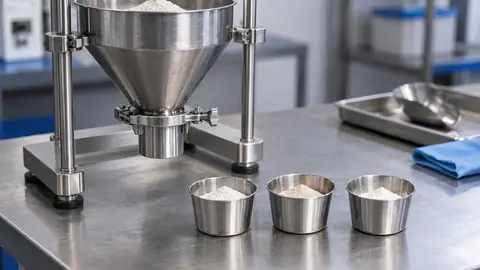
Design a magnesium glycinate blend trial that separates mixing performance, sampling error and segregation during transfer, hopper holding and filling.

Formulation and scale-up
Connect ingredient loading with capsule filling, tablet compaction, physical quality and finished-product performance in a focused pilot plan.

Formulation and scale-up
Use controlled component-removal and addition-order experiments to investigate mineral interactions without confusing appearance with chemical identity.

Formulation and scale-up
Use a transparent mass balance to distinguish lot-assay correction, manufacturing yield and an intentional nutrient overage in a magnesium product.

Formulation and scale-up
Translate powder measurements into a practical equipment trial without treating tapped density or a flow index as a guaranteed filling outcome.

Formulation and scale-up
Compare magnesium ingredients in the actual beverage matrix using controlled concentration, processing, storage and sensory observations.

Formulation and scale-up
Use a staged gummy development plan covering ingredient loading, process behavior, unit consistency, texture and package stability.

Formulation and scale-up
Separate descriptive observations, perceptible differences and preference when screening a mineral ingredient in a safe finished prototype.

Formulation and scale-up
Check ingredient loading, other formula components and actual fill behavior before promising a capsule count, tablet size or powder serving.