Quality & Regulatory
Magnesium Glycinate Deviations: SCAR and CAPA Steps
When a magnesium glycinate lot is out of specification: contain it, run a material review, issue a supplier corrective action request and verify CAPA.

Sooner or later a magnesium glycinate lot will not behave. The assay comes back low, the powder cakes in the hopper, a drum arrives with a torn liner, or the COA does not match the label. Whether the lot is truly out of specification (OOS) or only looks that way, what happens in the next few days decides whether the problem is contained, whether the supplier fixes the cause, and whether you can defend the outcome to an auditor or a customer.
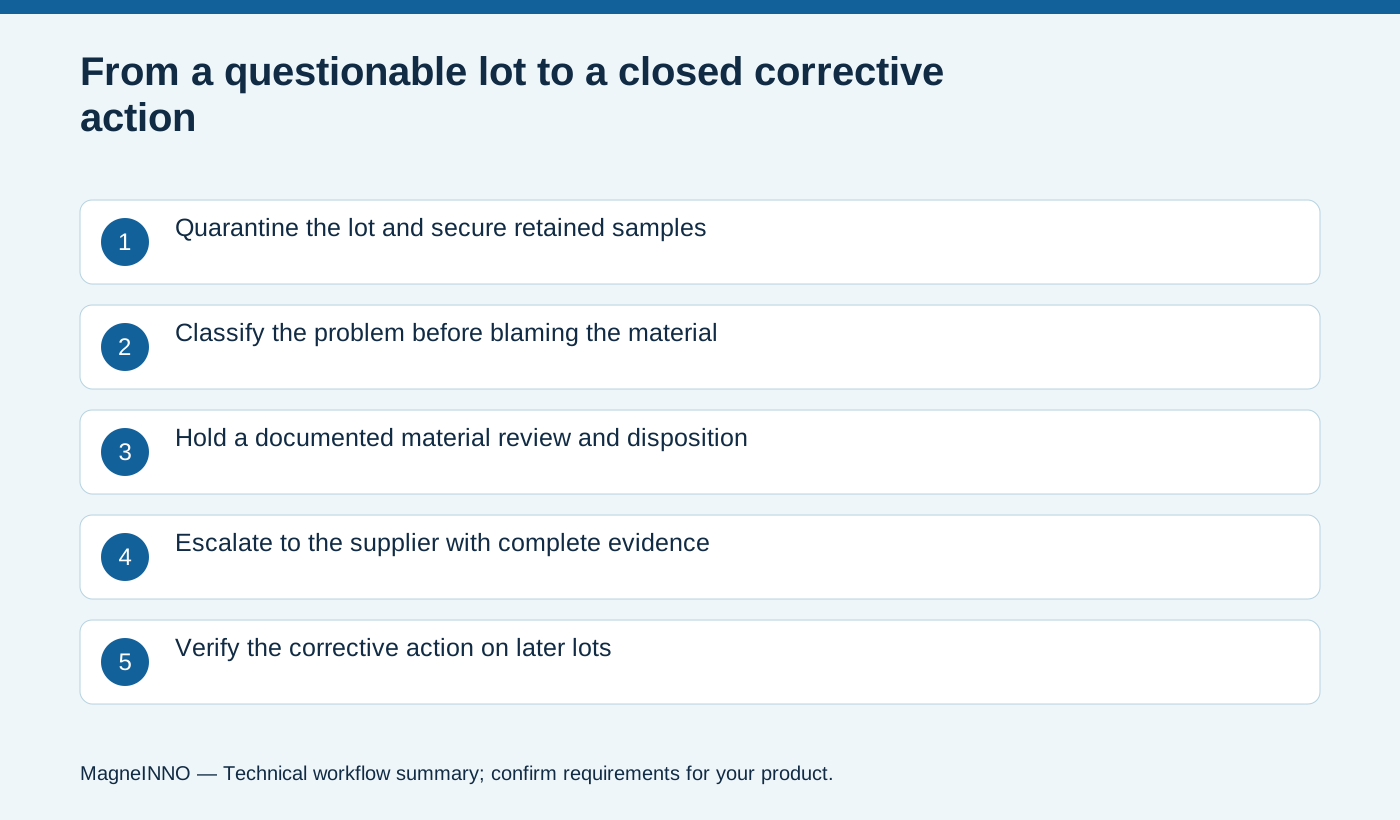
This checklist takes a buyer or quality team from first signal, through the material review and a supplier corrective action request (SCAR), to a closed corrective action and preventive action (CAPA).
First, contain: quarantine and secure evidence
- Treat the lot as potentially nonconforming material: place it, and any other lots from the same shipment, on hold in your system and physically.
- Retain unopened containers where possible, and keep the samples already taken.
- Record the lot number, supplier, date received and the exact observation.
- If the material is already in production, identify every batch that used it.
Containment comes before root cause. A lot that is "probably fine" should still be held until the review is complete.
Second, classify the problem before an OOS investigation goes to the supplier
Not every deviation is a bad lot. Before contacting the supplier, decide whether you are looking at a document discrepancy, a sampling or handling issue, a laboratory issue such as a dry-basis result compared with an as-is specification, a confirmed specification failure, a performance problem within specification, or a finished-product complaint. Each path needs different evidence, and only a confirmed failure or a clear supplier-side cause justifies a formal SCAR.
Our guide to investigating an incoming result that disagrees with the supplier covers the laboratory side of an OOS investigation in detail, and our list of COA red flags buyers miss helps rule out document errors first.
Third, hold a documented material review and disposition
Under the dietary supplement CGMP rule, quality control must conduct a material review and make a disposition decision when a specification is not met, when an unanticipated occurrence may lead to adulteration, and in other listed cases. When a specification is not met, the material is rejected unless quality control approves a treatment, an in-process adjustment or reprocessing as the rule permits, and the reviewer must document the review and decision at the time it is made. Conducting material reviews and approving or rejecting any reprocessing are listed quality control operations.
Many teams run this step as a material review board (MRB): quality, production and purchasing meet, look at the same evidence, and quality control signs the decision. A useful material review record captures:
- The observation and how it was detected.
- The classification from step two and the evidence for it.
- Retest results, with method, analyst and sample details.
- The disposition: release, reject, return, or approved treatment.
- The impact on finished batches already made.
Deviations can also appear during production rather than at receipt. The rule expects you to monitor in-process control points to detect deviations or unanticipated occurrences that could lead to a specification failure, so production observations like poor flow or caking belong in the same review.
Fourth, issue a supplier corrective action request with complete evidence
A supplier corrective action request is the formal way to ask the supplier to investigate and fix the cause. Suppliers respond faster to complete information, so the SCAR should include:
- Lot number, quantity received and date.
- Photos of containers, labels and the material.
- Your results with method references, sample description and reporting basis.
- The COA values you are comparing against.
- What you need: an investigation, retained-sample testing, a replacement lot, a credit, or a root-cause report.
Ask the supplier to test its own retained sample of the lot. Agreement or disagreement between the retained sample and your sample is one of the fastest ways to separate a lot problem from a transport or handling problem. Our article on retain sample programs explains why both sides should keep them.
Fifth, agree the supplier CAPA and verify it works
Whatever CAPA process the supplier uses, its response should state the root cause, the correction for the affected lot, the corrective action to stop recurrence, and how effectiveness will be verified. On your side:
- Increase testing on the next several lots from that supplier, then return to your normal incoming and periodic verification testing plan once results hold.
- Trend the attribute that failed.
- Update the specification if the problem exposed a missing attribute.
- Update the supplier's qualification status and re-confirm its COA.
- Close the CAPA only when the evidence shows the fix is working.
Who owns what when a CMO is involved
If a contract manufacturer receives and uses the ingredient, it runs the material review under its own quality system. The brand still needs visibility. FDA's small-entity guidance explains that a firm hiring a contractor for an operation remains responsible for the requirements related to the contracted operation. Set notification timelines and escalation contacts in your supplier quality agreement.
Escalation checklist
- Lot quarantined and production impact identified.
- Problem classified with supporting evidence.
- Material review documented and disposition decided by quality control.
- SCAR issued to the supplier with complete data and a clear request.
- Supplier retained sample tested.
- CAPA agreed, with effectiveness checks defined.
- Specification, supplier status and testing frequency updated.
How MagneINNO responds to a deviation report
MagneINNO, the ingredient brand of NutraINNO USA Inc., a U.S. company, issues a lot-specific COA with every shipment, so a report can be checked against the documented lot data. Our published quality metrics are a purity of 99.8% and, separately, a release pass rate of 99.8%. If you report a problem, our technical team can review your evidence against the lot COA and agree next steps with you. With more than 3,000 tonnes per year of capacity and in-stock material that typically ships in about three days, a replacement lot does not have to wait for a new production run.
FAQ
Should we retest before telling the supplier?
Do a quick check for obvious laboratory or sampling errors first, but inform the supplier early. Waiting weeks makes retained-sample comparisons harder.
Can a lot that failed one test be released after a passing retest?
Not by retesting alone. The material review must explain why the first result was invalid. Otherwise, the original failure stands.
What if the lot passes specification but performs badly?
Treat it as a specification gap. Investigate which attribute changed and add it to the specification with the supplier's agreement.
If you need to report a lot issue or want to understand our investigation process, contact our technical team.
Need documentation?