Quality & Regulatory
Magnesium Glycinate Supplier Quality Agreements: Who Owns Testing, Release and Change Notifications?
Allocate testing, shipment release, change notices and investigations across the ingredient supplier, manufacturer, importer, brand and CMO, without confusing agreement terms with regulatory duties.

A supplier quality agreement should make day-to-day responsibilities explicit: who tests a magnesium glycinate lot, who decides whether it can ship, who evaluates it on receipt, and who investigates a problem. Those decisions may involve several organizations, especially when the brand buys through a trader and uses a separate contract manufacturer.
The agreement is an operating document, not a transfer of every party’s legal responsibility. Define “release” carefully: a manufacturer’s approval to ship its ingredient is not the receiving company’s acceptance of that lot, and neither decision is the contract manufacturer’s release of the finished supplement. FDA guidance describes responsibilities in contractual arrangements and emphasizes that a firm must know enough about contracted operations to make its own product decisions. FDA’s dietary supplement CGMP guide
Start with the regulatory boundary
Do not assume that every organization in a supply chain has the same regulatory status. FDA’s FSMA FAQ says the preventive-controls exemption for dietary supplements is conditional and applies to qualifying finished dietary supplements. It also says dietary ingredients do not receive that exemption and are subject to applicable Part 117 requirements. A dietary supplement manufacturer may also have Part 117 CGMP obligations alongside Part 111, with Part 111 controlling where the rules conflict. Applicability depends on the activity and facility, so parties should confirm their situation with qualified regulatory counsel rather than using a contract as a substitute for that assessment. FDA’s FSMA FAQ
The FDA CGMP guide is nonbinding guidance. It explains that contractors must comply with requirements directly applicable to the operations they perform, and gives examples in which a firm distributing a product under its own label remains responsible for decisions about finished-product conformity and release. Use the agreement to organize communications and evidence, not to declare that another party has taken over obligations that remain applicable to your business. FDA’s guide to contractual operations
Allocate the work by decision
A useful agreement names both the accountable decision-maker and the party providing evidence or performing a task. The allocation below is a practical starting point; adjust it to the actual purchasing, manufacturing and distribution relationships.
Decision or activity | Suggested operational lead | Agreement should clarify |
|---|---|---|
Manufacturing and batch records | Actual ingredient manufacturer | Manufacturing site and product identity; batch documentation; test responsibilities; who approves the ingredient for shipment. |
Supplier communication | Contracted supplier or trader | Who sends current specifications and lot documents, routes questions to the manufacturer, and relays deviations or changes. |
Import-route document coordination | Importer identified for the actual supply route | Link shipment and supplier-lot identities; transmit agreed lot and quality documents to the receiving QA team; route holds, complaints and change notices to the supplier and manufacturer. Confirm applicable importer obligations separately. |
Receiving review and acceptance | Receiving brand or CMO, as agreed | Who checks identity, lot documents, packaging and agreed specifications; who places material on hold and records the disposition. |
Finished-product decision | The firm responsible for finished-product release | Who reviews manufacturing and testing records, resolves exceptions and authorizes release for distribution. |
For an imported supply route, name the importer and the contact who connects shipment records to supplier lots and receiving records. Agree who forwards lot documents, unresolved quality questions, holds and change notices between the manufacturer, supplier, importer and receiving QA team. These are operational coordination recommendations; separately assess the importer’s applicable regulatory obligations for the actual product and route rather than assuming the quality agreement defines them.
A trader may be the brand’s contractual contact without being the actual manufacturer. Identify both, including the manufacturing site where appropriate, and state whether the trader can answer technical questions directly or must coordinate a response. This makes document requests and investigations less likely to stop at the wrong organizational boundary. For role distinctions in an ingredient supply chain, see the buyer’s guide to manufacturing and supply roles.
Define the quality agreement’s working rules
Write a controlled document list into the agreement or an attached schedule. Specify which party provides the approved specification, lot-specific certificate of analysis, relevant method or testing information, and any agreed manufacturing or traceability records. Identify document versions, delivery timing, language and a contact for resolving missing or inconsistent records. Agree which tests are performed by the manufacturer and which, if any, are repeated or verified at receipt. A supplier certificate is evidence to review; the buyer should not assume it replaces the buyer’s own acceptance controls.
Make specifications unambiguous. For magnesium glycinate, distinguish elemental magnesium content from ingredient weight, purity and evidence of chelation. State the agreed reporting basis and method for each attribute, and ask the supplier and receiving quality team to reconcile differences in units, sample basis or test interpretation before making a disposition. These are separate specification questions, not interchangeable measures. A practical lot-traceability workflow can help connect ingredient records to finished-product testing.
Assign deviation and complaint handling by event. State who places affected material on hold, who leads the investigation, which parties provide records or samples, who approves a disposition, and how the outcome is communicated. Agree how urgent safety or quality concerns are escalated, how investigation status is updated, and who records the final decision. Include a process to connect an ingredient lot to the finished batches in which it was used.
Set change-notification expectations for changes that could affect the agreed material or its use. Examples to address include a manufacturing-site change, process or test-method change, specification revision, and change to the material’s composition or handling information. Define what counts as a notifiable change, who evaluates it, what supporting information is required, and whether written customer approval is needed before use. Set the notification and review timelines between the parties; do not rely on an undefined promise to notify “promptly.”
Finally, assign sample responsibilities rather than assuming they are identical for every party. FDA’s guide describes representative-sample and reserve-sample requirements for specified dietary supplement materials and finished products under Part 111. It does not establish a universal reserve-sample rule for every bulk dietary ingredient supplier. Specify any supplier retain sample, receiving sample or investigation sample you need by agreement, including identification, storage, access and retention expectations, while separately confirming applicable regulatory requirements for each operation.FDA’s sample guidance
Put it into practice
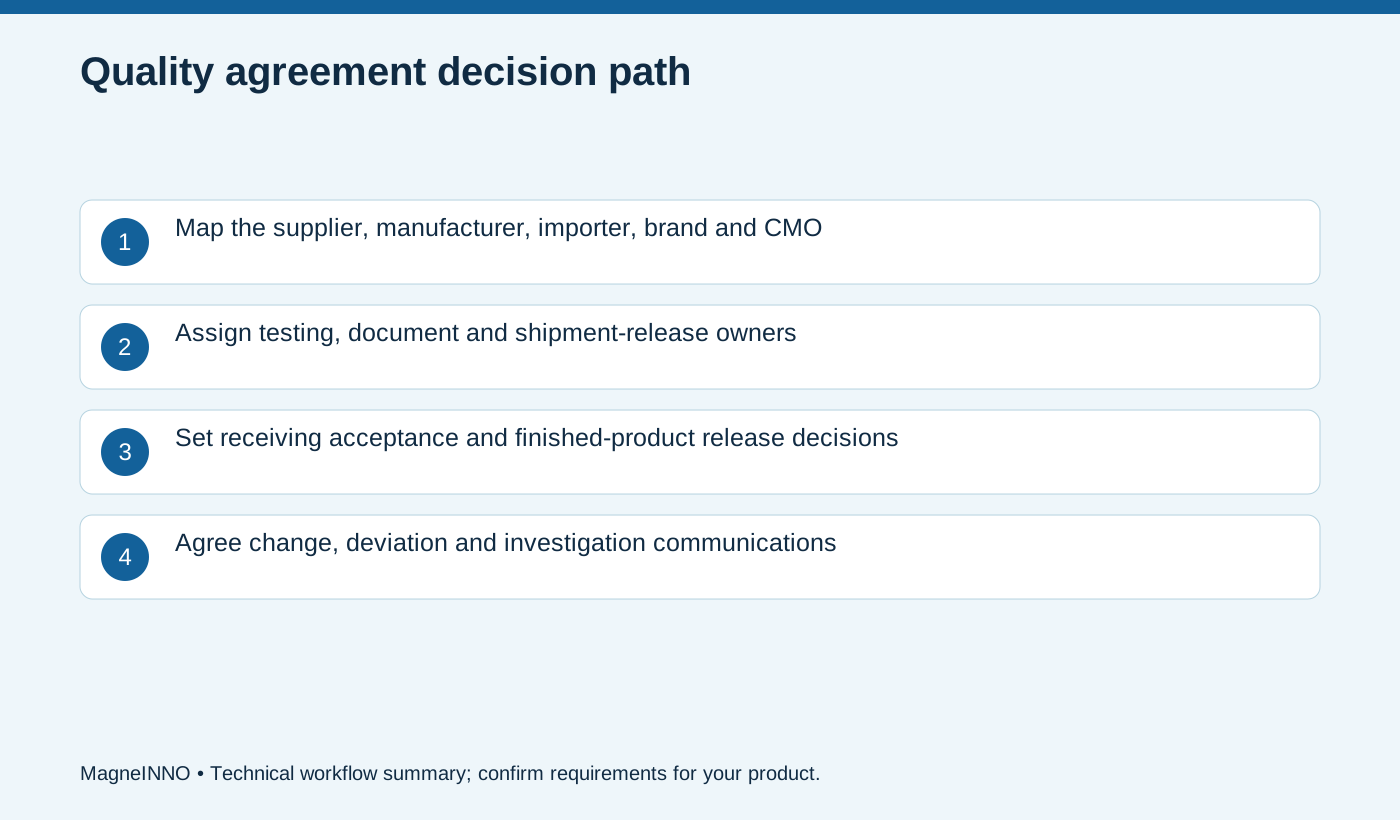
- Map the actual supplier, manufacturer, importer, brand and CMO for the product and route of supply.
- Name an owner for each testing, document, acceptance, release and investigation decision.
- Attach the current specifications and document schedule; identify methods and reporting bases.
- Agree change triggers, escalation contacts, response timelines and record-sharing expectations.
- Review the agreement when a site, process, service provider or product responsibility changes.
Before approval, check that the agreement, purchase specification and CMO instructions tell the same story. Where responsibilities are unclear, resolve the gap with the relevant quality teams before the next lot or production run. MagneINNO buyers can request a quality-document discussion to align ingredient records, receiving expectations and change communication for their supply arrangement.
FAQs
Does the supplier’s lot release mean the ingredient is accepted by the buyer?
No. Define the supplier’s shipment authorization separately from the buyer’s receiving review and disposition. The buyer’s written procedure and applicable requirements determine its acceptance decision.
Can the brand delegate finished-product release to a CMO?
A CMO can perform contracted operations and provide records, but the parties should identify who is authorized to make and document the finished-product release decision. FDA guidance describes responsibilities in contractual operations; an agreement does not remove applicable regulatory duties.
Does the same FDA rule apply to a dietary ingredient and a finished supplement?
Not necessarily. FDA distinguishes dietary ingredients from qualifying finished dietary supplements in its FSMA FAQ. Confirm the applicable requirements for each facility and activity rather than assuming the finished-product treatment also covers its raw ingredient.
Who should keep samples for an investigation?
The agreement should identify sample owners and access arrangements for the ingredient and finished product. Separately verify which sample requirements apply to each operation; FDA’s Part 111 guidance on finished dietary supplement samples should not be treated as a universal bulk-ingredient rule.
Need documentation?