Quality & Regulatory
Magnesium Glycinate Retain Samples: Building a Lot Investigation Program
Build a practical magnesium glycinate retain-sample program with risk-based quantities, controlled storage, traceable labels, review triggers and investigation records.

A magnesium glycinate retain-sample program preserves evidence after a lot has left receiving. It gives quality teams a controlled way to investigate complaints, unexpected test results, appearance changes, moisture concerns, packaging discrepancies or finished-product questions without relying only on a supplier’s retained material or an old certificate of analysis (COA). The program should be written for the specific material, packaging configuration, intended use and investigation risks. It should not simply copy finished dietary-supplement reserve-sample requirements onto a bulk dietary ingredient.
The FDA’s dietary supplement CGMP guidance distinguishes representative samples collected to determine whether specifications are met from reserve samples held for investigations. Its reserve-sample discussion applies to packaged and labeled dietary supplements distributed by the responsible operation, including requirements related to identification, container-closure systems and retention periods. It does not establish a universal quantity or retention period for every bulk raw-material supplier or ingredient buyer. Review the FDA scope and conditions here.
Start with the program boundary
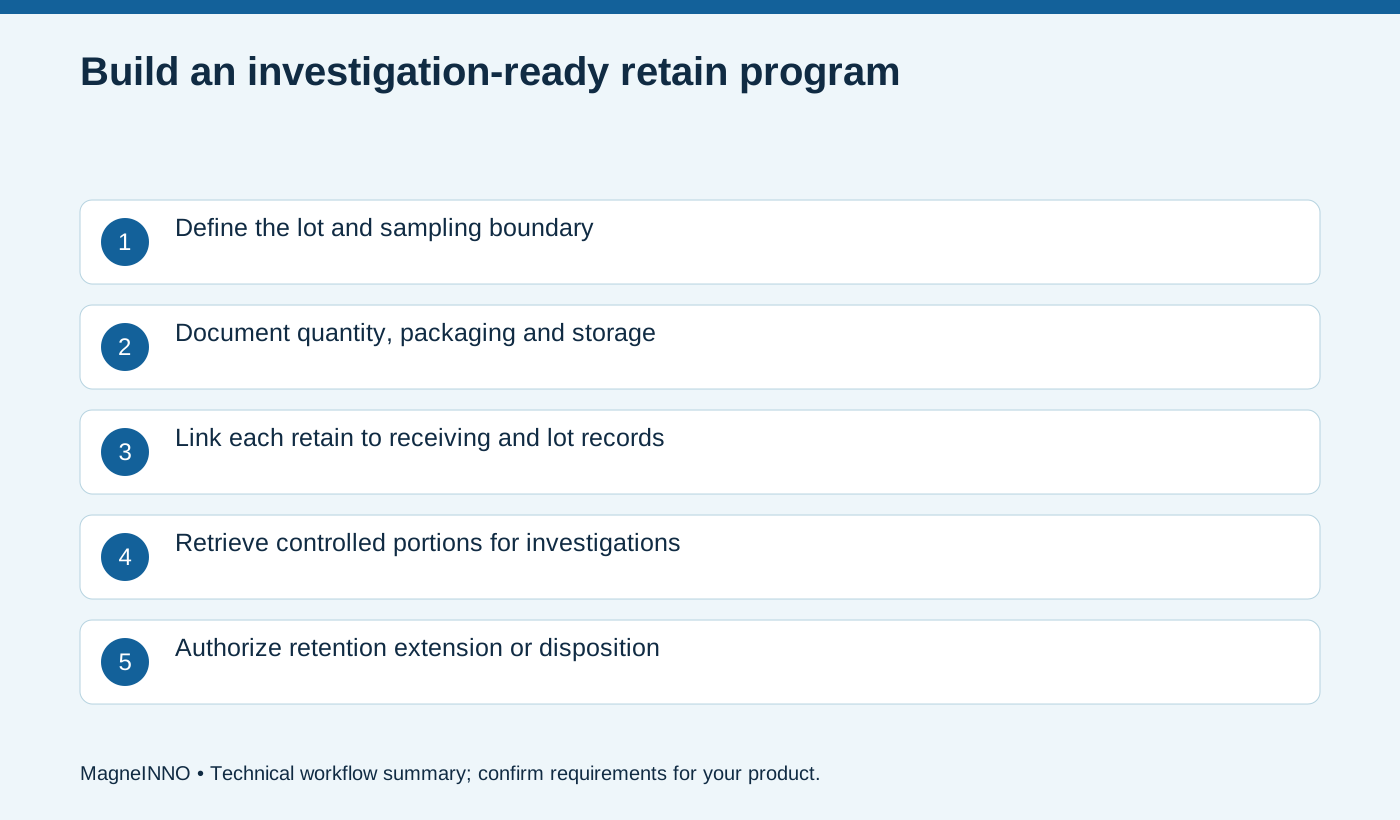
First define what the retain sample represents. For a magnesium glycinate ingredient, the unit may be a supplier lot, a unique shipment within that lot, or a receiving lot created under the buyer’s inventory system. Your procedure should state whether one retained unit represents the entire supplier lot or only the quantity received and sampled at your site. If a supplier lot arrives in multiple containers, document how the receiving sample was made representative and whether the retain is a composite, a container-specific sample or both.
This distinction matters because an investigation may concern a particular drum, bag, liner, pallet or shipment rather than the supplier lot as a whole. A single composite can support broad identity or assay review, but it may not preserve evidence of localized segregation, damaged packaging, moisture ingress or an unusual odor in one container. Use the receiving and sampling procedure to define when container-specific retains are needed; the representative-sampling discussion in MagneINNO’s quality knowledge base can be used as an internal reference point for that decision. See the representative-sampling guidance.
Set quantities by investigation need
For raw magnesium glycinate, there is no single defensible retain quantity that fits every laboratory method, packaging format or complaint scenario. Set the quantity by identifying the examinations your quality system may reasonably need: identity confirmation, elemental magnesium assay, moisture or loss-on-drying, microbial testing, selected contaminant testing, particle or flow observations, and organoleptic examination under an approved procedure. Do not taste an unqualified powder as part of routine investigation work.
A practical SOP can define a minimum quantity sufficient for the planned first examination plus a separate reserve for repeat or orthogonal testing. The quantity should account for laboratory portioning, method-specific consumption, sample preparation losses and the possibility that the first result requires confirmation. It should also specify whether the sample must be divided into sealed portions so that opening one portion does not expose the full retain to humidity or contamination.
The quantity is a company procedure decision, not a product specification and not a statement about magnesium content. Ingredient weight, elemental magnesium, purity and chelation status remain separate attributes. For example, a material described as 12% elemental magnesium is referring to the magnesium contribution by weight under the applicable specification basis; it does not mean that 12% is the ingredient’s purity, and it does not by itself prove a true chelate rather than a physical blend. Retain labels and investigation forms should preserve the supplier’s exact specification language and assay basis.
Control storage and packaging
Store the retain in a container-closure system that protects the sample from the risks you are investigating. For hygroscopic or moisture-sensitive powders, use a clean, compatible, well-closed primary container with an appropriate liner or seal, and record any secondary containment. Keep the retain away from direct sunlight, heat, water and strong odors. Your SOP should define the approved storage area, environmental monitoring expectations, access controls and what happens if the storage condition is out of limit.
Do not transfer a retain into an unrepresentative package merely for convenience. If the received ingredient was supplied in a sealed liner inside a fiber drum, the retained portion should use a closure that provides comparable protection for the smaller quantity. The FDA’s reserve-sample guidance makes a similar container-closure principle for finished dietary supplements: the retained system should provide protection comparable to the distributed system. Apply that as a design consideration for raw ingredients, while recognizing that the cited legal requirement is not automatically identical for bulk magnesium glycinate.
Record the date placed into storage, the person responsible, the storage location, the container condition and every opening or withdrawal. If the sample is split, assign each portion a child identifier linked to the original retain identifier. A tamper-evident seal can help reveal unauthorized access, but it does not replace complete access and withdrawal records.
Build an investigation-ready label
The label should allow an analyst to connect the sample to the original material without opening the container. At minimum, include:
- Ingredient name and internal material code.
- Supplier lot or batch number, receiving lot and shipment reference.
- Supplier, receiving date, sample date and sampler identification.
- Container or composite designation, sample quantity and portion number.
- Storage condition, retain status and scheduled review or discard date.
Link the identifier to the receiving record, approved specification, supplier COA, sampling worksheet, test results, nonconformance record and any disposition decision. The traceability chain should show which finished batches used the ingredient. MagneINNO’s ingredient-to-finished-product traceability resource is relevant when defining those links, but your own enterprise resource planning or quality system remains the controlling record. Use the lot-traceability guide as a supporting reference.
Define review triggers
A retain should be easy to retrieve when an investigation begins. Add explicit triggers to the quality procedure rather than leaving retrieval to individual judgment. Suitable triggers include a customer complaint that could involve the ingredient, a result outside specification, a result that conflicts with the supplier COA, an unexplained change in appearance or odor, suspected moisture uptake, damaged or compromised packaging, an unexpected finished-product assay, or a supplier change notification that may affect the material.
The first response should preserve the chain of evidence. Place affected inventory and, where appropriate, associated finished batches under documented hold; identify all related lots; gather the original sampling and testing records; and retrieve the retain without altering its condition. Compare the retain with the original description and approved specification, but do not treat a passing result from the retain as proof that every container in the received lot was uniform.
When results disagree, record the analytical method, sample preparation, reporting basis, laboratory, analyst, instrument status and calculations. Specifically reconcile whether results are reported on an as-is, dry-basis, compound-weight or elemental-magnesium basis before concluding that the material changed. FDA CGMP guidance requires methods used for required testing to be appropriate for their intended use and scientifically valid; it describes such methods in terms of accuracy, precision and specificity for the purpose. See the FDA method expectations.
Set retention and disposition rules
For a raw ingredient, establish the retention period through a documented risk assessment that considers the ingredient’s use, finished-product shelf life, complaint exposure, contractual expectations, regulatory obligations and the time needed to complete investigations. Do not automatically use the FDA finished-product reserve period as a raw-material rule. Where the ingredient is used in a dietary supplement operation, confirm the applicable responsibilities with qualified regulatory counsel and the quality unit.
The disposition step should require authorization. At the end of the approved period, quality personnel should confirm that no open complaint, deviation, recall, regulatory inquiry or supplier investigation requires continued retention. Document destruction, return or extension, including the date, quantity and approving person. If a sample is exhausted during an investigation, record the tests performed and the remaining quantity rather than simply marking the container empty.
Frequently asked questions
Is a retain sample the same as an incoming sample?
No. An incoming or representative sample supports release or acceptance decisions. A retain is preserved for later examination. One portion may serve both purposes only when your procedure clearly protects the quantity, identity and integrity needed for future investigation.
Should every bag or drum have its own retain?
Not necessarily. The answer depends on the sampling plan, lot structure, packaging risk and investigation history. A composite may be appropriate for a demonstrably representative lot, while container-specific portions may be prudent where packaging damage, segregation or moisture variation is credible.
Does the retain prove the original lot was compliant?
No. It is evidence from the retained portion under its storage history. Interpret it with the receiving sample, sampling records, laboratory data, packaging observations and traceability records. A retain cannot repair an undocumented or nonrepresentative original sampling process.
Does FSMA give ingredient buyers one universal retain rule?
No. FDA’s FSMA FAQ distinguishes dietary ingredients from finished dietary supplements and explains that dietary ingredients are subject to the applicable preventive-control and recordkeeping requirements described there. The exact obligations depend on the operation and regulatory status. Review the FDA FAQ before finalizing the scope.
A quality team can make the program operational by writing the sample definition, risk-based quantity rationale, packaging and storage controls, label fields, retrieval triggers, investigation workflow and authorized disposition steps into one controlled SOP. Align that SOP with the supplier quality agreement and the finished-product traceability process before the next magnesium glycinate lot is received.
Need documentation?