Quality & Regulatory
Magnesium Glycinate Incoming Release vs. Periodic Verification Testing: How to Build a Risk-Based Plan
Not every test belongs on every lot. This guide helps quality teams split magnesium glycinate testing into every-lot release checks, periodic verification of the supplier COA, and investigation-driven testing, and shows what should trigger quarantine or extra work.

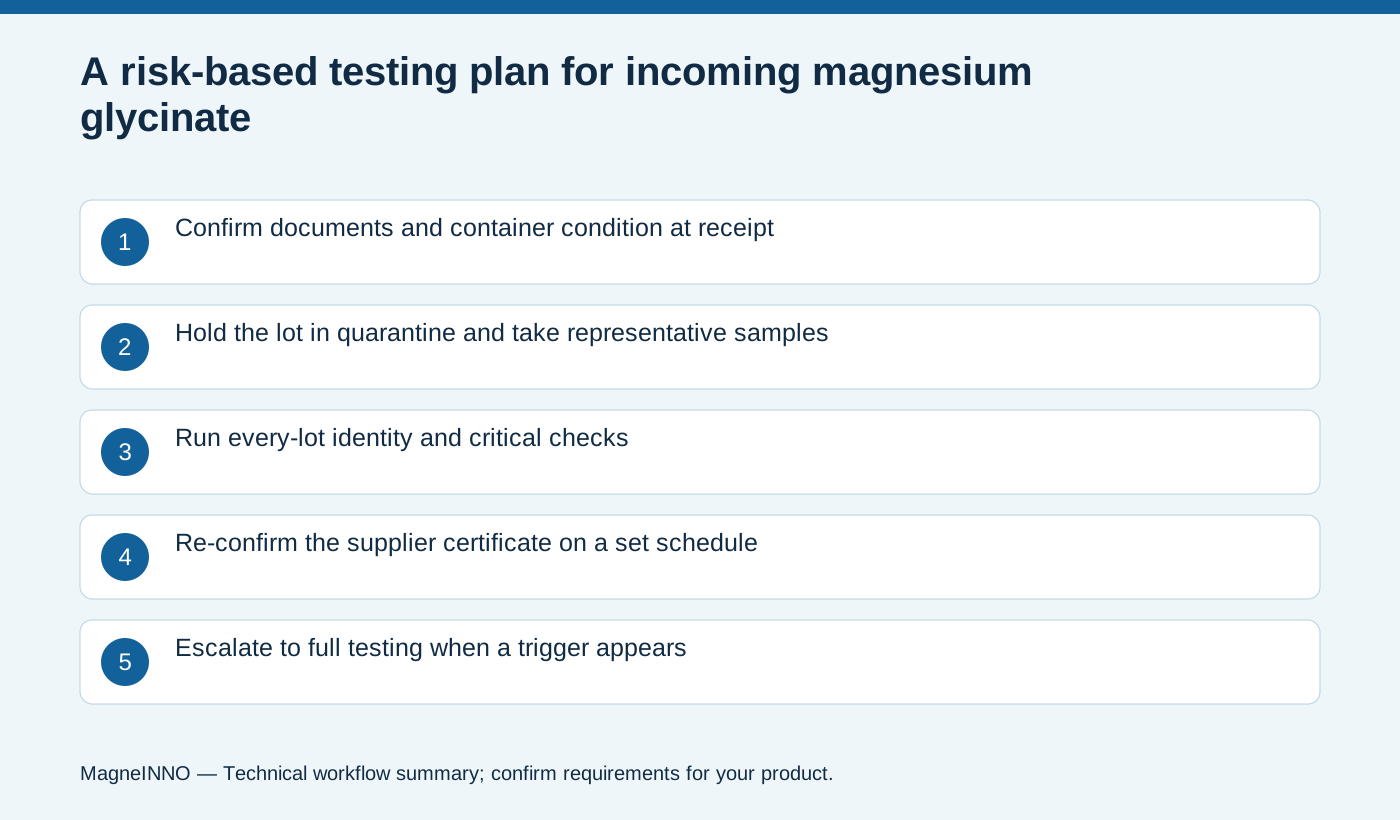
Quality teams often inherit an incoming testing plan that grew by accident: a full panel on the first lot, nothing on the next twenty, and a scramble when a customer asks why. A better plan separates three kinds of work: tests you run on every lot before release, tests you run periodically to keep trusting the supplier's certificate of analysis, and tests you run only when something looks wrong. This article shows how to build that split for magnesium glycinate.
Why one fixed test panel does not work
A single panel applied to every lot is either too heavy, which slows release and burns lab budget, or too light, which leaves the supplier COA unverified for long periods. The dietary supplement CGMP rule does not prescribe a panel. It requires that your component specifications cover identity and the properties needed for finished-product purity, strength and composition, and it sets rules for how you show those specifications are met. Within those rules you have room to design a risk-based plan.
Remember that Part 111 obligations sit with the firm that manufactures, packages, labels or holds the dietary supplement. If a contract manufacturer receives the ingredient for you, the plan below belongs in its procedures and your quality agreement, as described in our article on supplier quality agreements.
Layer one: every-lot release checks
Some checks are not optional and should happen on each lot.
- Receipt checks. The rule requires a visual examination of containers for label content, damage and broken seals, and of the invoice, guarantee or certification against the purchase order. Received components must then be held in quarantine until representative samples are collected and quality control approves release.
- Identity. For a component that is a dietary ingredient, magnesium glycinate included, you must conduct at least one appropriate identity test or examination before use unless FDA has granted an exemption. A supplier COA does not replace this step.
- COA review. Check that the COA matches the lot number on the drums, reports methods, limits and actual results, and that every value meets your specification. Our COA review workflow walks through the review line by line.
- Critical attributes for your dosage form. If your capsule line is sensitive to bulk density or your beverage depends on clarity, a quick in-house check on each lot is cheap insurance.
Layer two: periodic verification of the supplier COA
For specifications other than dietary ingredient identity, the rule allows you to rely on the supplier's COA instead of testing every lot yourself, but only after you qualify the supplier by confirming its results, document how you did it, and periodically re-confirm the COA. Quality control must approve the basis for qualification and re-qualification.
A practical periodic program defines:
- What is re-confirmed. Typically elemental magnesium assay, water or loss on drying, elemental contaminants and microbiology.
- How often. A fixed frequency, such as one lot per quarter or every set number of lots, adjusted for supplier history and risk.
- Which lab and method. Your own lab or an independent lab using methods you have verified for magnesium glycinate. FDA's small-entity guidance notes the rule requires a scientifically valid method and recommends a validated method whenever one is available.
- How agreement is judged. Define acceptable differences between your result and the COA value in advance. A result inside the specification but far from the COA value is a signal, not a pass.
Trend these results. A slow drift in assay or water content across several verifications is often the first sign of a process change at the supplier.
Layer three: triggered and investigation-driven testing
Some events should move a lot, or a supplier, back to full testing:
- Damaged packaging, broken seals, or evidence of moisture exposure in transit.
- A COA that is incomplete, inconsistent with the drum labels, or reports a new method.
- A supplier change notice covering process, site, raw materials or specification.
- An out-of-trend periodic verification result.
- A processing problem at the user, such as unusual flow, caking, color or odor.
- A finished-product complaint that could point to the ingredient.
When a triggered test disagrees with the supplier, follow a structured investigation instead of re-testing until you get a pass. Our guide on investigating incoming result discrepancies sets out the steps.
Matching tests to magnesium glycinate risks
Different attributes carry different risks.
- Identity and chelation: a physical blend of magnesium salts and glycine can mimic assay values. Identity methods should be chosen to distinguish a chelate.
- Elemental magnesium assay and reporting basis: affects label claims and overage. Confirm whether the result is as-is or dry basis.
- Water content: affects assay, flow and stability. Use the lot COA value for each lot rather than a fixed assumption.
- Elemental contaminants: typically part of periodic verification, with every-lot review of the COA values.
- Microbiology: periodic verification, plus triggered testing after packaging damage.
- Particle size and bulk density: often every lot for capsules, tablets and stick packs, because small shifts change fill weight.
Sampling matters as much as testing
A test only describes the lot if the sample represents it. Define how many containers are sampled, from which positions, and how composite and individual samples are used. Our note on designing a representative sampling plan explains the trade-offs.
How MagneINNO supports incoming testing
MagneINNO, the ingredient brand of NutraINNO USA Inc., a U.S. company, issues a lot-specific COA with test methods, limits and actual results for every shipment. Our published quality metrics are a purity of 99.8% and, separately, a release pass rate of 99.8%. We can share the specification sheet and method references your lab needs to set up verification, and a free 50 g sample for method set-up. Material ships in 25 kg fiber drums, carries a 24-month shelf life, and has GRAS status. Water content is reported on each lot COA.
FAQ
Can we skip identity testing if the supplier is qualified?
Not for a dietary ingredient under the rule as written, unless FDA has granted a petition for an exemption. Qualification allows COA reliance for other specifications.
How often should we re-confirm the COA?
The rule says periodically and leaves the frequency to you. Base it on supplier history, lot volume and the risk of each attribute, and document the rationale.
Should a CMO run the plan or the brand?
Whoever receives and uses the ingredient under Part 111 must run it. Brands should verify through the quality agreement that the plan exists and is followed.
To set up a testing plan for a new lot, contact our technical team for specification sheets, method references or a sample.
Need documentation?