Quality & Regulatory
Food Grade, USP or Pharmaceutical Grade Magnesium Glycinate? What Procurement Teams Should Confirm Before Buying Raw Material
Food grade, USP or pharmaceutical grade magnesium glycinate? What each claim can mean, which documents to request, and how to qualify the raw material.
Do not approve magnesium glycinate raw material based on the words food grade, USP grade or pharmaceutical grade alone. Each phrase is a starting point for qualification, not the end of it. The relevant question is whether the material has the identity, composition, contaminant limits, microbial limits, test methods, documentation and intended-use fit your quality system requires.
A useful starting framework is Food, supplement or pharmaceutical grade: qualifying a magnesium ingredient for its intended use. The same discipline applies whether the raw material is intended for a supplement, functional beverage, food application or a product subject to pharmaceutical quality requirements.
What Grade Wording on Magnesium Glycinate Can Tell You
In supplier quotes, food grade often describes an intended-use category or a commercial positioning. A food-grade label is not the same as a documented purity specification, and neither one confirms that the exact ingredient is permitted for your product at your use level. It should not be treated as a complete quality standard unless the supplier identifies the applicable jurisdiction, specification and acceptance criteria. A food-grade statement may be relevant to a formulation, but it does not by itself answer questions about elemental magnesium, chelation, heavy metals, microbial quality, allergens, storage or lot release.
A claim of USP magnesium glycinate needs more precision. Buyers should confirm with the supplier, and against the current official compendium, whether a monograph exists for the exact substance rather than assuming that one does or does not. This article does not assume either answer. A reference to a USP test method is also not the same as a substance monograph or a full conformity claim. The exact chemical form matters: a supplier's description of magnesium glycinate, magnesium bisglycinate, buffered material or a blend may not be interchangeable for a compendial assessment.
Pharmaceutical grade is not a complete approval decision either. The phrase is used loosely in commercial discussions, and on its own it does not establish that the raw material is an active pharmaceutical ingredient, an excipient, suitable for a particular drug application or compliant with a buyer's pharmaceutical quality system. Ask the supplier to define the claim in writing and connect it to a specification, intended use and supporting documentation.
Wording | What it may indicate | What procurement should confirm |
|---|---|---|
Food grade | A stated food-use positioning or supplier category. | Applicable specification, jurisdiction, contaminant limits, microbial limits and intended use. |
USP grade | A possible claim of conformity with a specific compendial requirement. | Exact substance, official monograph status, edition or reference, methods, limits and supplier declaration. |
Pharmaceutical grade | A broad quality or intended-use description. | Whether the claim relates to an API, excipient or another use, plus the quality system and regulatory evidence required. |
Why a USP Claim Needs a Specific Reference
A monograph claim and a supplier specification are different things. A supplier may set limits for assay, identity, moisture, elemental contaminants and microbiology in a customer or internal specification without claiming that the material meets a USP monograph. Conversely, a COA that lists test results does not prove a USP claim unless the supplier identifies the relevant compendial reference and explains how the material was evaluated.
For a USP-related review, ask for the exact substance name used in the claim, the current official reference, the applicable tests and limits, and whether each reported method is the official compendial procedure or an alternative method. If it is an alternative, ask for the validation or comparability evidence behind it, and remember that using selected USP methods does not mean the material conforms to a USP monograph. A generic statement such as "USP tested" says little until you know what was tested and against which requirements. When methods differ between supplier and buyer laboratories, request evidence that the method is suitable for its intended use. The principles of validation, verification and transfer are outlined in Validation, verification and transfer: qualifying a magnesium test method.
Separate Grade, Purity, Elemental Magnesium and Chelation
Grade describes a qualification context; it does not replace the material specification. Purity is meaningful only when the supplier defines what the reported value represents, which method was used, and whether the result is reported as-is or on another basis. Elemental magnesium is the amount of magnesium contributed by the ingredient, while ingredient weight is the total mass of the magnesium glycinate raw material. These are not interchangeable values.
Chelation is a composition or structural question, not a grade designation. A claim that a material is glycinate or bisglycinate should come with identity and composition data that the supplier can explain, and your QA team should decide which evidence it needs. Buyers should also ask whether the product is buffered, unbuffered or a physical blend, and which components are declared, because the formulation calculation depends on those components, the elemental magnesium assay and its reporting basis rather than the label alone. For background, see Compare chelated mineral ingredients by metal, ligand and evidence.
Documents to Request Before Approval
The procurement package should make the grade claim auditable. Ask for the following documents and require the supplier to identify which document supports each claim:
- A current product specification stating the material name, chemical form, appearance, composition, elemental magnesium basis, storage conditions and shelf-life expectations.
- A lot-specific COA showing the lot identifier, lot disposition, and for each attribute the result, acceptance limit and method reference, with units and reporting basis wherever the result is numeric. A result without its method and limit is difficult to evaluate.
- A heavy-metal or elemental-contaminant specification that identifies individual analytes, limits, reporting basis and analytical method. Avoid relying on a single combined statement when your risk assessment requires individual limits.
- A microbial specification that distinguishes enumeration results from absence or presence tests and defines the relevant acceptance criteria.
- Allergen, regulatory, dietary, GMO and other status statements required by your finished-product markets. Ask the supplier to identify whether each statement applies to the raw material, its processing environment or a finished product.
- A written change-control commitment covering changes to specification, test method, packaging, material description, manufacturing process or quality status.
Use a receiving workflow such as A receiving-team workflow for reviewing a magnesium glycinate COA to turn the document review into a repeatable release decision. For additional risk control, compare the requested heavy-metal and microbial sections with Write a useful elemental-contaminant specification for a mineral ingredient and Read microbial results without confusing counts, absence tests and shelf life.
Raw Material Grade Is Not Finished-Product Approval
A raw ingredient's grade wording does not transfer automatically to the finished product. Finished products have their own formulation, manufacturing, labeling, testing, release and regulatory requirements. The same raw material can fit one dosage form or market and not another, for example because of elemental load, taste, solubility, particle size, contaminant limits or documentation requirements.
The same distinction applies to pharmaceutical terminology. A supplier's description of a raw material as pharmaceutical grade does not make a supplement, beverage or other finished formulation a pharmaceutical product. Procurement, formulation and QA should agree on the intended use before the supplier's grade statement is written into an internal specification.
A Practical Qualification Workflow
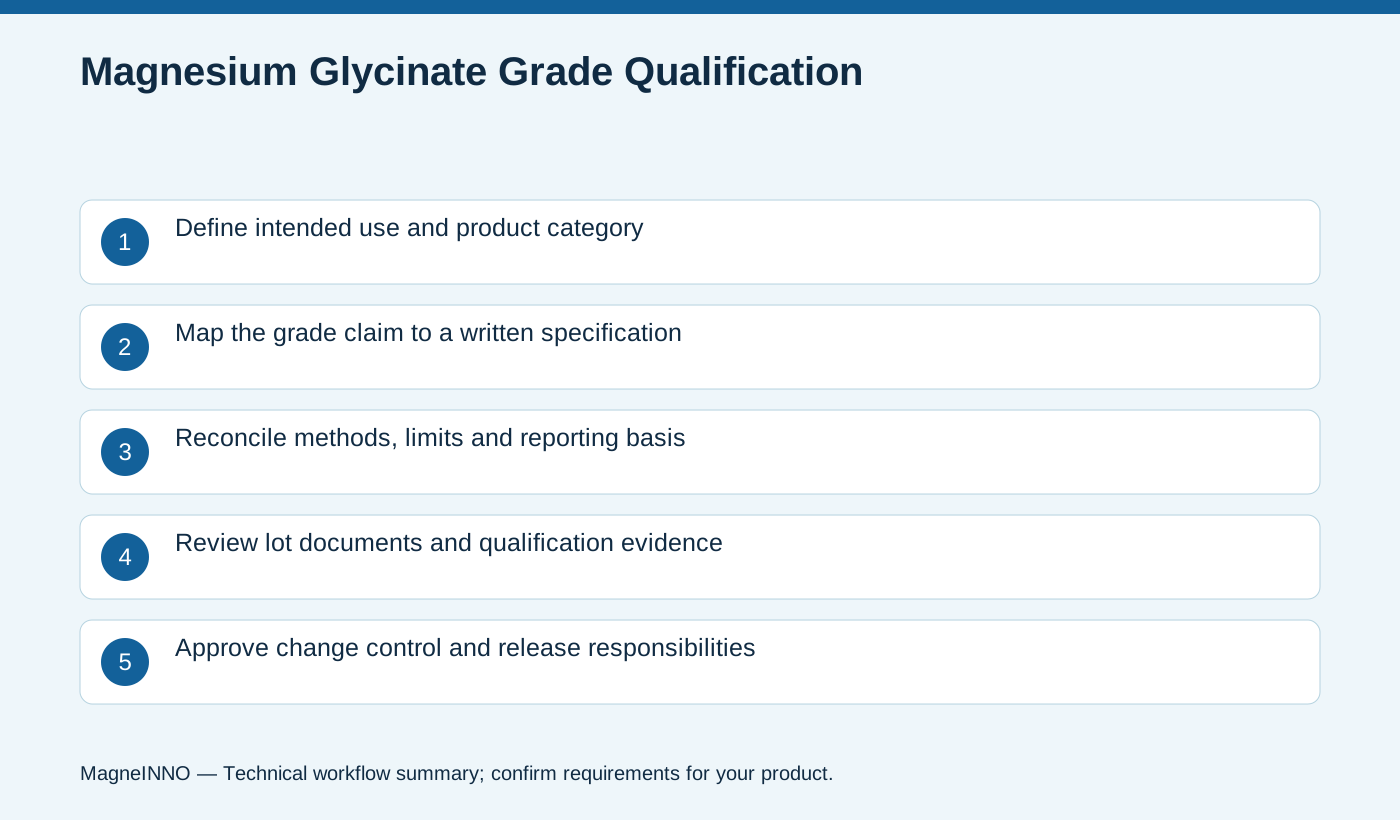
Run the qualification in order. Define the intended use, market and dosage form before any supplier grade language is compared. Then write down the required identity, composition, elemental magnesium, contaminant, microbial, allergen, packaging and storage criteria, and ask each supplier to map its grade claim to a specific specification and supporting documents. Agree the assay basis, method applicability and comparison criteria with the supplier before testing, then use a representative sample and its lot documentation to check that agreed approach in your laboratory. Approve the raw material only after formulation trials, QA review and change-control responsibilities are documented.
A technical RFQ works best when it asks for comparable answers instead of broad descriptions. The technical RFQ brief for magnesium ingredients can help procurement teams specify the evidence required before commercial comparison. Once a material is qualified, use a written supplier change-control process such as Write a supplier change-control brief for a qualified magnesium ingredient to preserve the approved basis. If you are comparing several bulk magnesium glycinate suppliers on these documents, the weighted supplier scorecard for procurement teams shows one way to score them side by side.
Frequently Asked Questions
Is food grade lower quality than USP grade?
The wording alone does not establish a quality ranking. Compare the two materials against the same intended-use requirements, methods, limits and documentation. A food-grade description can be adequate for one application, while a USP-related claim may be irrelevant if it does not address the buyer's actual formulation and release risks.
Does USP grade mean the supplier has a USP certificate?
Not necessarily. Ask what the supplier means by USP grade, whether an official monograph exists for the exact substance, which tests and limits apply, and whether the supplier is making a formal conformity claim or only referring to selected methods.
Can a purity result prove elemental magnesium content?
Not on its own. An undefined purity percentage does not establish a lot's elemental magnesium content. A compound assay can support a calculated magnesium value only when the compound, its composition and its hydration state are defined, and purity and elemental magnesium may still use different methods or reporting bases. Request both the definition of purity and the elemental magnesium result, then confirm whether each is reported as-is, dry basis or another agreed basis.
What should a buyer do when supplier and internal results disagree?
Place the lot on the appropriate quality hold, compare sampling plans, methods, standards, calculation basis and laboratory conditions, and document the investigation before accepting or rejecting the material. Do not resolve the disagreement by changing the specification after the result is known.
What should we request before evaluating MagneINNO raw material?
A B2B procurement team can request a sample, current COA, specification sheet and quote, then have formulation and QA review the material against the intended-use specification. Pack sizes and quote terms are covered in our guide to pack sizes, trial orders and quote terms.
Request a sample, COA/spec sheet or quote through Contact MagneINNO.
Need documentation?