Supply Chain
Technical Transfer for Magnesium Glycinate: What Must Stay Fixed from Pilot to CMO Scale-Up
A practical transfer package helps brands and CMOs compare pilot and commercial magnesium glycinate runs, document scale-up changes and make a supported QA decision.

A magnesium glycinate technical transfer is the documented handoff of an approved formulation and process from pilot work to a contract manufacturer’s commercial operation. The buyer’s decision is whether the receiving site has executed an agreed process and produced evidence that the commercial product meets its applicable requirements. The decision should rest on records and results, not on an assumption that a larger batch will behave like the pilot.
What must stay fixed from pilot to CMO scale-up? The approved product definition, critical process instructions, specifications, test methods and decision criteria must remain controlled. Equipment or operating details may need adjustment for the receiving site, but each proposed departure should be documented, assessed and approved through the agreed process. This is a practical, risk-based transfer approach, not a universal validation protocol or a fixed run-count rule.
Lock the pilot baseline
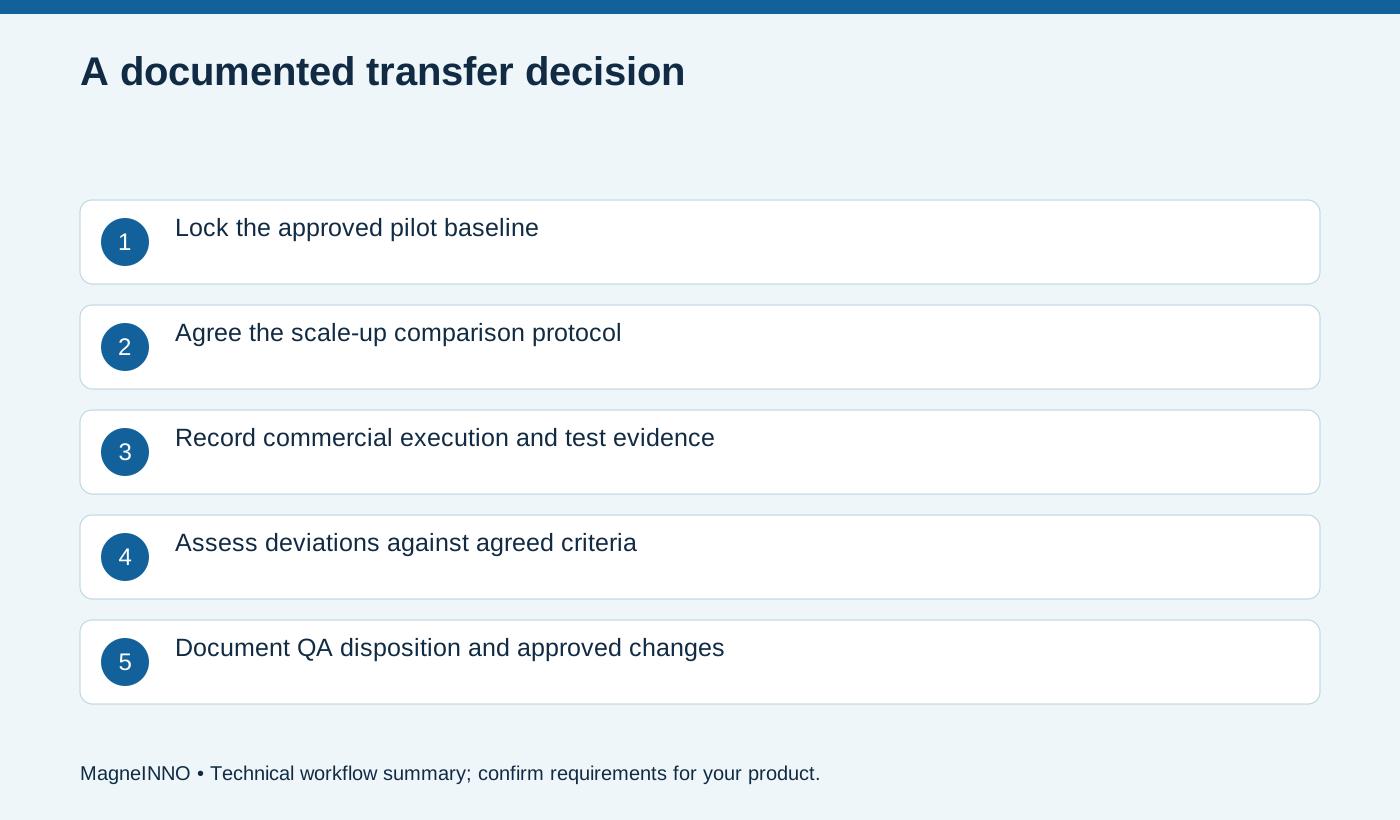
Start with the controlled pilot formula and batch record, including revision identifiers. Capture the intended component identities and quantities, process sequence, equipment, operating instructions, sampling points, in-process checks and finished-product specifications. Include pilot observations that help explain why particular steps or settings were selected, and label unresolved assumptions as such rather than presenting them as approved instructions.
For magnesium glycinate, distinguish the ingredient input from its elemental-magnesium content. Ingredient weight, elemental assay, purity and evidence of chelation describe different attributes; they are not interchangeable measures. Record the assay basis and the specification used for the ingredient, then keep those component records separate from finished-product results. For general component requirements, see the magnesium glycinate specification guide and the explanation of elemental magnesium versus ingredient weight.
The format determines which product attributes matter. A capsule project might include blend handling, dosage-unit consistency and finished-product specifications; a beverage powder might require checks selected for dispersion or other relevant performance needs. These are examples for protocol design, not universal criteria. Define what matters for the actual product before execution.
For dietary supplements, FDA’s CGMP guide describes a written master manufacturing record for each unique formulation and batch size, including controls and procedures intended to ensure applicable specifications are met. The record is a regulatory baseline; it does not, by itself, provide a complete pilot-to-CMO transfer protocol. The transfer package should make the approved instructions usable at the receiving site and identify the evidence the project will review. See the FDA dietary supplement CGMP guide.
Agree on the transfer protocol
Before scheduling the commercial run, have the brand, CMO production team, quality team and relevant laboratory personnel agree on the protocol and who has authority to approve changes and the final disposition. As a practical project document, it should identify the pilot reference, commercial process version, comparison points, acceptance criteria, test methods, sampling responsibilities, deviation handling and the records needed for QA review. These planning details are procurement and quality recommendations, not a list of documents specifically mandated by FDA for every transfer.
Separate process elements that must remain fixed from those that may be adjusted with prior review. For example, a different mixer, vessel geometry, transfer path or batch-charging sequence could affect how instructions are carried out. For each proposed departure, record the change, its rationale, potential impact, any compensating controls, the evidence needed to assess it and its approval status. Do not treat an unapproved adjustment as acceptable solely because a finished test result appears within specification.
- Identify the approved pilot formula and process revision, including component identities and the reference batch record.
- List the process steps, in-process controls and finished-product attributes that the team will compare, with justified acceptance criteria.
- Specify sampling locations, sample identification, test methods, reporting basis and responsibility for review.
- Define how deviations, inconclusive results, out-of-criteria results and proposed changes will be assessed and documented.
- Set the required QA decision and identify who can approve routine production or request further investigation.
Set criteria from the product’s established specifications and process risks instead of borrowing a threshold from an unrelated formula or dosage form. FDA’s guide discusses component, in-process and finished-batch specifications. It also says laboratory methods must be appropriate for their intended use and scientifically valid for the relevant specification; its discussion of methods is not a universal commercial process-transfer protocol. The project team can use the supplied method validation, verification and transfer resource to organize method-related questions.
Capture comparable evidence
During the commercial run, preserve the completed batch record and capture actual process settings, sequence, in-process observations, sampling details, interventions and deviations. Compare execution with the approved baseline and protocol, not only with a brief batch summary. If the commercial results differ from the pilot, the record should help the team determine whether a material, equipment, process, sampling or analytical difference may be relevant.
Review incoming ingredient records alongside the batch record, but do not treat a matching magnesium glycinate certificate of analysis as proof of finished-product comparability. It provides evidence about the tested ingredient lot against its component requirements; finished-product testing and process records address different questions. As a practical procurement recommendation, teams may agree in advance which incoming-lot documents and reference samples they need for this assessment. Do not confuse a voluntary raw-ingredient retain sample arrangement with FDA reserve-sample requirements for packaged and labeled dietary supplements. For a record trail from ingredient lot to finished-product results, see magnesium lot traceability.
If pilot and CMO results come from different laboratories or methods, document how the comparison will be interpreted. Confirm that the methods are appropriate for their intended use and clarify differences in sample preparation, reporting basis or other relevant method conditions before making a decision. FDA’s guide addresses laboratory method suitability; it does not establish one universal comparability approach for every magnesium glycinate project.
Make the decision traceable
Close the transfer with a written assessment that identifies the protocol and records reviewed, summarizes results and deviations, resolves or lists open questions, and states the QA decision against the pre-agreed criteria. The decision could support routine execution, require further investigation or identify additional work before the process is considered suitable for the intended operation. Record approved revisions in the applicable controlled manufacturing documents and retain the change rationale and authorization.
For supplement operations, FDA explains that contractors must comply with requirements directly applicable to the operations they perform. It also describes a distributing firm’s need to understand relevant manufacturing activities so it can make conformity and release decisions. Define responsibilities between the brand and CMO in the project documents rather than assuming a batch record alone answers every brand question. See the FDA CGMP guide.
Regulatory review should match the operation. FDA’s FSMA FAQ distinguishes dietary-ingredient operations from qualifying finished dietary supplements when describing the scope of the preventive-controls exemption: the exemption described is conditional for certain finished supplements and does not apply to manufacturing, processing, packing or holding dietary ingredients. Do not assume that an ingredient supplier and a finished-supplement CMO have identical regulatory treatment. See the FDA FSMA FAQ on dietary supplements.
FAQs
How many commercial runs should the transfer include?
The supplied FDA guide excerpt does not establish a universal commercial transfer run count. Agree the project scope with the CMO based on product and process risks, the pilot evidence, the scale-up changes and the criteria needed for a decision. Document the rationale for the planned evidence rather than choosing a number without a project-specific basis.
Does a matching ingredient certificate of analysis prove the scale-up succeeded?
No. It can support assessment of an ingredient lot against its component requirements, but it does not show how the commercial process was executed or establish that the finished product meets its own specifications. Review ingredient evidence, process records, in-process checks and finished-product results for their distinct purposes.
Does the FDA guide require a validated manufacturing process for this transfer?
The cited guide discusses appropriate and scientifically valid laboratory methods, including a recommendation to use a validated method when one is available. Do not extend that statement into a claim that it sets a universal process-validation protocol for magnesium glycinate scale-up. Agree on the process evidence and documentation with the applicable quality and regulatory teams.
What should the brand review before approving routine production?
As a practical project request, review the approved protocol, completed batch records, sampling and test results, deviation assessments, change approvals and written QA conclusion. Confirm that the evidence addresses the agreed criteria, that component and finished-product records are evaluated separately, and that material differences in assay basis or test method have been resolved.
Before the commercial run, ask the CMO and brand quality teams to align on the pilot baseline, evidence package and change-approval path. A magnesium glycinate supplier can also provide relevant ingredient documentation or discuss a sample for the project’s agreed evaluation; the transfer decision remains with the brand and CMO quality teams.
Need documentation?