Supply Chain
Magnesium Glycinate Supply Agreements: Volume Commitments, Price Review and Allocation Terms for Supplement Brands
How to structure a magnesium glycinate supply agreement: annual volume commitments, call-off orders, price review, shortage allocation and quality terms.

A magnesium glycinate supply agreement should do more than record a unit price and an annual quantity. It should explain how forecasts become orders, when prices can be reviewed, what happens if supply is constrained, and which obligations belong in the commercial agreement versus the supplier quality agreement. These points are easier to settle before the first call-off order than during a shortage or a price change.
Lead times belong in the same discussion. For MagneINNO, the planning references are stock held in California, about 3 days to ship in-stock orders and about 1–2 weeks for production orders, packed in 25 kg fiber drums. A long-term magnesium glycinate supply agreement should say which of those lanes applies to each call-off and how the confirmed ship date is communicated. The guide to bulk magnesium glycinate lead times and reorder planning shows how to turn those inputs into a reorder point.
The terms below are a buyer’s planning framework, not legal advice or a proposed contract. Actual obligations depend on the parties, applicable law and the complete agreement. Have qualified legal counsel review the final contract, including how it interacts with purchase orders, specifications and quality documents.
Start with the volume commitment model
An annual volume commitment can support continuity and planning, but the document should state exactly what the commitment means. Is it a minimum quantity the buyer must purchase, a forecast used for planning, or a target with no purchase obligation? Does it apply to a calendar year, contract year or another period? Clarify how shortfalls, excess demand and unused committed quantities are handled rather than relying on the phrase “annual volume” alone.
Separate the annual planning figure from release orders. A call-off arrangement lets a buyer schedule shipments or releases against an agreed quantity over time. Set out the permitted order sizes, release frequency, notice period, delivery window and order acceptance process. Define when a call-off becomes binding, and whether it may be changed or cancelled after acceptance. Specify how long the agreed price applies to each accepted order.
Forecasts should have defined purposes. For example, distinguish a nonbinding planning forecast from a shorter firm period used to reserve capacity or materials. State how often forecasts are updated, which format is accepted, and how the parties address a material change in projected demand. A forecast should not silently become a purchase commitment. Keep two obligations apart. An annual minimum, if the parties agree one, is a purchase obligation over the contract period and can bind even before any single order is placed. A shipment obligation arises for each call-off, and the contract should say when a call-off becomes binding on both sides.
A simple illustration: a brand plans 36,000 kg of bulk magnesium glycinate over a contract year, shares a rolling three-month forecast each month, and treats only the next 30 days of call-offs as firm. In 25 kg drums, the annual planning figure is 1,440 drums, or about 120 drums a month on average. These numbers are an example for structuring the clauses, not MagneINNO order quantities or commercial terms. The agreement would then state whether the 36,000 kg is a binding annual minimum or a planning figure, whether quantities become binding automatically when they enter the 30-day window or only when the supplier accepts the call-off, and whether firm call-offs count toward any annual minimum. It should also say how a quarter that runs 20% below forecast is handled.
Price review terms in a long-term supply contract
A long-term contract can use a fixed price for a stated period, scheduled reviews, or a defined adjustment mechanism. Whichever model the parties choose, specify the review interval, the evidence each party may request, the notice period and the date any approved revision takes effect. Avoid open-ended language that allows an unspecified price change at any time, or wording that leaves the buyer unable to plan around a proposed adjustment.
If the parties use a reference index or cost-based formula, name the reference, explain how it is applied, and define what happens if it is discontinued or materially revised. Identify any adjustment limits or thresholds only if the parties have negotiated them. A review mechanism can also state that a change requires written agreement, rather than assuming that a review automatically changes the price. Do not leave the baseline period, calculation method or supporting records undefined. Also say what happens if a review ends without agreement. Common options are that the existing price continues, the question moves to a named escalation step, or future supply under the agreement ends after a stated notice period. Orders already accepted should keep the price and terms agreed when they were accepted.
Price is only one part of total procurement cost. Compare quotations on the same basis, including the ingredient specification and grade, packaging, order quantity, delivery terms, documentation and any agreed service requirements. These are items to clarify in the RFQ and agreement, not assumptions about a supplier’s price structure.
Define allocation before a shortage
Allocation language matters most when requested quantities exceed available supply. The agreement should explain how the supplier will notify the buyer of a constraint, what information the notice will include, and how allocation decisions will be made. Buyers can request objective criteria, such as reference to accepted orders, a stated allocation method or another mutually agreed basis. The contract should clarify whether allocation applies across products, customers or time periods without assuming that any particular priority rule is standard.
The agreement should also state the buyer’s options when an allocated quantity is below an accepted order: partial delivery, revised dates, cancellation of the affected quantity, or another remedy agreed by both parties. Set out who communicates changes to the forecast and production plan, and how any revised schedule is confirmed. Avoid treating a forecast as guaranteed supply or a general allocation clause as a specific continuity commitment. The clause should also say whether allocation reduces the supplier's delivery obligation or only sets out how a shortage is handled. If the supplier delivers less than ordered, state whether the missing quantity counts against the buyer's annual commitment. Events outside either party's control, often called force majeure, are usually covered in a separate clause, so check that the two clauses fit together.
For continuity planning, procurement should map the agreement against internal demand scenarios, reorder timing and qualification needs. If a substitute or alternate source is contemplated, quality and formulation teams should assess comparability and change-control requirements before it is used. A commercial clause that permits substitution does not, by itself, establish technical approval.
Keep commercial and quality responsibilities distinct
The commercial supply agreement typically addresses purchasing mechanics: commitments, forecasts, accepted orders, pricing, delivery, invoicing, allocation, termination and dispute handling. The supplier quality agreement should define quality-system responsibilities, approved specifications, documentation, lot disposition, deviations, investigations, complaints, records and change notifications. The documents should be consistent, but duplicating requirements in several places can create conflicts if one document changes and the others do not.
Agree which document controls if terms conflict, how amendments are approved, and whether an attachment or purchase order can change a quality obligation. Make responsibilities explicit. The supplier releases a lot for shipment, and the buyer's QA team decides whether to accept it on receipt. Those are separate decisions. State who sends the lot-specific COA, when it must arrive relative to the shipment, what the buyer tests or verifies on receipt, how a discrepancy is escalated, and what happens while an investigation is open. Assigning a task in a quality agreement does not transfer either party's legal duties under applicable regulations.
Shelf life needs its own terms. MagneINNO magnesium glycinate has a 24-month shelf life, but that is the total life of a lot, not the life left when it ships. The agreement should set a minimum remaining shelf life at shipment, the storage conditions each party maintains, and who carries the risk when reserved stock ages before the buyer calls it off.
Change notification also needs a clear route between the documents. Identify which changes require advance notice, including specification, composition, process, manufacturing site, test method, packaging and documentation changes. Agree a notice lead time, the supporting data that comes with each notice, who evaluates the change, and whether written approval is needed before implementation. Say how open orders and existing inventory are handled during the transition. Include a process for urgent changes and for recording decisions. The agreement should direct teams to the applicable qualification and release procedures rather than treating notification alone as approval. See Magnesium Glycinate Supplier Specification Changes and the supplier change-control brief for practical review points.
Negotiating the agreement in a workable order
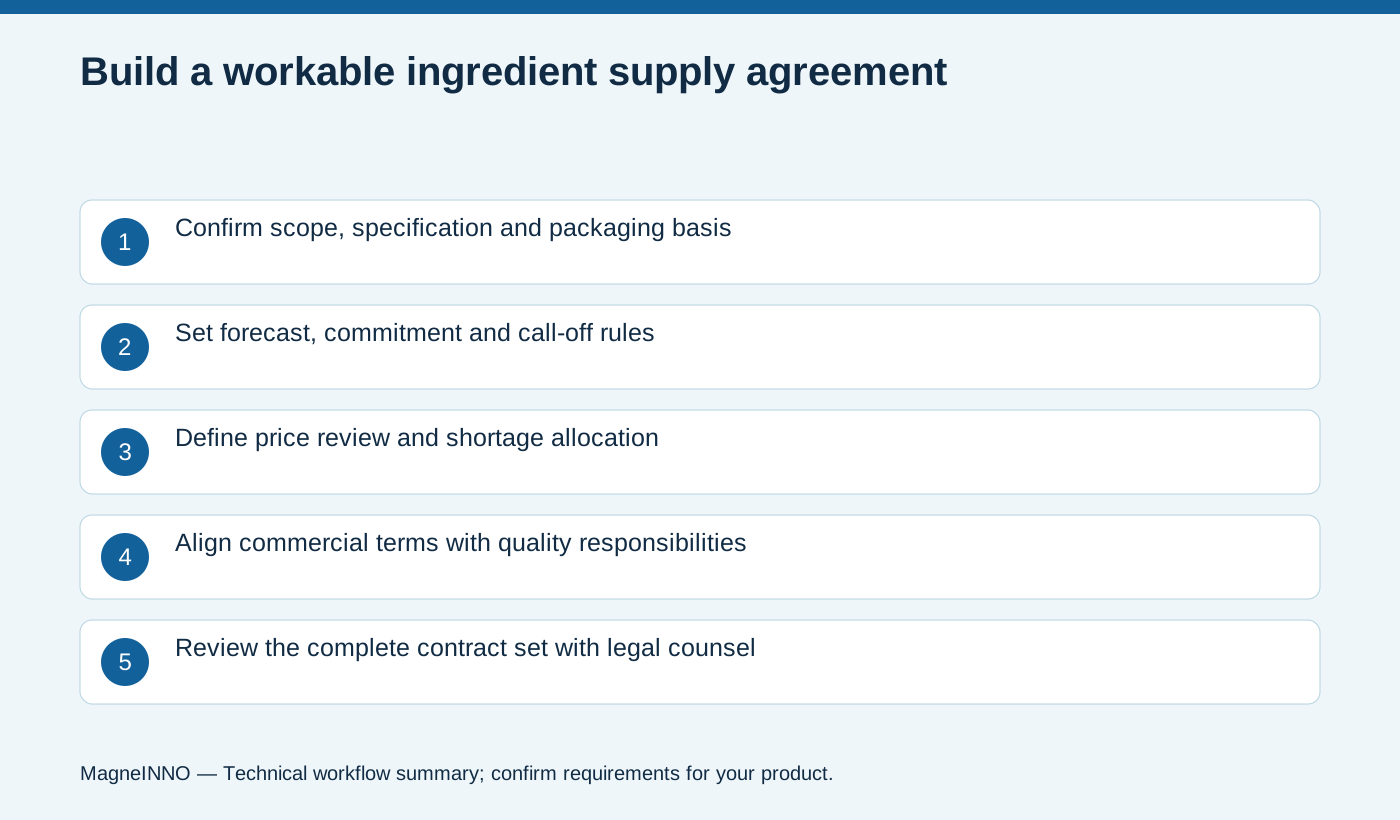
There is no single correct order, but talks usually go more smoothly when formulation and quality first confirm the approved ingredient identity, specification, intended use and packaging basis. The commercial terms then move together. Shortage communication, allocation criteria and partial-order handling affect how much an annual commitment is worth to the buyer and which price model makes sense, so discuss them alongside the volume commitment, forecast cadence, firm period and price review rather than after them. Bring legal and QA reviewers in early, so their comments shape the draft instead of arriving once the terms are settled. Keep the commercial agreement, purchase-order terms and quality agreement aligned as each section is drafted.
Before signature, circulate a responsibility matrix to procurement, finance, formulation and quality. Check that the purchase-order workflow matches the contract, that forecast fields are operationally usable, and that the quality agreement points to the current specification and change process. Record unresolved assumptions as open negotiation items rather than relying on informal emails to define core obligations.
Frequently asked questions
Does an annual volume commitment require a buyer to take delivery of the full quantity?
Not necessarily. The contract must define whether the figure is binding, a forecast or a target, and what consequences follow if actual purchases differ. Do not infer a take-or-pay obligation or a delivery schedule from an annual quantity alone.
Should the supplier quality agreement contain prices and annual volume?
Usually, commercial terms belong in the supply agreement or purchase documents, while quality responsibilities belong in the quality agreement. The parties should review the full document set for consistency and explicitly state how conflicts and amendments are handled.
Can a supplier change a specification during a contract?
The agreement should specify required notice, assessment and approval steps for changes. Procurement should coordinate with quality and formulation so a commercial change process does not bypass technical qualification or product requirements.
What should a buyer request before negotiating a commitment?
Request the current specification and representative COA, confirm packaging and ordering assumptions, and provide a realistic forecast for discussion. Ask the supplier to quote against the same defined scope so the proposed price and service terms can be compared consistently.
MagneINNO™ magnesium glycinate is supplied by NutraINNO USA Inc., the U.S. company behind the MagneINNO brand, and is built on proprietary MagniLift™ technology for supplement and beverage brands that need dependable, well-documented supply.
If you are evaluating MagneINNO as a magnesium glycinate supplier for an annual contract, request free 50 g samples, the COA and specification sheet, or a quote based on your forecast, packaging and documentation needs. Have procurement and quality review the proposed commercial and quality terms together before placing a commitment.
Need documentation?