Supply Chain
Bulk Magnesium Glycinate Lead Times and Reorder Planning: Safety Stock and Lot Reservation for Supplement Brands
Bulk magnesium glycinate lead times for supplement brands: separate stock and production orders, set reorder points and safety stock, and reserve lots.

Bulk magnesium glycinate lead time should be managed as a supply planning input rather than a single supplier promise. Procurement, formulation and quality teams need to distinguish an order filled from available U.S. stock from an order that requires production, then connect that timing to demand, safety stock, lot release, shelf life and retest controls.
For MagneINNO orders, the planning references are stock held in California, with in-stock orders shipping in about 3 days and production orders taking about 1–2 weeks. Treat these as planning inputs. They are not a guarantee of current inventory, and they do not replace confirming the specific lot, quantity and release status before you issue a purchase order.
Separate stock and production lead times for bulk magnesium glycinate
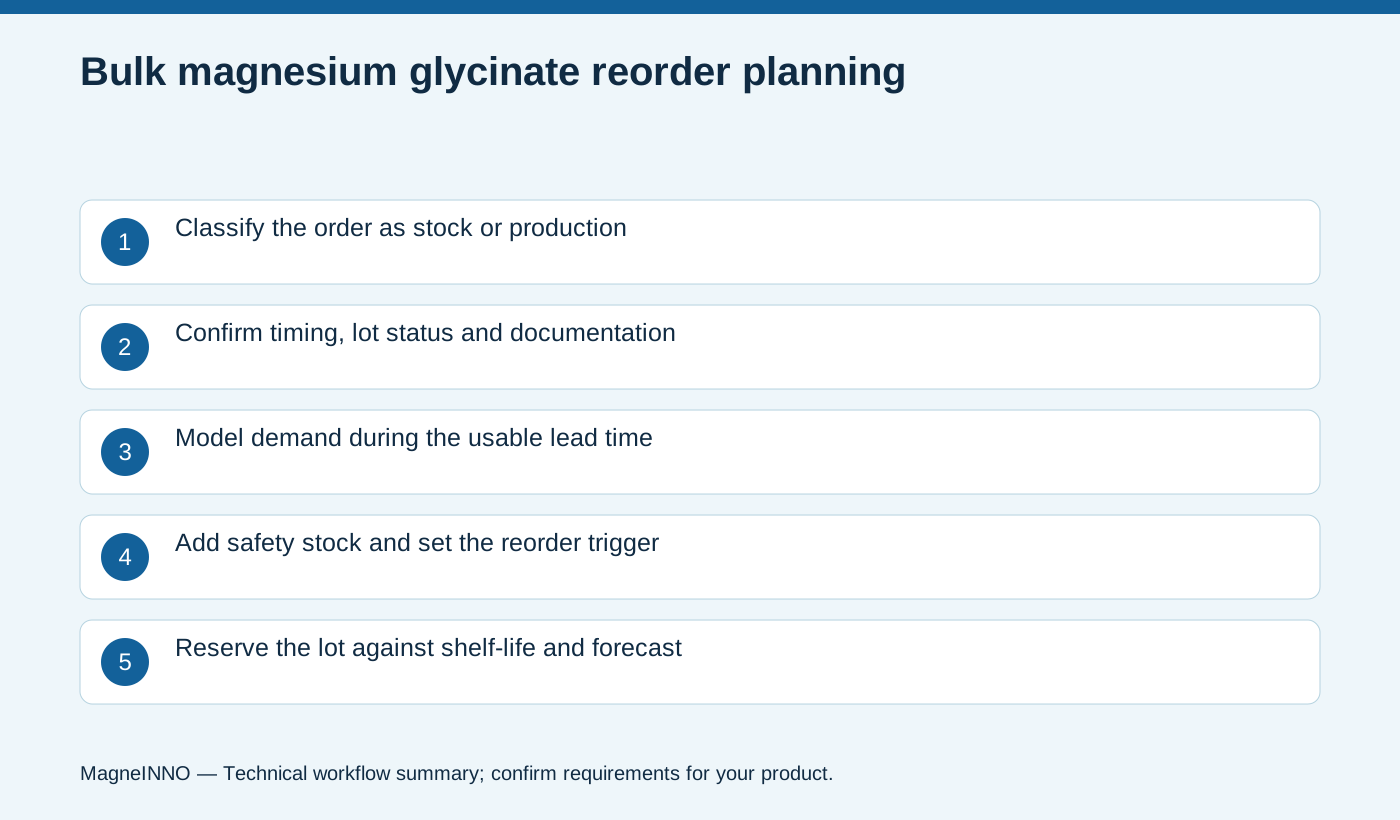
Create two lanes in the purchasing plan. The first is an in-stock lane: the material is already positioned in California, subject to confirmation, and the stated shipping timing is about 3 days. The second is a production lane: the supplier schedules the order for production, with an indicative timing of about 1–2 weeks. Your internal planning lead time should include supplier confirmation, documentation review, lot release, receiving inspection and any hold period required by your quality agreement.
For each purchase order, ask the supplier to identify whether the order is allocated from available stock or scheduled for production. Request the planned ship date, lot number when available, expiration or retest date, applicable certificate of analysis, packaging configuration and any documentation needed for incoming release. Procurement should record the confirmed date separately from the general lead-time estimate.
Ask for enough information to connect the raw-material lot to your production schedule, finished-product batch plan and expected depletion date.
A magnesium glycinate reorder point example
Assume a brand uses 3,000 kg of bulk magnesium glycinate per month and plans on a 14-day lead time, counted in calendar days from placing the order to having released, usable material on hand. That figure covers the production order, transit, receiving and the normal quality-release time. For a simple example, use a 30-day planning month. Average daily demand is 3,000 kg divided by 30 days, or 100 kg per day. Demand during the 14-day lead time is 1,400 kg, which is the same 100 kg per day carried across 14 days.
Now assume the brand wants five days of demand as safety stock to cover forecast variation and any receiving or release delays beyond the normal times already counted in the lead time. Five days at 100 kg per day is 500 kg. The reorder point is lead-time demand plus safety stock: 1,400 kg + 500 kg = 1,900 kg. Because the material is packed in 25 kg fiber drums, it helps to express the trigger in whole drums as well; 1,900 kg is 76 drums.
This example uses generic planning numbers and does not describe MagneINNO inventory, order quantities or commercial terms. A brand should replace the assumptions with its own average demand, peak demand, supplier-confirmed lead time, quality release time and acceptable service-risk target.
Planning input | Example | Buyer action |
|---|---|---|
Average daily demand | 100 kg per day (3,000 kg over 30 days) | Use actual consumption and forecast data. |
Planning lead time | 14 days (1,400 kg of demand) | Confirm stock or production status for each order. |
Safety stock | 5 days (500 kg) | Set it from demand variation, release time and service risk. |
Reorder point | 1,900 kg (76 drums of 25 kg) | Trigger review before usable inventory reaches this level. |
How to set safety stock without overbuying
Safety stock should reflect the risks that can actually interrupt production. Review the variability of monthly demand, forecast confidence, supplier-confirmed lead time, internal quality-release time, finished-product production dates and the consequences of a stockout. A brand with stable demand and frequent replenishment may need less coverage than a brand with campaign production, seasonal launches or long approval cycles.
Review safety stock after a meaningful change in demand or supply conditions. Examples include a new dosage form, a reformulation that changes elemental magnesium content, a production schedule change, a revised incoming-testing plan or a supplier specification change. Keep the reason for each safety-stock level in the planning record so finance, procurement and QA can review the same assumptions.
Use a usable-inventory figure rather than a warehouse quantity. Deduct material placed on quality hold, material reserved for another work order, damaged packaging and lots that will reach their internal minimum remaining shelf-life rule before consumption. When you compare stock with the reorder point, add open purchase orders that are already confirmed, so the same low balance does not trigger a second order.
Lot reservation and allocation controls
Lot reservation is a written agreement that a specified quantity, lot or production allocation will be held for a defined planning window. Before requesting a reservation, provide the date you expect to call off the material, required specification, packaging needs, forecasted drawdown and the minimum remaining shelf life you will accept at shipment. Ask the supplier to confirm what is reserved, how long the reservation remains valid and what happens if the forecast changes.
A reservation should not replace lot documentation. When the lot is identified, QA should review the COA, specification revision, production date where provided, expiration or retest information, packaging integrity requirements and sampling plan. The receiving team can use the bulk magnesium glycinate receiving checklist to structure the inspection record.
This record-keeping matches common supplement quality practice, where each received lot of an ingredient is identified separately and held until quality control approves it for use. Your planning lead time should therefore include the time your own team needs for identity testing, specification checks and release, not only the shipping time.
For a broader stock plan, connect reservations to ingredient demand, elemental magnesium requirements and purchase quantity. The guide to magnesium elemental cost and batch planning covers the relationship between elemental content, ingredient mass and planned production quantities.
Shelf life, retest dates and the amount to hold
A stated 24-month shelf life does not mean every received lot has 24 months remaining. Procurement should ask for the lot date and remaining shelf life at shipment, then compare that information with the brand’s expected consumption window, finished-product shelf life and internal minimum remaining-life requirement.
For how water content, storage conditions and finished-product testing relate to shelf life, see magnesium glycinate stability and shelf life.
Retest arrangements require clear ownership. Ask whether the material has an expiration date, a retest date or both. For a retest date, ask which tests support continued use, who performs the retest and how QA approves the result before the material is used. An expiration date is a different limit, and retesting should not be treated as a way to use material past it. A retest date also does not extend finished-product shelf life or replace the brand’s own stability assessment.
Storage and packaging can affect the practical planning window. Document the required storage conditions, package closure expectations, moisture-control precautions and receiving inspection. Review the technical guidance on magnesium glycinate packaging, storage and stability before setting a large reservation or accepting a lot with a shorter remaining life.
Procurement checklist
- Classify the order as available-stock or production-scheduled and record the confirmed date.
- Calculate demand during the confirmed lead time and add a documented safety-stock allowance.
- Ask for lot identity, COA, specification revision, packaging details and remaining shelf life.
- Reserve only the quantity that fits forecast consumption and the internal minimum-life rule.
- Review the reorder point after demand, formulation or quality-release conditions change.
Frequently asked questions
What should a buyer ask about bulk magnesium glycinate lead time?
Ask whether the order is filled from confirmed California stock or scheduled for production, the expected ship date, the lot or allocation status, the documentation timing and the remaining shelf life at shipment. Request the supplier’s written confirmation for the specific order.
Should safety stock cover the full production lead time?
No. The demand expected during the confirmed lead time belongs in the reorder point. Safety stock is the extra buffer on top of it, sized for forecast error and for delays beyond the normal lead time, including slower receiving or quality release.
How does lot reservation affect inventory?
A reservation can improve continuity by linking planned demand to an identified allocation, but reserved material keeps ageing while it waits. Any purchase or cancellation commitment depends on the written terms, so confirm those with the supplier. Review the reservation quantity and call-off window regularly so reserved material does not exceed the brand’s realistic consumption plan.
What should be requested before a purchase order?
Request a sample where needed for qualification, then obtain the current COA, specification sheet, packaging information, storage requirements, lot timing and a quote for the intended order scenario. MagneINNO can provide free 50 g samples for evaluation; commercial and supply terms should be confirmed directly for the specific requirement. For how pack sizes, trial orders and quote terms usually work, see magnesium glycinate wholesale for supplement brands.
MagneINNO™ magnesium glycinate is supplied by NutraINNO USA Inc., the U.S. company behind the MagneINNO brand, and is built on proprietary MagniLift™ technology for supplement and beverage brands that need dependable, well-documented supply.
When you evaluate MagneINNO as a bulk magnesium glycinate supplier, request a sample, COA/spec sheet or quote with your target format, required documentation, forecast window and desired lot-reservation conditions.
Need documentation?