Quality & Regulatory
How to Set Organoleptic Acceptance Criteria for Magnesium Glycinate Raw Materials
Build a controlled magnesium glycinate organoleptic specification for incoming lots, with safe odor review, reference custody, escalation rules and clear analytical limits.

A magnesium glycinate organoleptic specification should answer a narrow incoming-quality question: does the lot’s observable physical condition remain consistent with the approved raw-material reference and documented expectations? It can support an accept, hold or investigate decision before analytical testing, but it cannot establish identity, elemental magnesium content, purity, chelation, safety or clinical efficacy.
For dietary supplement operations, specifications are expected at applicable control points and for components used in manufacturing. FDA guidance also distinguishes a specification from the examination or testing method used to determine whether it is met. Your organoleptic procedure should therefore define the observation conditions, recording method and escalation pathway rather than relying on informal “looks normal” judgments. [FDA CGMP guidance]
FDA’s FSMA FAQ distinguishes dietary ingredients from qualifying finished dietary supplements when describing the conditional preventive-controls exemption. Assess the requirements applicable to the actual operation rather than assuming the finished-product exemption also covers the bulk ingredient. The dietary supplement CGMP guide is nonbinding guidance and does not provide a universal sensory-inspection protocol. See the FDA FSMA FAQ.
Define the decision scope
Write the specification for the raw ingredient as received, not for a finished capsule, powder drink or gummy. A raw magnesium glycinate lot may be acceptable in appearance while still requiring identity, assay, moisture, microbiological, elemental-impurity or other testing under your approved quality plan. Conversely, a lot that appears different from the qualified reference should be placed on hold while the cause is assessed, even if the supplier certificate appears complete.
Keep this decision separate from consumer preference testing. Finished-prototype taste, mouthfeel and aftertaste work belongs to a sensory-development program with its own qualified samples and controls. Do not taste or conduct mouthfeel testing on unqualified incoming powder. Odor observations should occur only when permitted by your site risk assessment and an approved SOP that addresses exposure, hygiene, personnel suitability and stop conditions.
Build the specification around observable attributes
A practical specification normally covers appearance, color, physical condition and, where approved, odor. Use descriptive terms that an inspector can apply consistently. Avoid vague wording such as “good quality,” “fresh” or “normal” unless those terms are defined against a controlled reference.
Attribute | Specification design | Escalation trigger |
|---|---|---|
Appearance | Describe the expected powder form, uniformity and absence of visible foreign matter under controlled conditions. | Unexpected particles, discoloration, packaging debris or a visibly changed condition. |
Color | Use a qualified reference and a bounded descriptive range or approved visual standard. | A difference beyond the approved comparison range or disagreement between inspectors. |
Physical condition | Record lumps, caking, excessive compaction, leakage, wetness or other condition relevant to handling. | Condition suggests moisture exposure, package failure, contamination or transport damage. |
Odor | Only under an approved SOP; describe deviation from the qualified reference without tasting. | Unexpected, strong, chemical, rancid, solvent-like or otherwise unexplained odor. |
Control the observation conditions
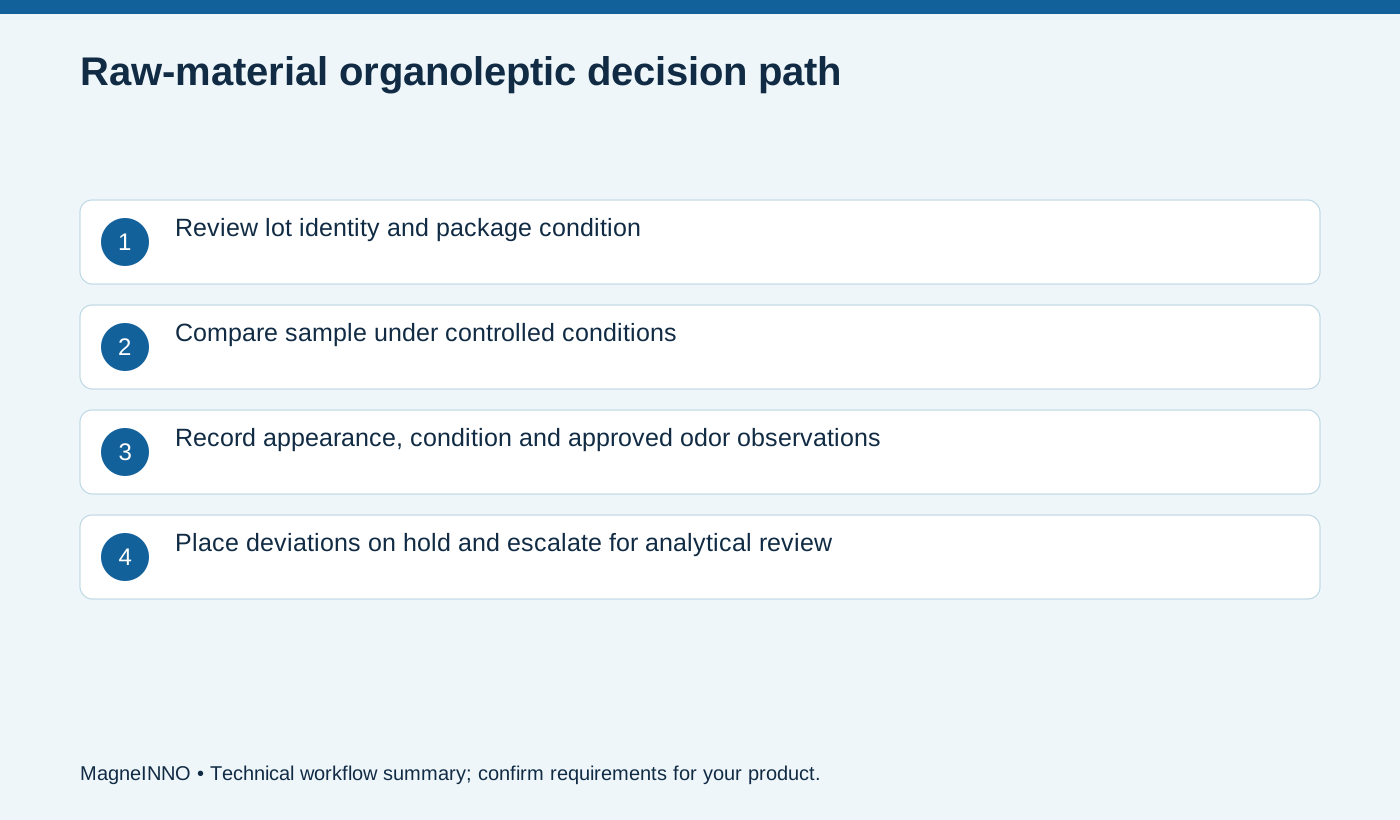
A visual criterion is only useful when the viewing conditions are controlled. Define the inspection area, lighting type, background, container-opening process and any required personal protective equipment. The procedure should state whether the lot is examined in the original package, in a clean inspection vessel, or both. Record whether the sample was undisturbed, mixed, sieved or otherwise handled; these actions can change the apparent physical condition.
Use the same lighting and background for routine comparison. Keep the qualified reference in a sealed, identified container with custody records, storage conditions and an assigned review date. Do not allow an uncontrolled retained sample, supplier photograph or memory of a previous lot to become the de facto standard. Replace or requalify the reference when its age, packaging history or condition could make the comparison unreliable.
For odor, define the approved sequence precisely. A trained, authorized person may inspect the package headspace or sample container only as allowed by the SOP. The procedure should specify when to stop, how to ventilate or isolate the material, how to document an unexpected odor and when to involve safety or quality personnel. No tasting, ingestion or mouthfeel assessment belongs in an incoming raw-material release procedure.
Use representative sampling and traceable records
Organoleptic observations should be tied to the lot, shipment, package and sample identifiers. Define how samples are selected so that the observation reflects the lot rather than one convenient container. FDA guidance describes representative sampling as a means of determining whether applicable specifications are met; your site procedure should translate that principle into a documented sampling plan appropriate to the material and risk. [FDA representative-sample guidance]
For a practical record, capture supplier, material name, internal item code, lot number, package count reviewed, date and time, inspector, environmental or viewing conditions, each attribute result, deviations, photographs where permitted, and the disposition. A useful record distinguishes “not observed,” “not applicable” and “not performed.” It should also show whether the result was accepted, placed on hold, sampled for additional testing or escalated as a supplier-quality event.
Your broader incoming-lot workflow can connect this observation to certificate review and analytical release through the COA review workflow and a documented representative sampling approach. These links should support the process; they do not replace your approved specifications, methods or quality agreement.
Set escalation rules before the first deviation
Do not let an inspector decide informally what a deviation means after seeing it. Establish in advance that an unexpected color, foreign matter, package damage, unexplained caking or odor difference triggers a hold pending quality review. The next step may include package inspection, review of transport and storage history, supplier notification, comparison with retained material, moisture or water-activity testing where relevant, microscopy, identity testing or other scientifically appropriate examination.
The analytical response should be risk-based. Organoleptic results are screening evidence, not proof of a chemical conclusion. They cannot confirm that a material is magnesium glycinate rather than another magnesium compound or a physical blend, and they cannot demonstrate the stated elemental magnesium level or chelation. If identity or chelation is a concern, use the approved analytical strategy, such as the methods described in your quality system, rather than upgrading a visual impression into a release claim.
FDA guidance states that examination and testing methods should be appropriate for their intended use and scientifically valid for the specification being assessed. That supports a clear separation between a controlled organoleptic check and confirmatory laboratory testing. [FDA method guidance]
Procurement and QA implementation
- Request the supplier’s current material description, storage conditions, packaging details and change-notification commitments.
- Approve a written appearance and physical-condition description using a controlled reference lot.
- Define the inspection environment, sample selection, odor safeguards and record fields in the SOP.
- Train authorized inspectors with comparison exercises and document qualification or retraining needs.
- Link every deviation to hold, investigation and analytical-testing decisions before release.
When communicating with a supplier, ask the supplier and your laboratory to reconcile reporting bases separately: ingredient weight, elemental magnesium, assay basis, moisture basis and any chelation or identity method. Organoleptic consistency can help identify a lot that needs attention, but it cannot reconcile those analytical bases or substitute for a release specification.
FAQs
Should the specification include a color number?
Only if your site has a suitable, controlled measurement or visual standard and the result is meaningful for the material. A descriptive range tied to a qualified reference may be more practical than an unsupported color number. Avoid inventing numerical limits without historical data, method capability and quality approval.
Can an acceptable appearance release a lot?
Usually, it should be one input to incoming review, not the complete release decision. Identity, assay, purity, safety and other applicable tests remain separate. A visually consistent powder can still fail an analytical specification.
Can inspectors smell every incoming lot?
Only when the practice is authorized by your risk assessment and SOP. Define safe handling, personnel restrictions, ventilation, stop conditions and documentation. Never taste unqualified raw material, and do not treat odor as a consumer sensory score.
How often should the reference material be replaced?
Set the interval through your quality system using packaging, storage, age, stability and change-control considerations. Review it when the supplier, manufacturing process, packaging, specification or observed material condition changes.
A well-controlled magnesium glycinate organoleptic specification gives receiving teams a consistent early warning system. Its value is highest when the limits are deliberately modest: document what can be observed, hold unexplained deviations, and use analytical testing to answer questions that appearance and odor cannot.
Need documentation?