Quality & Regulatory
Magnesium Glycinate Dual-Sourcing: How to Prove Two Suppliers Are Formula-Equivalent
A second magnesium glycinate supplier protects continuity only if the new material behaves like the approved one. This protocol shows quality and technical teams how to compare specifications, COA reliability and real process performance before an alternate source goes into production.

Two suppliers selling "magnesium glycinate" do not automatically sell the same material. The name tells you the ligand and the mineral. It does not tell you the elemental magnesium range, whether the product is buffered, how much water it carries, how it flows in your encapsulator, or how it tastes in a stick pack. Dual-sourcing is a sound continuity decision, but only when the second source has been shown to be equivalent for your formula, not just for the label on the drum.
This guide sets out a practical comparability protocol for quality, R&D and procurement teams that want an approved alternate source without inheriting a hidden reformulation project.
Start from one specification, not two supplier sheets
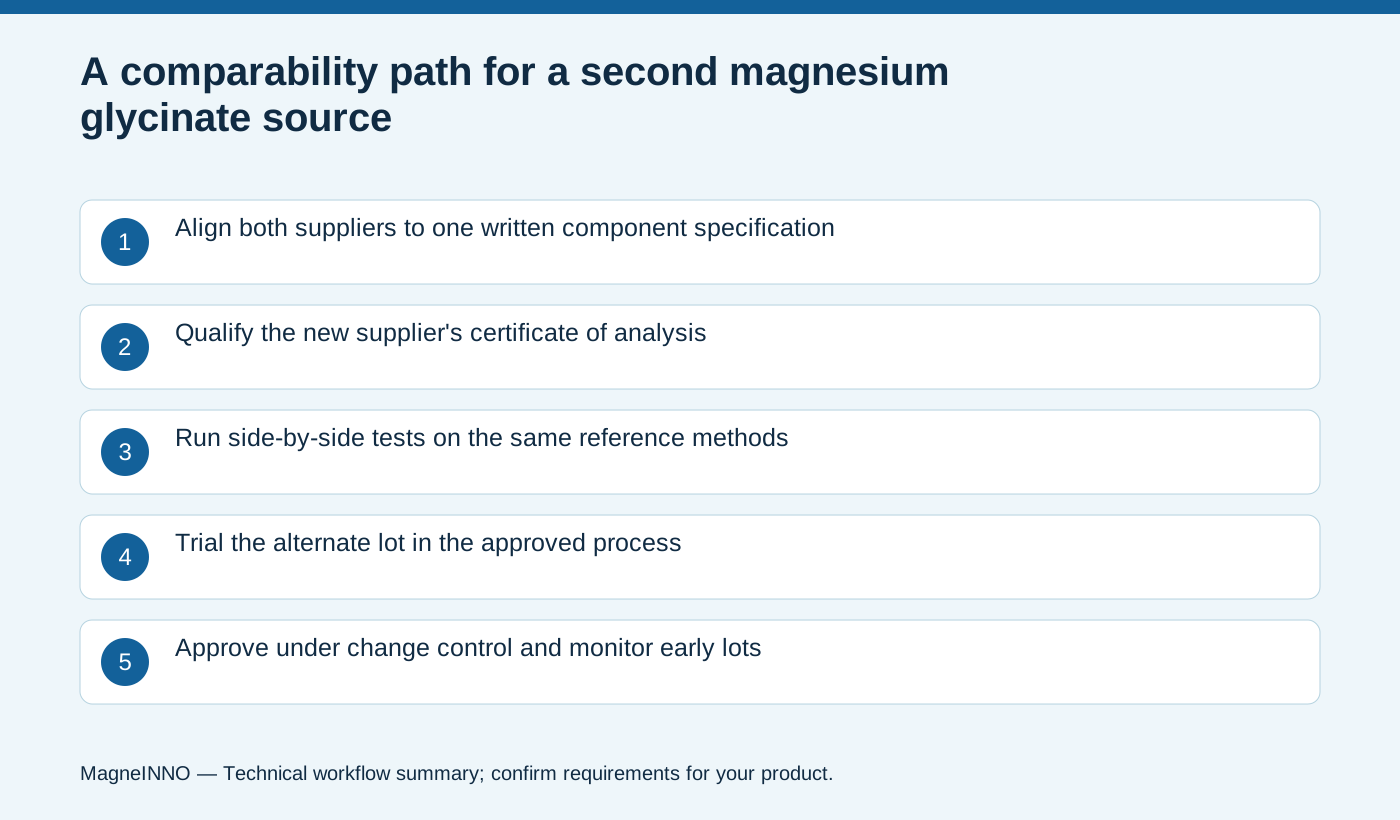
The most common dual-sourcing mistake is comparing the new supplier's spec sheet with the incumbent's spec sheet. That compares two marketing documents. Instead, write or update your own component specification first, then test both suppliers against it.
Under the dietary supplement CGMP rule, a firm that uses a component must set an identity specification and the component specifications needed to meet finished-product purity, strength and composition, along with limits on contaminants that could adulterate the batch. For magnesium glycinate, a useful single specification usually defines:
- Identity: the method you rely on to confirm the material is a magnesium glycinate chelate and not a simple blend. Our FTIR and complementary-analysis plan explains how to pair methods.
- Elemental magnesium assay: the range and the reporting basis (as-is or dry basis). A 12% grade and a 10% grade are different materials for your fill weight.
- Water or loss on drying: reported on each lot COA; compare the method and basis, not only the number.
- Particle size and bulk density: critical for capsules, tablets and stick packs.
- Contaminant limits: elemental contaminants and microbiology, with named methods.
- Sensory attributes: appearance and odor, plus taste where the dosage form exposes it.
If the incumbent material was never fully specified, this is the moment to fix it. Otherwise you will not know which properties your product actually depends on.
Qualify the second supplier's COA before you rely on it
Many brands plan to accept the alternate supplier on the strength of its certificate of analysis. That can be acceptable, but the CGMP rule sets conditions. To rely on a supplier COA for components other than identity testing of dietary ingredients, the user must first qualify the supplier by confirming the supplier's test results, the COA must show methods, limits and actual results, qualification must be documented, and the COA must be re-confirmed periodically. Identity testing of a dietary ingredient is still required before use unless FDA grants an exemption.
In practice, qualification for an alternate source means:
- Collect several lots, not a single sample, so you see lot-to-lot spread.
- Test those lots in your own lab or a contract lab on the same methods used for the incumbent.
- Compare the results with the supplier COA values and look for systematic bias, not just pass or fail.
- Record who approved the qualification and when re-confirmation is due.
If the supplier's methods differ from yours, decide which method governs before you compare numbers. FDA's small-entity guidance describes a scientifically valid method as one that is accurate, precise and specific for its intended purpose. Two methods can both be valid and still disagree at the edge of a range.
Design the side-by-side comparison
Equivalence is a decision about your product, so the comparison must reflect your process. A practical side-by-side study has three layers.
Layer one: material attributes
Run the incumbent and alternate lots together on the full specification. Pay attention to properties that sit near a limit for either supplier. A material that passes the same specification with a different water content, particle-size distribution or bulk density can still change capsule fill or powder flow.
Layer two: process performance
Make a pilot batch with each material in the approved process. Track the parameters your master record already controls: blend time, flow, fill or compression weight variation, capsule or tablet appearance, and dissolution or disintegration where relevant. For powders and beverages, check wetting, dispersion, clarity and taste. Our guide on keeping magnesium blends uniform covers what to watch during mixing.
Layer three: finished-product results
Test the pilot finished product against the finished-product specification. This is the decisive layer. Quality control personnel must not release a batch whose component fails its identity specification, and each finished batch must conform to product specifications before release. If the alternate source only works after a process adjustment, record that adjustment as a formal change rather than a quiet operator habit.
Decide what "equivalent" means before you see the data
Write acceptance criteria before testing so the result cannot be argued backwards. Typical criteria include:
- All specification attributes within limits for every tested lot.
- Elemental magnesium results on the same reporting basis, with differences small enough that your label claim and any formulation overage remain valid.
- No change in the dosage-form outcome that matters to you, such as fill weight range, tablet hardness, sachet fill accuracy or beverage clarity.
- No new sensory complaint in a blinded comparison where taste is relevant.
If one attribute differs but stays inside the specification, decide whether the specification was too wide. Dual-sourcing studies often reveal that a limit was set from the incumbent's COA rather than from product need.
Put the alternate source under change control
Approval of a second source is a change to how the product is made, even when the formula stays the same. Record it through your change-control system, update the approved-supplier list, and link the qualification report to the component specification. Our supplier change-control brief gives a template for what each supplier should notify you about.
After approval, monitor the first few commercial lots from the alternate supplier more closely than routine lots. Compare trend charts across suppliers rather than treating each lot in isolation. If one supplier drifts toward a limit, you want to see it before a lot fails.
Common pitfalls
- Testing a sample instead of production lots. A sample shows what is possible; production lots show what is typical.
- Mixing reporting bases. An assay on an as-is basis cannot be compared directly with one on a dry basis. See our note on as-is assay, dry basis and loss on drying.
- Ignoring grade differences. A different elemental magnesium grade changes the ingredient mass needed per serving.
- Forgetting the CMO. If a contract manufacturer runs your product, its receiving and process teams must accept the second source too.
How MagneINNO supports a comparability study
MagneINNO is the ingredient brand of NutraINNO USA Inc., a U.S. company. For qualification work we can provide a lot-specific COA with methods, limits and actual results, a specification sheet, and a free 50 g sample for initial screening, with production lots available for multi-lot studies. Our magnesium glycinate grades are offered at 12%, 10% and 8% elemental magnesium, matched to capsules and tablets, gummies, and powders or beverages respectively. Material ships in 25 kg fiber drums with a 24-month shelf life, and water content is reported on each lot COA. Production capacity of more than 3,000 tonnes per year supports a stable second source; in-stock material typically ships in about three days, and production orders in one to two weeks.
FAQ
Do we have to retest identity if the second supplier provides a COA?
For a component that is a dietary ingredient, the CGMP rule requires at least one appropriate identity test or examination before use unless FDA has granted an exemption. COA reliance applies to other specifications after supplier qualification.
How many lots should we test?
There is no single number in the rule. Choose enough production lots to see typical variation; many teams start with three and expand if results sit near a limit.
Can the alternate material use a different grade?
Yes, but then it is a reformulation, not a like-for-like second source. Recalculate ingredient mass and verify the label claim.
If you are building a dual-sourcing plan, contact our technical team to request a specification sheet, lot COAs or a sample for your comparability study.
Need documentation?