Supply Chain
Bulk Magnesium Glycinate Receiving Checklist
A receiving inspection checklist for bulk magnesium glycinate: match the COA to the order, inspect drums and seals, quarantine, sample and record release.

A bulk magnesium glycinate lot can be perfect when it leaves the supplier and compromised by the time it reaches your dock. A torn liner, a crushed drum, a pallet left in the rain, or a label that does not match the paperwork can turn a good ingredient into a quality problem. The receiving step is where those issues are cheapest to catch.
This receiving inspection checklist is for procurement, warehouse and quality teams who receive magnesium glycinate bulk powder and other powdered magnesium ingredients and need to move them from the dock into quarantine and, eventually, release.
Who this applies to
The dietary supplement CGMP rule applies to firms that manufacture, package, label or hold dietary supplements. If your contract manufacturer receives the ingredient, these checks belong in its procedures, and your quality agreement should confirm that they happen. If you receive it yourself, they belong in yours.
Before the truck arrives
- Confirm the purchase order details: product, grade, quantity, lot count and packaging.
- Ask the supplier to send the COA and packing list in advance so they can be checked before unloading.
- Prepare a quarantine location that protects against contamination, moisture and mix-ups.
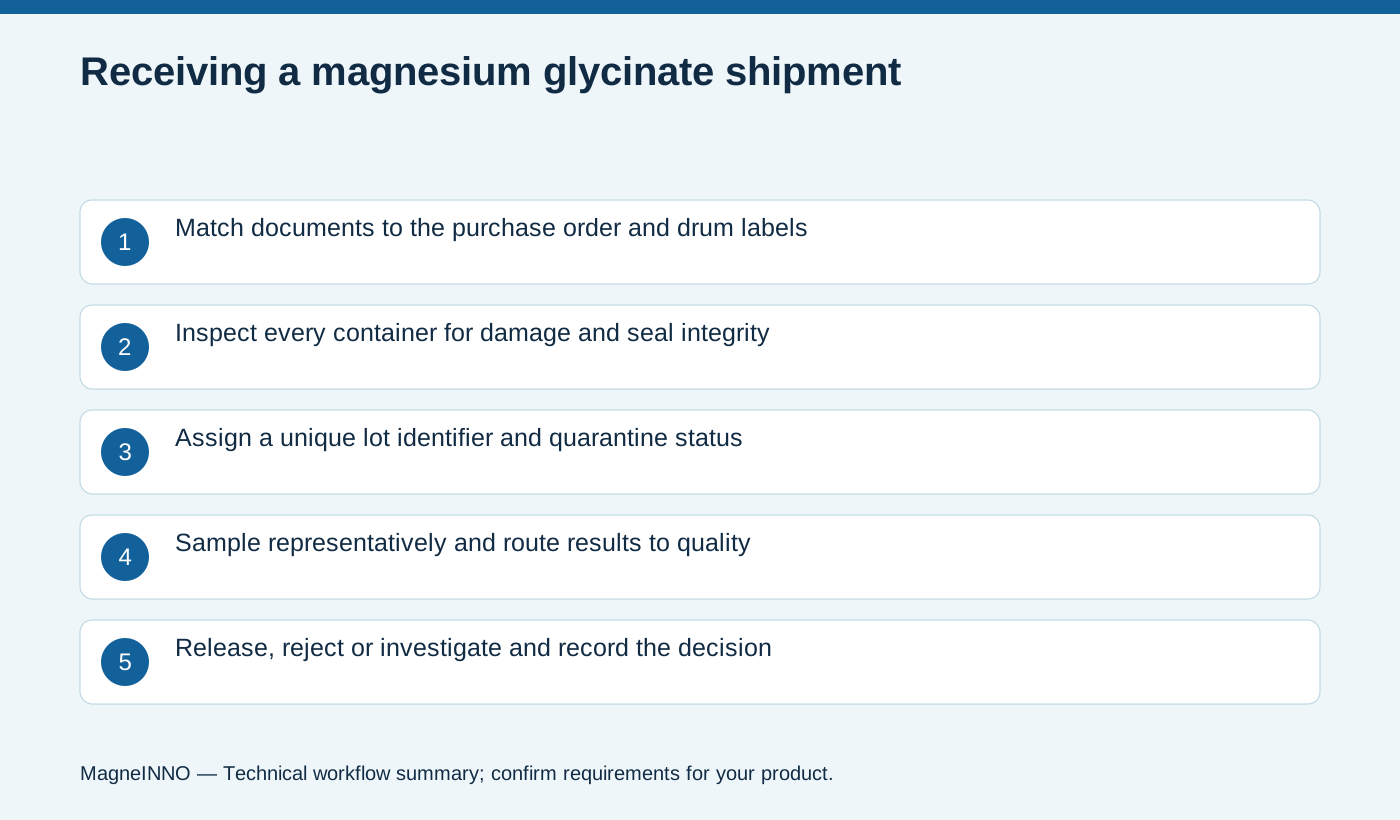
Step one: match the COA and documents to the order
The rule requires a visual examination of the supplier's invoice, guarantee or certification to ensure the components are consistent with your purchase order. In practice, check:
- Product name and grade on the invoice, packing list, COA and drum labels all agree.
- Lot numbers on the COA match the lot numbers on every container.
- Quantities and container counts match the order.
- The COA shows test methods, limits and actual results, and every value meets your specification. Our COA review workflow is a good companion to this step.
Stop and escalate if documents disagree. A document discrepancy is easier to resolve before the material is mixed into stock.
Step two: inspect every fiber drum and seal
The rule requires you to visually examine each immediate container for appropriate content label, container damage, or broken seals to judge whether the condition may have led to contamination or deterioration. For fiber drums of magnesium glycinate, look for:
- Dents, cracks, punctures or crushed rims.
- Missing, loose or broken lid closures and tamper seals.
- Wet patches, staining or water marks on drums and pallets.
- Damaged inner liners or visible powder outside the liner.
- Labels that are missing, illegible, or inconsistent with the documents.
- Pest activity or foreign material on the pallet.
Photograph anything unusual before moving it. Photos are the best evidence for a transport claim or a supplier investigation.
Step three: assign identity and status
Each unique lot within each shipment must be identified so you can trace it to the supplier, the date received, the component name, its status and the finished product it goes into. Use one identifier consistently in every record. Put the material into quarantine status straight away.
Step four: sample and route to quality
Components stay in quarantine until representative samples are collected, quality control reviews and approves any test results, and quality control releases them. FDA's small-entity guidance notes that the rule requires representative samples of each unique lot of components, packaging and labels that you use. Sample from undamaged containers unless you are deliberately investigating damage, and record which containers were sampled. Our note on representative sampling explains how to choose them.
Do not forget packaging and labels you receive
If you also receive bottles, pouches, liners or printed labels for the finished product, similar rules apply. Received packaging and labels must be visually examined, quarantined and released by quality control before use, with each lot identified for traceability.
Step five: decide, record and release
Receiving records must include the date received, the initials of the person performing each operation, the results of any tests or examinations, and any material review and disposition decision. The rule also lists certificates of analysis, invoices and guarantees as receiving records to keep. A simple receiving form with these fields, completed at the time of the work, will cover most audits.
Possible outcomes:
- Accept into quarantine pending test results and release.
- Accept with exception for minor outer damage where the inner liner and seal are intact, with the exception documented.
- Reject or hold for investigation for broken seals, wet product, damaged liners or document mismatches. Our note on investigating incoming result discrepancies covers how to work through a hold.
When transport conditions are questionable
If the shipment was delayed, exposed to heat or moisture, or arrived with visible damage, record the conditions and decide whether extra testing is needed. Water content and appearance are the obvious checks for magnesium glycinate; compare results with the lot COA. Our guide to packaging, storage and stability evidence covers what to review.
Storage after receipt
Hold the material in its closed original container in a clean, dry area, off the floor, protected from humidity. Reseal partially used drums promptly and record the opening date. For how storage conditions relate to water content and shelf life, see our magnesium glycinate stability and shelf-life guide.
How MagneINNO ships magnesium glycinate
MagneINNO, the ingredient brand of NutraINNO USA Inc., a U.S. company, ships magnesium glycinate in 25 kg fiber drums with a lot-specific COA that reports methods, limits and actual results, including water content. The material carries a 24-month shelf life when stored as directed. In-stock orders typically ship in about three days and production orders in one to two weeks, and we can send COAs ahead of delivery so your team can check documents before the truck arrives.
FAQ
Can we accept a drum with a dented side but an intact seal?
Possibly, if the inner liner is intact and there is no sign of contamination. Document the exception and consider sampling that drum separately.
Who signs off on release?
Quality control approves test results and releases components from quarantine. Warehouse staff record receipt but should not release.
Do we need to sample every container?
The rule requires representative samples of each unique lot. How many containers you sample depends on your sampling plan and risk.
For COAs in advance of a delivery or packaging specifications, contact our team.
Need documentation?