The practical answer
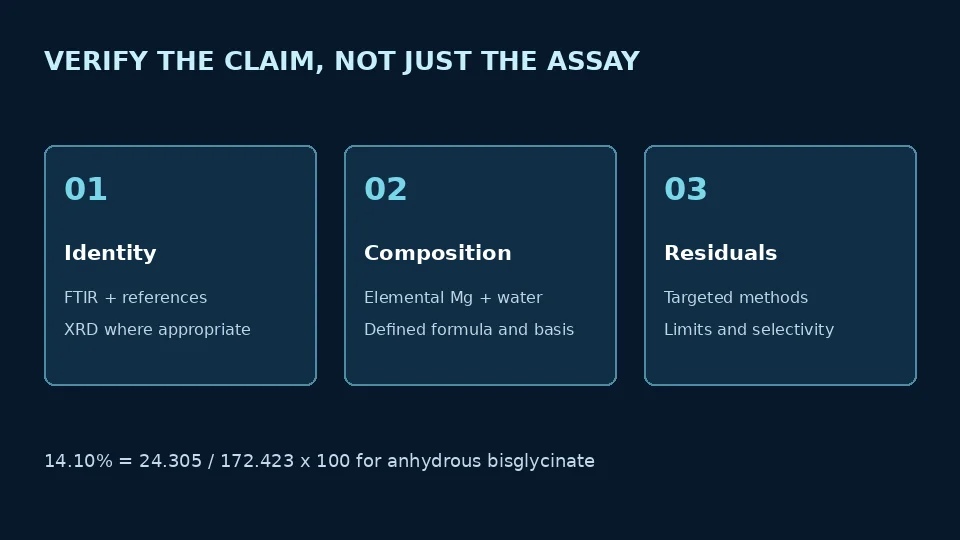
No single elemental magnesium result or FTIR overlay establishes complete chelation. Define what fully chelated means in the specification, then combine reference-based identity work with elemental assay, water and targeted tests for relevant unreacted components. A pure anhydrous 1:2 magnesium bisglycinate composition calculates to about 14.1% elemental magnesium, not 20%; that arithmetic checks composition but does not quantify chelation. [1–3]
Start with a definition that can be tested
Ask whether fully chelated describes the intended molecular structure, the absence of particular unreacted materials, or a numerical proportion of magnesium assigned to a chelated form. These are different statements. A useful specification identifies the material, reporting basis, relevant residual components and the decision each method supports.
Write down the measurand before accepting a chelation percentage. Does the denominator include all magnesium or only an extracted fraction? What happens to magnesium and glycine during preparation? What detection limit, recovery and uncertainty support the calculation? A result reported as not detected means below a defined detection capability, not proof of absolute absence.
For US dietary-supplement operations, 21 CFR 111.320 requires methods appropriate to their intended use and scientifically valid for each specification being tested. That principle is useful in qualification; it does not prescribe one universal chelation test for every commercial ingredient. [1]
Use FTIR as identity evidence, not a percentage meter
Compare FTIR spectra from the received lot and a qualified reference under the same preparation and measurement conditions. Ask the laboratory to explain which features support the proposed identity and coordination assessment, rather than accepting a match score without its basis. The public science page describes FTIR in this supporting role. [2]
Include appropriate challenge materials when establishing whether the method distinguishes the intended ingredient from a physical mixture or relevant residual components. Water, physical form, baseline treatment and sampling can influence a comparison. Keep the original spectrum, reference identification, preparation record and interpretation together.
FTIR alone does not provide a universal conversion from band intensity to chelation percentage. If a quantitative model is offered, review how its calibration materials were characterized, its validation range and how mixtures outside that range are handled. Do not promote a qualitative identity procedure into a quantitative release claim.
Check elemental magnesium against a defined formula
For anhydrous magnesium bisglycinate, C4H8MgN2O4, ChemSpider lists an average molecular mass of 172.423. Using the approximate atomic weight 24.305 for magnesium gives 24.305 / 172.423 × 100 = approximately 14.10% elemental magnesium. The calculation assumes one magnesium and two glycinate units with no water or other components. CIAAW gives a natural-material magnesium atomic-weight interval of 24.304 to 24.307; the approximate value used here does not change the 14.1% conclusion. [3] [4]
A material consisting only of that defined anhydrous bisglycinate cannot simultaneously be 20% elemental magnesium on the same total-mass basis. Adding water or a magnesium-free carrier lowers, rather than raises, the magnesium mass fraction. An unexplained 20% result calls for a composition, basis and analytical review. It does not identify the cause by itself.
Do not reverse the inference. A result near 14.1% does not prove complete chelation, and a result below it does not prove incomplete reaction. Commercial compositions and hydration states differ. A mixture can have a plausible total magnesium value without establishing the chemical association of its magnesium.
ICP-OES can measure total elemental magnesium under a suitable procedure. It does not preserve or determine the original coordination structure. Ask for the sample preparation, reporting basis, calibration, recovery and uncertainty, then reconcile the result with the declared composition. [2]
Use water and targeted residual tests to answer narrower questions
Karl Fischer water results help put an elemental assay on the correct mass basis. Do not assume a general loss-on-drying result represents only water. State the basis before comparing a received ingredient with an anhydrous theoretical value. Water testing supports mass balance; it does not establish chelation. [2]
For free glycine, an HPLC procedure must demonstrate that it distinguishes the specified free analyte from glycine released during preparation. If the procedure dissociates or otherwise changes the ingredient, a total glycine result cannot simply be relabeled free glycine. Ask for selectivity, extraction conditions, recovery and reporting limits for the intended matrix.
The same caution applies to free magnesium testing. Complexometric titration requires a defined operational procedure: pH, reagents, extraction conditions and endpoint can affect the fraction measured. An assay after complete decomposition is a total-magnesium measurement, not automatically a selective free-magnesium test. The public science page lists complexometric titration for free magnesium, but this guide does not provide or validate a universal laboratory protocol. [2]
XRD can assess relevant crystalline phases against suitable reference patterns within the method detection limits. Failure to detect a crystalline residual is not proof that every magnesium species is chelated; low levels or amorphous material may not be resolved. Use the result for the phase question it actually answers. [2]
What to request when a supplier states a chelation rate
When a supplier states a chelation rate, treat the figure as a claim that still needs an auditable evidence package. Ask for the method name and its analytical principle so your laboratory can tell whether the procedure addresses coordination, free species or only total elemental magnesium. Request the basis and denominator of the percentage: whether it uses total magnesium or a defined chelated fraction, and whether the mass is as-is or dry. Ask which reference standard or reference material was used to calibrate or interpret the result. Require a lot-specific certificate of analysis that shows the same lot number as the shipment, together with the underlying laboratory report that produced the percentage.
Compare that package with your identity, elemental assay, water and residual-component file. A stated rate that cannot be traced to a named method, a clear denominator and a matching lot report is incomplete for purchasing. Align supplier claims with the verification approach on the public science page, where chelation integrity is supported by orthogonal methods rather than by a single figure. No single test proves full chelation; a complete evidence package does the work a headline percentage cannot. [2]
Turn the evidence into a purchasing decision
Request one lot-linked package containing the composition statement, approved specification, elemental assay and basis, water result, identity evidence and the targeted residual methods relevant to the claim. Record the method revisions, reference materials and acceptance criteria. Resolve contradictions before qualification instead of averaging incompatible results.
For beverage grade magnesium glycinate, keep identity qualification separate from application qualification. A clear identity conclusion does not establish magnesium glycinate pH stability, flavor performance or shelf life in a finished drink. Run the complete beverage at the intended concentration, acid system, process and package.
Close the review with a precise statement of what passed. For example, the lot met the agreed identity, composition and residual-component specifications within stated method capabilities. When a supplier states a chelation rate, accept it only after the method, denominator, reference and lot-linked report above support that specific claim. Request technical documentation and a formulation sample against those requirements.
Common questions
Can 20% elemental magnesium prove full chelation?
No. A pure anhydrous 1:2 bisglycinate composition calculates to about 14.1% magnesium. A 20% figure needs a composition and reporting-basis investigation; total elemental content cannot establish a chelation fraction.
Does a low free-magnesium result prove all magnesium is chelated?
Not by itself. The method must selectively measure the defined free fraction without materially changing the species during preparation. Review identity, composition and relevant residual evidence together.
Does fully chelated mean a beverage will stay clear?
No. Raw-material identity and finished-beverage performance are separate decisions. Check the complete formula after processing and during storage.
Sources & further reading
- 21 CFR 111.320, Requirements for laboratory methods
- MagneINNO public science page, analytical methods and interpretation boundaries
- Royal Society of Chemistry ChemSpider, magnesium glycinate structure record 76358
- CIAAW, magnesium atomic weight