The practical answer
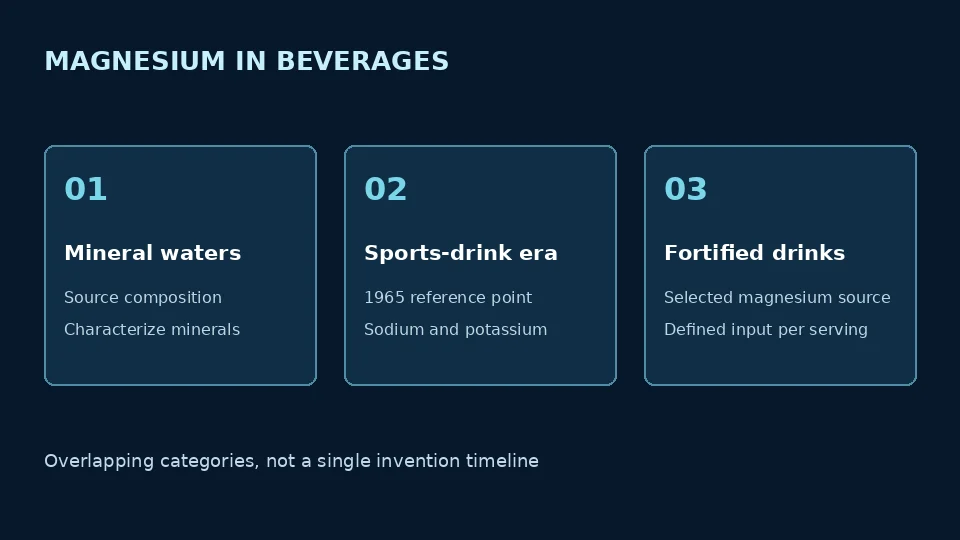
Magnesium in beverages has more than one history. Natural mineral waters brought dissolved minerals into drinks before modern fortification. The sports-drink era established a separate model of deliberately formulated electrolytes, initially focused on sodium and potassium in a well-documented 1965 example. Later fortified beverages made individual mineral targets part of the formulation brief. These are overlapping categories, not a sequence in which every sports drink contained magnesium. [1–4]
Mineral water came before the fortification brief
The Science History Institute describes bottled mineral waters circulating in Europe in the eighteenth century and lists magnesium among the minerals in the waters at Bath. Chemists also tried to reproduce the composition and carbonation of natural waters. In 1772, Joseph Priestley described a method of making sparkling water by introducing carbon dioxide. These are milestones in water chemistry and beverage production, not evidence for a modern magnesium glycinate ingredient or any present-day product claim. [1]
For a formulation team, the useful distinction is the source of the minerals. A natural water has a mineral composition to characterize. A fortified drink has an ingredient addition to specify. Neither description by itself tells a buyer how much elemental magnesium the finished serving contains.
The distinction remains regulatory as well as historical. In the United States, 21 CFR 165.110(a)(2)(iii) defines mineral water as containing at least 250 ppm total dissolved solids from a protected underground source, with characteristic mineral proportions. No minerals may be added to that water. The 250 ppm figure refers to total dissolved solids, not magnesium alone. A magnesium fortified water formulation cannot simply borrow that identity because its minerals dissolve in water. [2]
The sports-drink era was not a magnesium origin story
The University of Florida documents beverage development in 1965 around water, sugar and salts, discussing sodium and potassium as the principal electrolytes in that project. This provides a clear example of deliberately designed electrolyte drinks, but not a basis for saying magnesium was in every early sports-drink formula. [3]
Electrolyte is a category of substances, not another word for magnesium. For procurement, the lesson is to ask for the actual mineral list and contribution of each ingredient. A magnesium electrolyte drink formulation requires its own elemental magnesium target; it cannot be reconstructed from the phrase sports drink.
The development logic also changed. A formulator could choose the water, carbohydrate system and salts rather than accept the mineral profile of a spring. That distinction helps explain why a modern drink brief needs a complete composition, not simply a reference to a historical beverage category.
Fortified beverages made mineral selection a separate task
By December 2018, Beverage Industry was reporting on mineral-fortified waters and other functional beverages, including formulation issues specific to magnesium. Its supplier interviews discuss transparency, solubility, chalkiness and off-taste as practical development concerns. This is evidence of industry activity at that time, not a current market-size estimate or proof that any ingredient works in every drink. [4]
For magnesium fortified beverages, the procurement question is no longer just whether magnesium is present. It is which source supplies it, how much ingredient is required per serving, and whether that input fits the liquid, process and package. Mineral fortification of beverages should be planned in elemental units while the batch sheet records the corresponding ingredient mass.
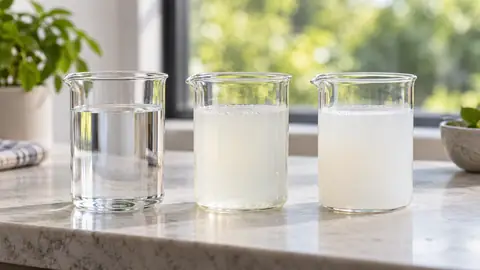
A request for a magnesium ingredient for beverages should therefore include the serving volume, target magnesium contribution, base formula, pH, appearance target and intended processing. A clear sparkling drink and a reconstituted powder may share a target in milligrams but need different development work.
What the history changes in a current brief
Treat water composition, added ingredient composition and finished-product labeling as three separate records. First characterize the water and other ingredients that already contribute magnesium. Then calculate the extra input needed from the candidate grade. Finally verify the finished beverage rather than treating a recipe calculation as a release result.
In ready to drink beverage magnesium fortification, build a control without the added magnesium and a prototype at the intended concentration. Compare appearance, pH and sensory properties after the planned process and during storage. Historical use of minerals in drinks is not an application test for a new formulation.
Agree the product category before choosing a label panel. FDA issued guidance in January 2014 on distinguishing liquid dietary supplements from beverages. A liquid format alone does not settle the classification. Have the regulatory team review the product representation and intended use, then develop the ingredient and labeling file for that category. [5]
Use the timeline without turning it into a forecast
The three useful reference points are mineral-water chemistry, deliberately formulated electrolyte drinks, and beverage fortification with individually specified minerals. They explain why current teams have several technical routes rather than a single standard magnesium drink.
This history does not establish a launch date for the first magnesium-fortified beverage, a first use of magnesium glycinate in drinks, or a growth forecast. For a current project, use the beverage feasibility guide and clarity-screen method below, then request samples and technical information against the written formulation brief.
Common questions
Did all early sports drinks contain magnesium?
No such conclusion follows from the historical example cited here. The documented 1965 project centered on sodium and potassium. Review the actual formulation rather than assuming an electrolyte drink contains magnesium.
Is mineral water the same as magnesium-fortified water?
No. The US mineral-water identity does not allow minerals to be added. A drink with an added magnesium ingredient needs its own identity and labeling assessment.
Sources & further reading
- Science History Institute, Powerful Effervescence (2008)
- 21 CFR 165.110, Bottled water
- University of Florida, history of its 1965 sports-drink development
- Beverage Industry, report on vitamin and mineral beverage formulation (December 2018)
- FDA, Distinguishing Liquid Dietary Supplements from Beverages (2014)