The practical answer
An enterprise lot-traceability audit verifies an unbroken link from raw-material synthesis and sub-lot milling through every 25 kg drum label, warehouse release record, contract manufacturer batch production record (21 CFR 111.260) and one-up, one-back distribution log (21 CFR Part 1 Subpart J). Receiving teams cannot waive dietary-ingredient identity testing under 21 CFR 111.75 or skip unique receiving lot assignment and quarantine under 21 CFR 111.155 and 111.180. [1-5]
Connect synthesis batches to sub-lots and 25 kg fiber drums
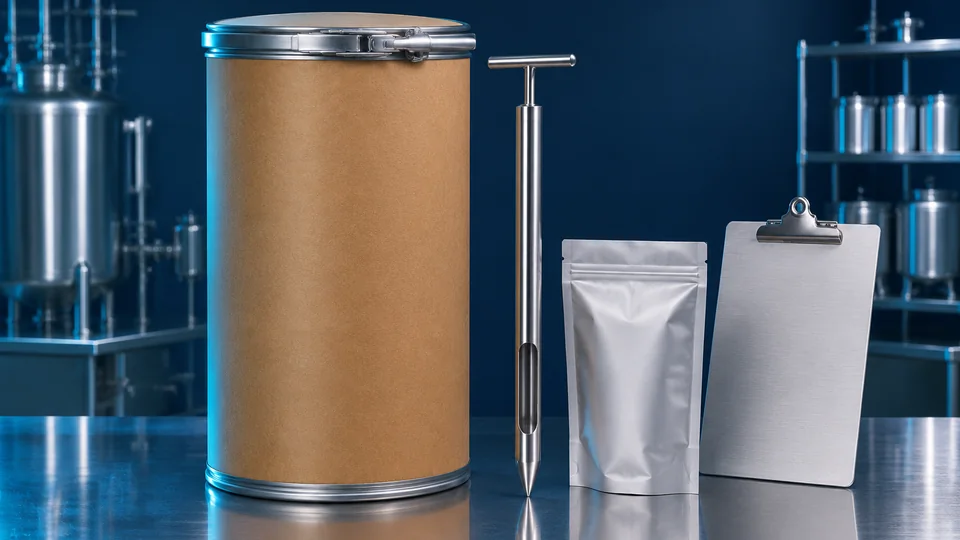
Traceability failures frequently occur between chemical synthesis and physical packaging rather than on the sales invoice. A commercial bulk run may share a single parent reaction batch while undergoing screened particle-size sub-lotting or multi-pallet staging prior to shipment in 25 kg fiber drums. Enterprise QA qualification requires explicit documentation showing how any sub-lot code or warehouse SKU maps cleanly back to the parent batch and lot-specific COA.
Confirm during supplier qualification that every individual drum carries a physical lot number and container sequence number matching the bill of lading, packing list and released analytical certificate. Reject undated template documents or generic specification sheets presented in place of lot-linked release records. Request a redacted sample traceability pack during initial qualification to inspect field continuity before commercial purchase orders.
Separate quarantine, receiving tests and COA reliance under 21 CFR Part 111
Under 21 CFR 111.155, a dietary supplement manufacturer receiving bulk magnesium bisglycinate must visually inspect shipping containers for damage or broken seals, assign a unique receiving identifier to maintain traceability and hold incoming material in physical or electronic quarantine until quality control disposition. [2] Archiving bills of lading, supplier invoices, guarantees and test dispositions is mandated under 21 CFR 111.180. [3]
Crucially, relying on a qualified supplier certificate of analysis under 21 CFR 111.75(a)(2) does not eliminate incoming testing obligations for dietary ingredients: 21 CFR 111.75(a)(1) still requires at least one appropriate test or examination to confirm ingredient identity before use in production unless FDA has formally granted an exemption. [1] Pairing supplier-provided ICP-OES, FTIR, XRD, HPLC, Karl Fischer moisture and complexometric titration (<= 0.02% w/w free magnesium) files with receiving identity verification closes both compliance and quality-risk gaps.
Map component lots across CMO batch records, reserve samples and distribution
When a contract manufacturing organization (CMO) splits one multi-drum shipment across several capsule, gummy or beverage lots, internal batch genealogy often breaks unless both receiving IDs and consumed drum weights are tied into each Batch Production Record under 21 CFR 111.260. [4] Require CMOs to reconcile theoretical versus actual ingredient usage per finished SKU and retain representative reserve samples under controlled conditions.
For U.S. food and beverage channels governed alongside general food recordkeeping under 21 CFR Part 1 Subpart J (section 1.326 and related provisions), one-up and one-back custodial records must link warehouse dispatch directly to the immediate shipper and immediate commercial recipient. [5]
| Genealogy stage | Regulatory anchor | Mandatory link identifier | Enterprise audit failure flag |
|---|---|---|---|
| Parent batch to sub-lot | Supplier QMS & batch record | Parent lot ID + milled/screened sub-lot code | No written link when particle-size fractions are repackaged |
| Drum receipt & quarantine | 21 CFR 111.155 & 111.180 | Unique receiving ID + drum count + seal status | Material staged on manufacturing line prior to QC release |
| Identity & COA qualification | 21 CFR 111.75 | Lot-matched COA + in-house ID confirmation | Using a supplier template COA without lot identity test |
| CMO batch consumption | 21 CFR 111.260 | Batch Production Record component lot & mass | Single bulk PO logged without split-batch drum mapping |
| Warehouse release & recall | 21 CFR Part 1 Subpart J | BOL, lot-matched packing list & customer SKU lot | Cannot isolate affected finished lots within audit window |
On smaller screens, scroll the table horizontally.
Test the paper trail with a timed mock-traceability audit
Before approving a bulk magnesium bisglycinate supplier for enterprise launch programs, run a four-hour tabletop traceback exercise using an illustrative prior release package. Pick one container number and ask quality teams to trace forward to all finished SKUs and backward to constituent glycine and magnesium inputs, analytical release records and facility quality certifications.
MagneINNO™ supplies fully reacted unbuffered magnesium bisglycinate through NutraINNO USA Inc. from Ontario, California warehouse stock. Every commercial lot carries a lot-matched COA covering orthogonal analytical methods (ICP-OES, FTIR, XRD, HPLC, Karl Fischer moisture and complexometric titration <= 0.02% w/w free magnesium), produced at an NSF GMP for Sport registered facility with self-affirmed GRAS and Non-GMO Project Verified documentation paths. In-stock California lots ship in 25 kg fiber drums (24-month shelf life) in about 3 days (1 to 2 weeks for production orders), and free 50 g samples ship for pre-qualification verification. [6]
Common questions
Can a supplier COA waive incoming 21 CFR 111.75 identity testing for magnesium glycinate?
No. While 21 CFR 111.75 allows conditional reliance on qualified supplier COAs for certain component specifications, 21 CFR 111.75(a)(1) still requires conducting at least one appropriate test or examination to verify dietary ingredient identity prior to batch release.
What links a parent magnesium bisglycinate lot to multi-batch CMO production?
Record the unique receiving identifier assigned under 21 CFR 111.155 alongside exact drum serials and weighed ingredient quantities inside every finished Batch Production Record under 21 CFR 111.260 so split consumption stays auditable.
Why should enterprise QA review sub-lot codes before commercial POs?
Drying, milling or screening steps can split a single parent reaction batch into distinct commercial sub-lots. Confirming parent-to-sub-lot traceability prevents COA confusion across staggered 25 kg fiber drum deliveries.
Sources & further reading
- 21 CFR 111.75, What must you do to determine whether specifications are met?
- 21 CFR 111.155, What requirements apply to components of dietary supplements?
- 21 CFR 111.180, Under this subpart G, what records must you make and keep?
- 21 CFR 111.260, What must the batch production record include?
- 21 CFR Part 1 Subpart J, Establishment, Maintenance, and Availability of Records
- MagneINNO Quality Systems and Lot Documentation