Quality & Regulatory
How to Read a Magnesium Glycinate Safety Data Sheet: Handling Information and Its Limits
Learn how procurement, receiving and EHS teams should use a magnesium glycinate SDS for workplace handling without confusing it with a COA, TDS or chelation evidence.

A magnesium glycinate safety data sheet (SDS) is a workplace hazard-communication document. It helps procurement, receiving, warehouse and EHS teams understand how a material is identified, classified and handled when employees may be exposed during normal use or a foreseeable emergency. It is not, by itself, proof of purity, elemental magnesium content, chelation, food suitability or finished-product safety.
For a buyer, the practical question is not whether an SDS looks comprehensive. The question is whether the document matches the material being purchased, comes from the relevant supplier or manufacturer, is current enough for the site’s document-control process, and gives workers usable information for the actual workplace conditions. OSHA describes hazard communication as a system involving labels, safety data sheets, warnings and employee training. [See OSHA’s Hazard Communication overview](https://www.osha.gov/hazcom).
What an SDS is intended to do
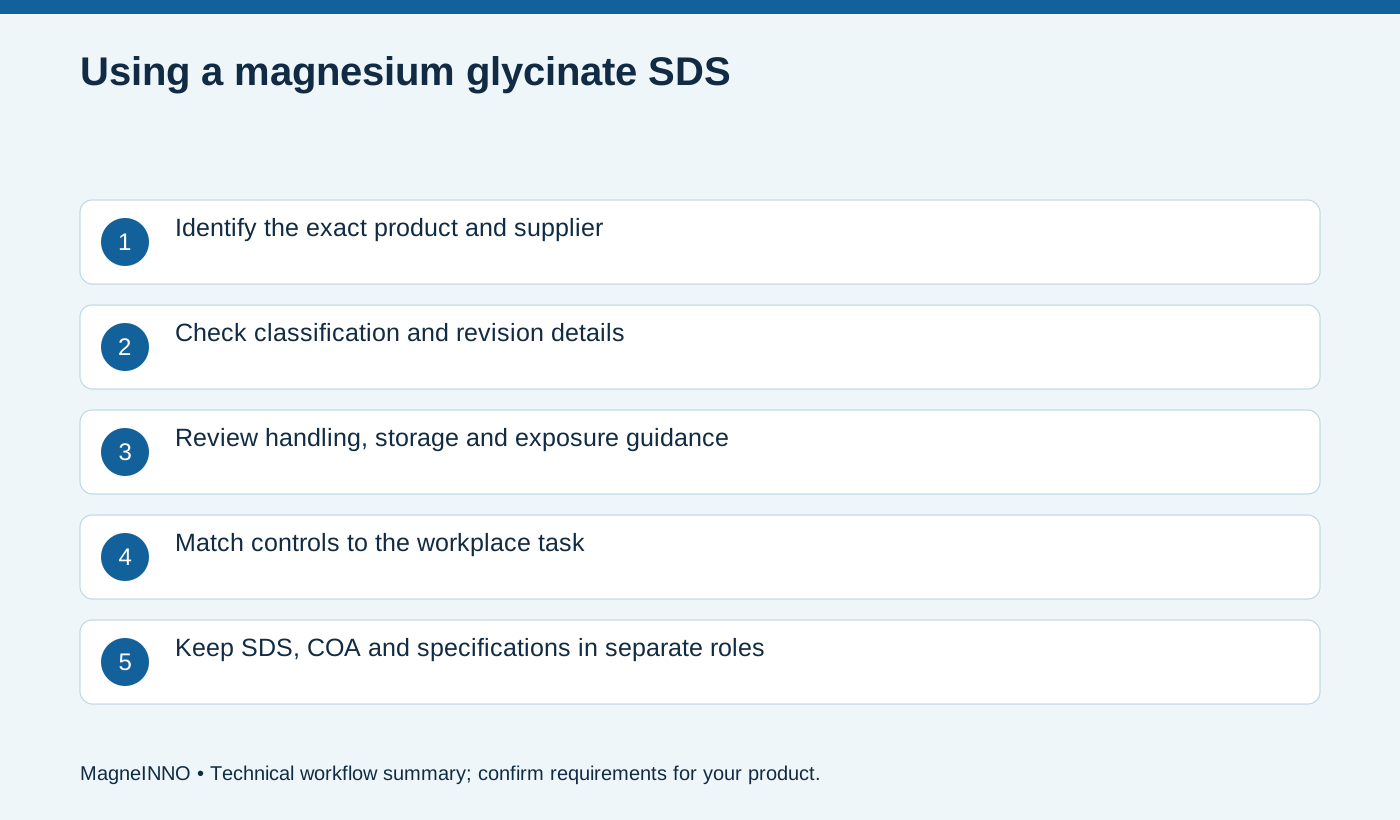
An SDS is therefore a controlled communication tool for occupational handling. It may support decisions about receiving, storage, spill response, fire response, exposure controls and first aid. It does not replace a site-specific risk assessment, written hazard-communication program, operating procedure, training or the supplier’s product specification.
Start with identity, revision and supplier details
Begin with Section 1, Identification. Confirm that the product name, recommended use, restrictions on use and supplier or responsible-party contact information align with the purchase order, packaging and internal material master. For magnesium glycinate, record the commercial name exactly as supplied rather than assuming that “glycinate,” “bisglycinate” or a branded grade describes the same composition.
Check the document date and revision information, normally found in Section 16 or in the supplier’s document-control block. Compare the SDS revision with the version retained in your quality or EHS system. A receiving team should escalate mismatches such as a different product name, supplier, physical form, country contact or intended use before the material is released for routine handling.
The SDS should be traceable to the supplier and product, but that does not mean it is a batch-specific record. A lot number, manufacture date, assay result or release decision generally belongs in the certificate of analysis and related quality records, not in the SDS.
Review classification without inventing a hazard conclusion
Section 2, Hazard(s) Identification, is the key location for the supplier’s stated classification, signal word, pictograms, hazard statements and precautionary statements, where applicable. Read the actual section supplied for the material. Do not assign a classification, exposure limit or PPE requirement merely because the ingredient is a powder or because another magnesium product has a different SDS.
Also look for information about hazards not otherwise classified and unknown acute toxicity or mixture-related limitations where provided. If a section states that no applicable information was found, treat that as a documented information status, not as proof that the material is harmless. OSHA requires SDSs to indicate when no relevant information is found for a subsection. [The OSHA rule provides the SDS section requirements](https://www.osha.gov/laws-regs/regulations/standardnumber/1910/1910.1200).
Use Sections 7 and 8 for handling decisions
Section 7, Handling and Storage, should be read against the real receiving and production workflow. Confirm the supplier’s instructions for handling, hygiene, incompatibilities, storage conditions and practices that reduce dust, spills or contamination. Translate those instructions into site procedures only after considering room design, ventilation, transfer equipment, container size, open charging steps and emergency arrangements.
Section 8, Exposure Controls/Personal Protection, may identify occupational exposure limits, engineering controls, administrative controls or personal protective equipment. An SDS may state that an exposure limit is unavailable. That does not authorize a buyer to create a numerical limit or select specific PPE without the applicable workplace assessment. EHS should determine controls using the actual SDS, task evaluation, local requirements and professional judgment.
For powdered ingredients, procurement can make the SDS more useful by asking suppliers to identify the supplied physical form and any relevant dust or handling information, while avoiding assumptions about the final classification. Receiving should keep the SDS accessible during each work shift where the rule applies. OSHA permits electronic access when it creates no barrier to immediate employee access in the work area. [See the workplace accessibility provisions in 29 CFR 1910.1200](https://www.osha.gov/laws-regs/regulations/standardnumber/1910/1910.1200).
What the other sections contribute
Sections 3 through 6 and 9 through 16 provide supporting context: composition information, first aid, fire response, accidental release measures, physical and chemical properties, stability, toxicological information, ecological information, disposal, transport, regulatory information and revision history. OSHA specifies the 16-section order for SDSs, while noting that it does not enforce the information requirements in Sections 12 through 15 under that standard. That distinction does not remove the need to review the supplier’s complete document or other applicable requirements.
Section 3 should not be treated as a substitute for a commercial composition specification. It may identify hazardous ingredients or confidential information within the regulatory framework, but it is not necessarily a full formula, elemental assay or chelation report. Section 9 may describe appearance or other properties, but it does not establish that a particular lot meets a buyer’s physical, chemical or nutritional specification.
SDS versus COA, TDS and chelation evidence
Neither an SDS nor a TDS proves chelation. Chelation claims require an agreed analytical and specification approach, such as orthogonal identity or structure-related evidence where appropriate. Likewise, an SDS does not establish purity, elemental magnesium percentage, clinical safety, finished-product suitability or efficacy. Keep those questions in the quality, regulatory and formulation review streams.
A practical procurement and receiving workflow
- Request the current supplier SDS before approval, and identify the exact product name, supplier and intended use.
- Compare Sections 1, 2 and 16 with the supplier record, packaging, purchase order and controlled-document register.
- Have EHS review Sections 4, 5, 6, 7 and 8 against receiving, storage, dispensing and spill-response tasks.
- Use the COA, specification and supplier qualification records for identity, assay, contaminants and lot release.
- Define a change-control trigger for revised SDSs, changed classifications, new supplier contacts or changed handling instructions.
This workflow keeps the SDS in its proper role: workplace hazard communication. It also prevents a common procurement error, where a regulatory handling document is used as evidence for composition, chelation or finished-product claims. When requesting a quote or sample, ask the supplier to provide the SDS together with the specification and lot documentation, then route each document to the correct reviewer.
FAQs
Does every magnesium glycinate shipment need an SDS?
The applicable requirement depends on the material, classification, use and workplace circumstances. OSHA requires employers to have an SDS in the workplace for each hazardous chemical they use, with specific provisions for certain sealed-container operations. Ask EHS or counsel to assess the actual use rather than applying a blanket conclusion to every ingredient shipment.
Can an SDS confirm that the material is food grade?
No. An SDS communicates workplace hazards and protective information. Food, supplement and finished-product suitability require separate specifications, supplier qualification, regulatory review and product-specific evidence.
Does a non-hazardous classification mean no controls are needed?
No. The classification shown on the SDS should be read with the actual task and workplace assessment. Dust control, hygiene, housekeeping, spill procedures and training may still be relevant to the operation.
Should the SDS and COA use the same lot number?
Not necessarily. An SDS is generally a product-level document, while a COA is tied to a particular batch. Procurement should be able to connect both records to the approved product and supplier, but should not expect the SDS to function as a batch release certificate.
For a controlled purchasing process, request the current SDS and specification with every new supplier qualification or material change, and ask your EHS and quality teams to document their acceptance criteria.
Need documentation?