Supply Chain
Beverage-Grade Magnesium Glycinate Supplier Guide: What Drink Brands Should Ask Before the First Bulk Purchase
What beverage brands should confirm with a magnesium glycinate supplier: regulatory pathway, elemental magnesium, drink testing, documents and pilot lots.
Before the first bulk order, request the specification sheet, representative lot COAs with methods and actual results, beverage-relevant test information, regulatory documents for the intended use, and enough sample material for bench and pilot work. Then qualify the ingredient in your own beverage base before reserving commercial material.
“Beverage grade” must be defined by the buyer
“Beverage grade” is useful procurement language, but it does not by itself establish a regulatory category. Define the requirement in the raw-material specification and purchase documents. For a drink brand, that specification may cover elemental magnesium, identity, chelation evidence, sensory attributes, dissolution behavior, particle size, bulk density, microbiology, elemental contaminants, packaging and storage.
The specification should also state the intended finished-product pathway. A powder for a stick pack, a liquid dietary supplement and a conventional beverage can create different documentation and label questions. Keep the raw ingredient specification separate from the finished-product specification: a supplier COA supports incoming material review, while the finished product still needs its own release criteria.
Choose the regulatory pathway before requesting documents
Start by confirming how the finished product will be classified. A brand's preferred pathway does not settle the question on its own, because FDA looks at how the product is represented and intended to be used, including its name, packaging, serving size, labeling and marketing. Powder drink mixes and stick packs raise the same question. The FDA guidance on distinguishing liquid dietary supplements from beverages describes factors used to assess that classification and explains that the guidance reflects current agency thinking rather than independently creating legally enforceable requirements. Read it with your regulatory team before finalizing product positioning. FDA guidance on liquid dietary supplements and beverages is the relevant starting point.
For a dietary supplement, your quality system should address component specifications and identity testing. 21 CFR 111.70 describes identity, purity, strength, composition and contamination-related specifications for components used in dietary supplement manufacturing. 21 CFR 111.75 addresses verification. At least one appropriate identity test is required for each dietary ingredient unless FDA has granted an exemption. For other component specifications, a supplier COA can be relied on only after the supplier is qualified, which includes confirming COA results by testing, documenting that qualification, reconfirming periodically and having the quality control unit approve the reliance.
Label architecture also follows the pathway. A dietary supplement generally uses a Supplement Facts panel, while a conventional food or beverage uses a Nutrition Facts panel when applicable. For a conventional beverage, ask for the supplier’s regulatory basis for the intended food use. Food ingredients generally need GRAS status or another lawful basis. FDA explains that GRAS status can be established through scientific procedures or, in some circumstances, through experience based on common use in food. FDA’s GRAS overview can help structure that review. For MagneINNO, request the applicable self-affirmed GRAS documentation for the intended use.
What to define in a beverage magnesium glycinate specification
Elemental magnesium is the first number to clarify. A 12%, 10% or 8% designation refers to elemental magnesium content, not automatically to purity, ingredient quality or chelation. The ingredient weight needed in a formula depends on the specified elemental fraction and the assay basis reported by QA. Ask the supplier to reconcile as-is, dry-basis or other reporting conventions before approving a formula calculation.
MagneINNO offers three grades: 12% Taste Optimized is positioned for capsules and tablets, 10% Taste Free for gummies, and 8% Ultra Taste Free for powders, stick packs and beverages. These are formulation starting points rather than exclusive dosage-form limits. For a magnesium glycinate drink, the 8% grade, which has the lowest taste load of the three, is the usual starting point, but taste and clarity still need to be verified in the complete beverage. Grade choice by format is set out in using magnesium glycinate in beverages, and taste, pH and positioning are covered in magnesium glycinate for functional beverages.
Ask for identity and chelation evidence separately. FTIR can support identity review, while the buyer should understand what the method can and cannot establish about the material. Pair the supplier’s documentation with your own incoming-material plan. The technical discussion of FTIR and chelation verification is useful when writing the RFQ.
For RTD beverages, request a defined solution screen: test concentration, water quality, mixing order, temperature, pH, observation time, turbidity or clarity method, sediment review and any relevant processing conditions. “Is magnesium glycinate water soluble?” has no universal answer for procurement. Performance depends on grade, use level, pH, other salts, sweeteners, flavors, carbonation and process. Run the test in your own base; do not treat a powder COA as finished-drink stability evidence.
For a structured bench method, see the beverage clarity and stability screen and the guide to magnesium glycinate solubility and dissolution. Acidic and mineral-rich bases deserve their own check, and the page on pH, citrate and phosphate interactions shows how to isolate the cause when haze or sediment appears.
For powders and stick packs, include particle size distribution, bulk and tapped density, a moisture limit with its method (for example loss on drying), a defined flow test such as angle of repose or a fill trial on your own equipment, and packaging compatibility, each with an acceptance criterion. Clumping and segregation can affect filling and unit uniformity, so use a pilot blend and filling trial. The knowledge page on powder flow and bulk density can help your team structure those questions.
Documentation to request before the first order
Request a current specification sheet, a representative lot COA with test methods, limits and actual results, a technical data sheet, SDS, allergen statement, non-GMO statement and any required Kosher or Halal certificates. Add microbiology, heavy-metal and California Proposition 65 information to the request when those controls are relevant to your market and finished-product risk assessment.
If your team is new to reviewing supplier documents, the guide on how to read a magnesium glycinate COA and the overview of heavy metals and California Proposition 65 cover the main review points.
The rest of the document package should cover the regulatory statement supporting the intended use, change-control expectations, packaging details, storage conditions, shelf-life statement and retain-sample or lot-traceability practices. Ask whether the quoted material is the same grade, specification revision and production process that will be supplied for the pilot and first commercial order. A document package is only useful when it matches the exact material being evaluated.
Move from a 50 g sample to a qualified pilot lot
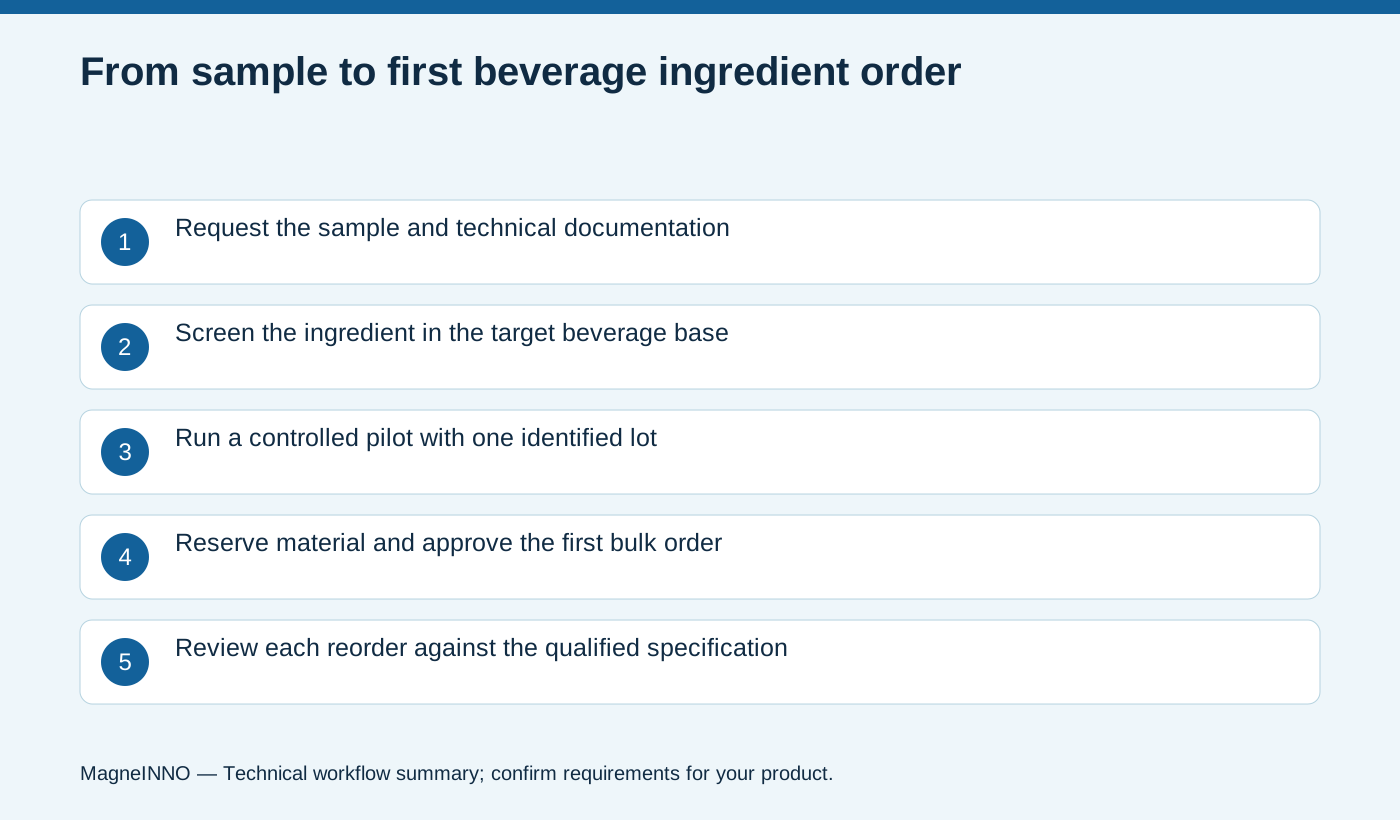
Start with a free 50 g sample, the specification sheet and a representative COA for the intended grade. Screen taste, dissolution, clarity, pH response and process compatibility in the target base, then run a pilot using one identified lot and record the formula, process and observations. Where practical, reserve material from that same lot before commercial scale-up, and approve the first order against the same specification and change-control expectations.
Supplier questions checklist
Question | Why ask | Evidence to expect |
|---|---|---|
Which elemental magnesium grade is being quoted? | Prevents ingredient mass and elemental content from being confused. | Grade name, elemental specification and assay basis. |
What identity and chelation evidence is available? | Supports raw-material qualification. | Identity results, such as FTIR, and the basis for any chelation statement. |
What is tested on each lot? | Shows whether the COA covers your release risks. | COA with limits, methods and actual results. |
Has beverage-base testing been performed? | Separates raw-material data from formula performance. | Test conditions and observations, if available. |
What particle-size, density and flow data are available? | Helps plan stick-pack filling and powder handling. | Test method, range and sampling basis. |
What microbial and elemental-contaminant limits apply? | Aligns incoming controls with market requirements. | Specification, methods and lot results. |
What regulatory documents support this use? | Confirms the food or supplement pathway. | Applicable statements and supporting files. |
What packaging and storage conditions apply? | Protects material during receiving and use. | Drum format, shelf life and storage instructions. |
How are changes communicated? | Preserves qualified formula performance. | Written change-control commitment. |
Can pilot and commercial lots be linked? | Reduces scale-up surprises. | Lot identification and reservation options. |
What are current stock and production timelines? | Aligns supply with launch and seasonal demand. | A current quote with confirmed timing. |
What quantity and commercial terms should we plan for? | Makes the first bulk purchase comparable and budgetable. | Written quote, pack size and commercial terms. |
Planning the first bulk purchase
MagneINNO holds U.S. stock in California: in-stock orders ship in about 3 days, and production orders take about 1–2 weeks. The standard bulk pack is a 25 kg fiber drum, with a stated 24-month shelf life. Keep opened drums closed and dry, and confirm the applicable storage instructions in the current documentation. Annual capacity is more than 3,000 tonnes, but buyers should still request current availability, allocation and timing for their specific project.
MagneINNO™ magnesium glycinate is supplied by NutraINNO USA Inc., the U.S. company behind the MagneINNO brand, and is built on proprietary MagniLift™ technology for supplement and beverage brands that need dependable, well-documented supply.
Beverage supplier FAQ
Is there an official beverage grade for magnesium glycinate?
There is no universal regulatory definition created by the phrase “beverage grade.” Treat it as a buyer-defined specification covering intended use, test methods, acceptance limits and supporting documents.
Is magnesium glycinate water soluble enough for clear drinks?
It depends on the grade, use level, pH, process and complete beverage matrix. Start with an initial screen of the selected material in the actual formula, then run a stability study in the intended package, at the planned storage conditions and over the target shelf life. Do not approve a clear RTD claim from raw-material documentation alone.
What documents should a beverage brand request?
At minimum, a specification sheet, a lot COA with methods and actual results, and regulatory documentation for the intended use. The documentation section above lists the full package.
Which grade fits stick packs and RTD beverages?
The 8% Ultra Taste Free grade is the recommended starting point for powders, stick packs and beverages. Confirm sensory, dissolution, clarity, filling and finished-product performance in your own process.
Does magnesium glycinate in a conventional beverage need GRAS status?
A food ingredient needs GRAS status or another lawful basis for its intended use. Ask the supplier for the applicable self-affirmed GRAS documentation and have your regulatory team assess whether it covers the proposed beverage, use level and conditions.
How much sample do I need and how fast can bulk material ship?
A free 50 g sample is available for initial screening. Confirm whether that quantity fits your bench plan, then request current timing for the specific bulk grade: typically about 3 days for in-stock orders and about 1–2 weeks for production orders.
To begin qualification, request a free 50 g sample, specification sheet, COA or quote and include your beverage base, target format, intended regulatory pathway and required documentation.
Need documentation?