Chelation Science
Chelated Magnesium for Supplement Brands: What "Bisglycinate Chelate" and "Buffered" Mean on a Supplier Spec
How to read chelated magnesium, magnesium bisglycinate chelate, fully reacted and buffered on a supplier spec, and what to verify before you buy.

For a supplement brand buying magnesium bisglycinate powder, the terms "chelated," "magnesium bisglycinate," "fully reacted" and "buffered" are not interchangeable specification limits. Some describe an intended chemical form. Others may be supplier-defined descriptions of processing or composition. None of them, on its own, confirms the lot's elemental magnesium percentage, the amount of each component in a blend, or the adequacy of the supporting evidence.
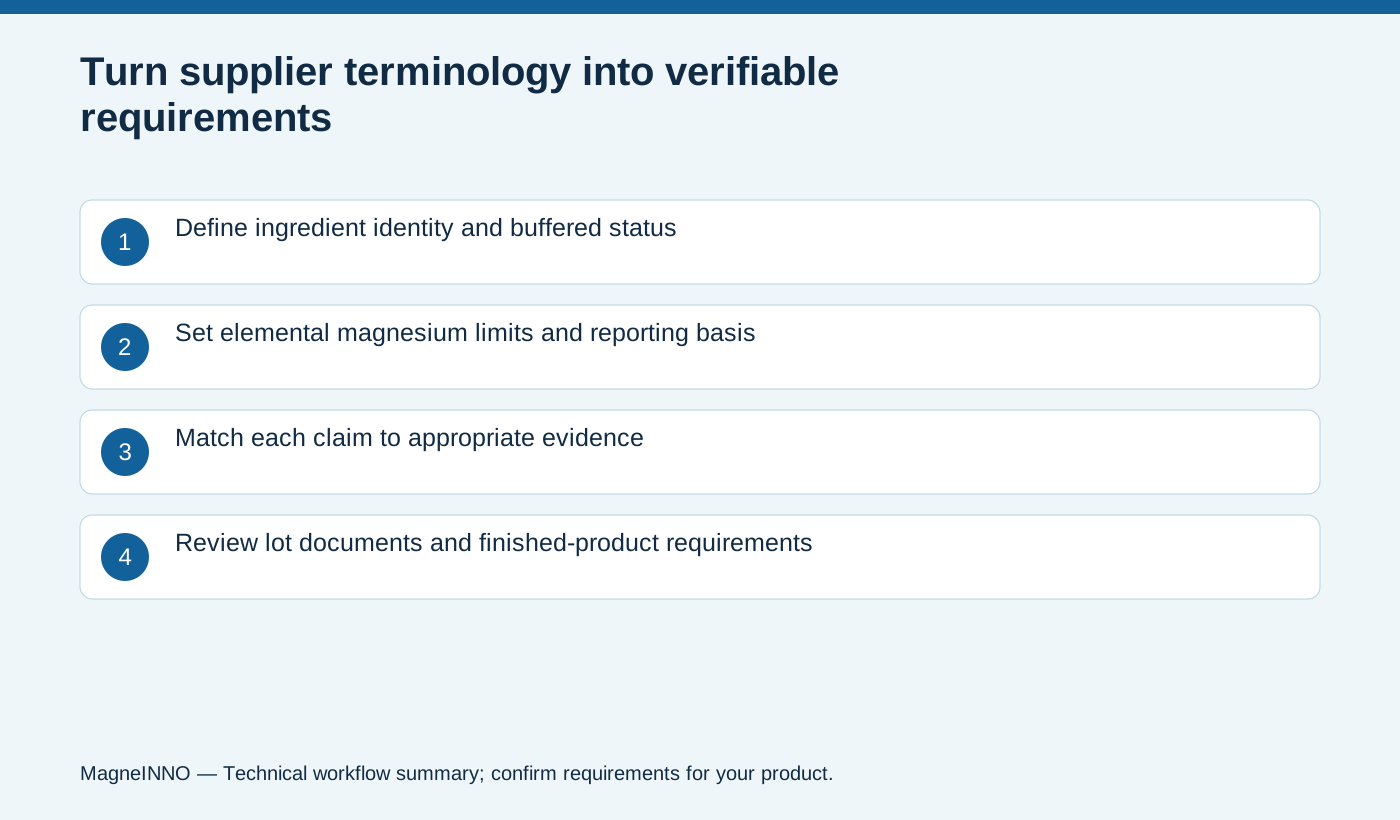
The practical approach is to translate each term into a separate, verifiable requirement: ingredient identity, composition, elemental magnesium assay and the evidence used to support the specification. That makes supplier comparisons and incoming-quality decisions more consistent, and it gives procurement and QA the same checklist when a new magnesium bisglycinate supplier is under review.
What chelated magnesium and bisglycinate chelate mean on a supplier spec
In chemistry, a chelate forms when one ligand binds the same metal ion through two or more sites. For glycine, those sites are the amino nitrogen and a carboxylate oxygen. Being bound to a ligand is not enough on its own to make a chelate. On a spec, "chelated magnesium" is still a broad description: the word does not identify the ligand, establish the ingredient's precise composition or show that a particular lot meets an analytical acceptance criterion. Ask the supplier to state the named magnesium form and the evidence used to verify it. The distinction between a chelated ingredient and a physical blend deserves its own evidence review. This guide to FTIR and chelation verification covers what that review usually looks at.
"Magnesium bisglycinate chelate" names magnesium bound to two glycinate ligands. It is more informative than "chelated magnesium," but the name alone is not a complete composition specification. It does not tell a buyer whether the material contains only that form, whether other magnesium sources are present, what assay basis applies, or whether the supplier has defined lot-level limits. Magnesium glycinate is commonly used as another name for magnesium bisglycinate, so the two names do not necessarily describe different ingredients. Whichever name a supplier uses, including "chelated magnesium glycinate," the commercial composition still has to be verified from the specification.
"Fully reacted" can sound definitive, but buyers should treat it as descriptive wording unless the supplier defines what it means and how compliance is assessed. Request the supplier's definition, acceptance criteria and supporting documentation rather than assuming the phrase is a standardized analytical result.
What buffered magnesium glycinate means for composition
"Buffered" should trigger a composition question. The term is often used for a material that combines a glycinate ingredient with another magnesium source, but the word itself does not identify the additional source or its proportion. Specify whether the ingredient must be unbuffered or may be buffered, and request a composition statement detailed enough to tell the two apart.
A buffered magnesium bisglycinate is not automatically a poor choice for every formula. It is a different material, and the specification, label review and formulation math should treat it as one. For more on what to request, see this guide to buffered and unbuffered composition.
What elemental magnesium percentage can you expect?
The wording on a spec does not establish a guaranteed elemental magnesium range. Theoretical composition gives a reference point. Anhydrous magnesium bisglycinate has the formula C4H8MgN2O4 and a molar mass of about 172.4 g/mol. Magnesium (atomic mass 24.305) therefore makes up about 14.1% of the pure anhydrous chelate by mass. That figure is a calculated benchmark for the idealized compound. It is not a specification for any commercial ingredient or lot. The explanation of theoretical magnesium content in bisglycinate sets out the assumptions behind it.
A commercial result can differ from the theoretical value. Water, free glycine or other components would lower the magnesium fraction, and an added magnesium source in a buffered material could change it in either direction depending on what was added. The reporting basis matters too. A dry-basis result excludes moisture from the denominator, so the same material reports a higher magnesium percentage on a dry basis than as-is. Ask the supplier to state the numerical specification, the reporting basis and the moisture correction used. If documents use different bases, QA and procurement should request a reconciliation before comparing results or setting an incoming limit.
Keep elemental magnesium separate from purity and chelation. Elemental magnesium percentage describes the mass fraction of magnesium in the ingredient. A purity result describes a separately defined assay or quality attribute, and its meaning depends on the method and specification. Neither a purity figure nor the word "chelate" can substitute for a stated elemental magnesium result. An ingredient COA is also not a finished-product test report. Finished-product content depends on the formula, processing and the finished-product testing that applies.
For example, if a supplier offers a 12% elemental magnesium grade, that percentage is a statement about magnesium content by ingredient mass. It is not a purity percentage, proof of a particular ligand structure, or confirmation that the product is unbuffered. Treat example percentages as examples unless they are set as acceptance limits in the supplier's current specification.
Specification checks before buying magnesium bisglycinate powder
A useful supplier review assigns each claim to the evidence that can address it. A COA reports results against defined tests and limits. The specification defines the acceptance criteria. Supporting technical documents explain identity, composition, methods and reporting conditions. Ask for all three when the terminology matters to your product.
Define identity and composition. State the requested magnesium form, whether the ingredient must be unbuffered or may be buffered, and which composition details the supplier must disclose.
Set an elemental magnesium limit. Put the required numerical range in the specification and name the analytical method, units, reporting basis and any moisture correction. A limit without a stated basis is hard to compare across suppliers or lots.
Match the evidence to each claim. Ask what identity or chelation evidence supports the description, what the elemental assay measures, and how the results relate to the stated composition. FTIR can be one part of an identity assessment, but it is not a substitute for an elemental assay or a complete composition statement. ICP-OES measures total elemental magnesium in the sample. It does not show what share of that magnesium is chelated or how magnesium is distributed among different compounds. For more on what elemental methods can and cannot show, see ICP methods and their limits.
Review the lot record. Confirm that the COA is lot-specific, that results are compared with the current specification, and that any reporting-basis discrepancy is resolved before release. This COA review workflow can help receiving teams organize that check.
Confirm change control. Ask how changes to composition, methods, limits or specification wording are notified and reviewed before the ingredient is used in an approved formula.
Regulatory and labeling questions sit with your own regulatory team. Terms on a supplier spec are commercial and technical descriptions, and how an ingredient may be named on a finished-product label depends on the rules for your product category and market.
How MagneINNO documents its grades
MagneINNO™ magnesium glycinate is supplied by NutraINNO USA Inc., the U.S. company behind the MagneINNO brand, and is built on proprietary MagniLift™ technology for supplement and beverage brands that need dependable, well-documented supply. Its grades are specified by elemental magnesium content at 12%, 10% and 8%, so buyers can match the stated figure to their formulation math and incoming limit. Stock is held in California, in-stock orders ship in about 3 days, production runs take about 1–2 weeks, and material is packed in 25 kg fiber drums with a 24-month shelf life. Free 50 g samples are available so QA can run its own identity and assay checks before approval. A specification sheet and lot COA can be requested along with the sample.
FAQs
Does "magnesium glycinate" always mean "magnesium bisglycinate"?
Commonly, yes. Magnesium glycinate is widely used as another name for magnesium bisglycinate. The name still does not settle a commercial ingredient's composition, so ask the supplier to define the ingredient and document the specification. This explanation of magnesium glycinate versus bisglycinate gives more terminology context.
Does "fully reacted" prove that the ingredient is a chelate?
Not by itself. Request the supplier's definition and the evidence that supports the defined claim. A descriptive phrase should not replace specified identity criteria or appropriate analytical documentation.
Is 14.1% elemental magnesium the figure to expect on a COA?
No. About 14.1% is the calculated magnesium fraction of pure, anhydrous magnesium bisglycinate. A commercial ingredient's result depends on its composition, moisture and reporting basis, so use the supplier's stated specification and method rather than the theoretical figure.
Can I compare two elemental magnesium percentages directly?
Only after confirming that the results use comparable units, methods and reporting bases. Ask QA to reconcile differences such as as-is versus dry-basis reporting before using the figures to rank suppliers or assess a lot.
What should a buyer request before approval?
Request the current specification, a lot-specific COA, the composition statement, method and reporting-basis details, and the technical evidence supporting identity and chelation terminology. For a B2B evaluation of a magnesium bisglycinate supplier, contact MagneINNO to request a free 50 g sample, a COA and spec sheet, or a quote.
Need documentation?